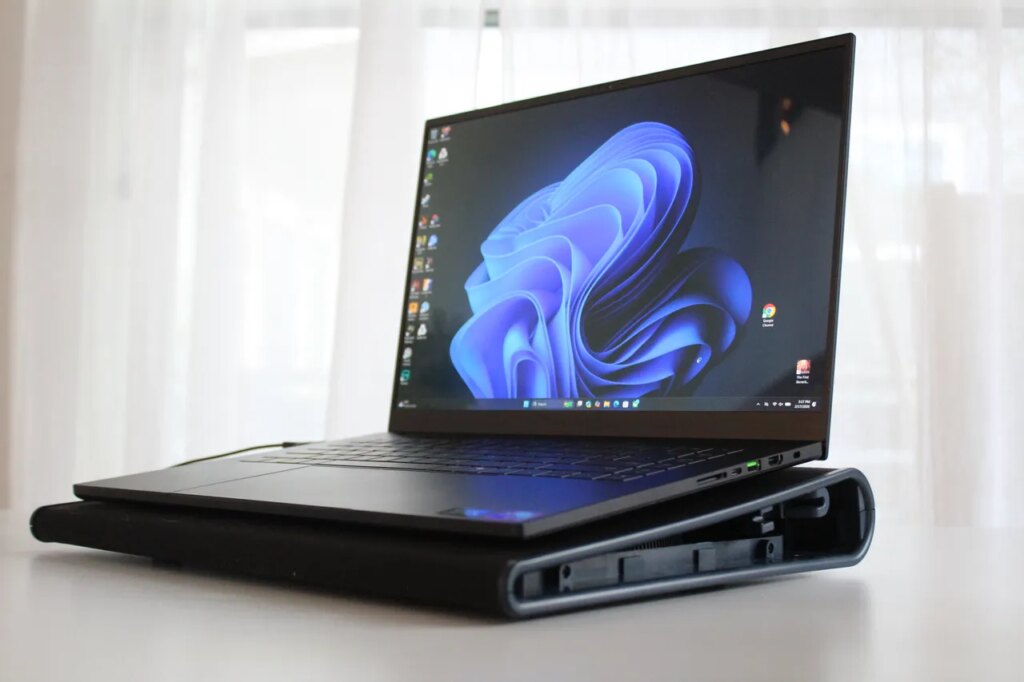
The idea of using a laptop cooling pad feels antiquated. These days, laptop chips have become extremely efficient. The fans on MacBooks (if they even have them) are barely used, and both Intel and Qualcomm are pushing efficiency on the Windows front.
But people keep buying laptop cooling pads, so surely there is a use case in 2026 that actually makes sense, right? I tried out a couple cooling pads paired with a couple of different gaming laptops, and walked away surprised at how effective they could be.
Do Cooling Pads Actually Work?
Laptop cooling pads have been around for decades, and the idea has always been simple: provide extra air to blow through a laptop that’s otherwise restricted by its own cooling system. In theory, more air means lower temperatures—and, ultimately, better performance. This is the whole idea of the power modes that exist in Windows, which ramp up the RPMs (rotations per minute) of the fans to add more air to both improve performance. More than that, less heat also means a longer-lasting laptop that doesn’t degrade as quickly over time. It’s by that same logic that laptop cooling pads offer help.
The problem, however, is that a cooling pad is a rather inefficient way of transferring air into your device. Most laptop cooling pads, including the two that I tested, use one large fan or two smaller fans to blast cold air across the bottom of the laptop. This is the first reason why the vast majority of modern laptops won’t benefit much from a cooling pad, as these laptops tend to only have vents along the hinge. Without vents or open holes, blowing air across a sheet of metal or plastic isn’t going to do anything to cool the components on the other side. It’ll only generate a bunch of fan noise.
Gaming laptops are the main exception, though, which is why they are the primary use case for such an accessory. Most gaming laptops have a few open vents, usually above the fans, like the Razer Blade 16, which is one of the laptops I used to test these cooling pads. Laptops like the Blade 16 are designed for intensive tasks like gaming, video editing, or local AI processing—and use a high-wattage GPU and CPU to get the kind of performance you need. My model has two of the most powerful laptop components on the market: the RTX 5090 and Ryzen 9 HX 370. As you might guess, they generate a lot of heat when cranked up. Modern chips tend to max out at 100 degrees Celsius, before throttling back performance to bring down temperatures.
Most laptops use fans to cool these components, but the thickness of the laptop chassis is also a determining factor in how much the system will need to throttle back performance to keep temperatures down. In the end, it’s geometry and physics, and every millimeter of space in the laptop chassis has an effect on how cool it can keep its internal components. And unlike in a large desktop PC, you have very restricted space. That’s especially true in the modern era, where even gaming laptops have become increasingly thin.
That’s why even the most powerful chips that are used in laptops today operate under much lower wattage than their desktop counterparts. You’d never know that based on the deceptive way Nvidia labels its graphics cards, of course, as an RTX 5090 on a gaming laptop is a completely different beast compared to a desktop RTX 5090. But marketing aside, it all comes down cooling capacity—and in theory, cooling pads can help with that. As I found in my testing, they can actually bring down temperatures and offer better performance. Just keep your expectations in check, as they’ll never magically transform a laptop RTX 5090 into a desktop RTX 5090.
Performance Testing
The two laptop cooling pads I tested are the newer Razer Laptop Cooling Pad and the Targus 17” Dual Fan Chill Mat. My goal here was to see if the juice is really worth the squeeze, spanning from a cheaper old model to the fanciest thing I could find. The Targus is designed primarily for the stated goal of protecting your lap or work surface from heat, while not suffocating the thermals of the device with a pillow or blanket. Meanwhile, others are built into laptop stands that are meant to be stationary on your desk. That’s the Razer option.
To see if either is worth the money, I ran the 3DMark Time Spy benchmark to monitor both performance and temperatures in four scenarios. First, I started with the Razer Blade 16 flat on the one flat surface of the desk without a cooling pad to get a baseline. This is how gaming laptops are designed to function, and the device’s rubber feet give some clearance for airflow. But in terms of improving the thermals, it can only go up from here—unless you’re trying to use your laptop on a blanket or pillow.
From there, I tried out the Targus 17″ Dual Fan Chill Mat. This is an old-school cooling pad, powered fully by a USB-A cable attached to your laptop. It’s not overly thick or loud, but it also doesn’t cool the laptop much more than just lifting up the back of the laptop with a stand. As you can see in table below, performance and internal temperature on the Targus Chill Mat was more or less the same as the Razer Cooling Pad when it was turned off, as shown in the table below.
For what it’s worth, the surface temperatures near the typical hot spots along the keyboard and hinge also didn’t feel noticeably cooler when on the Targus. The main benefit is to enable safe use of a gaming laptop on your lap. As I mentioned earlier, using a gaming laptop on your lap, pillow, or blanket can cause serious performance and cooling problems, but the Targus Chill Mat is a comfortable way of lifting the laptop off your lap and providing air so it doesn’t overheat. There are dozens and dozens of similar types of cooling pads or laptop stands with built-in fans on Amazon, and the Targus functions just about as well. But please don’t make the mistake of buying something like this believeing that they actually reduce temperatures or increase performance.
Next, I tried out the Razer Cooling Pad, which might be the most premium laptop cooling pad ever made. True to the Razer brand, it’s sturdy and well-built, coming in all-black with a splash of RGB lighting across the front. Unlike the Targus, this is part cooling pad and part laptop stand, propping your laptop up off the table. But the key to it being actually quite good at cooling the laptop is the design. It uses a single, 140mm fan that can spin up to 3,000 RPM (rotations per minute). But the key to it actually directing air in through the vents is the combination of a chamber and foam seal. The laptop rests right on the foam, which both directs the air created by the fan into the laptop and dramatically reduces the fan noise. I was surprised by how much noise is dampened by the thick layer of foam. Don’t get me wrong—this thing is still loud, but there’s a dramatic difference when the laptop is on the foam.
As you can see in the table above, the best case scenario in both performance and temperatures is using the Razer Blade 16 with an exclusive feature called Hyperboost turned on with the Razer Cooling Pad. It’s only compatible with the last three generations of Razer Blade 16 laptops, but if you do happen to have a Razer Blade 16 from 2025, 2024, or 2023, the Hyperboost mode will dynamically ramp up the fans on the cooling pad as the system itself heats up. It can “unlock” the device’s thermal restrictions and add an extra 20 watts of power to the CPU and GPU. Without Hyperboost, you’re getting a very loud blast of air, even if the laptop is at idle. With Hyperboost, you’re getting a 10 percent improvement in performance and a drop of 10 degrees Celsius on the CPU. It’s about half that without Hyperboost turned on.
I was even more impressed when I tried a budget-level gaming laptop with the Razer Cooling Pad. I ran the same benchmark in all the scenarios on the MSI Cyborg 15—the exact opposite of the Blade 16 I was testing. While the cooling pad only boosted the performance by 3 percent, the change in temperatures was massive, dropping the max CPU temperatures by 20 degrees Celsius. That really convinced me about the long-term use case for a proper cooling pad for someone trying to make their tech last as long as possible.
Who Really Needs a Cooling Pad?
The increases in performance and drops in temperature are impressive, but you really only need a cooling pad under specific circumstances. If you’re someone who likes the idea of playing games on a couch (which is admittedly uncommon), something like the Targus Chill Mat might be worthwhile.
But if you really want to prolong the life of your gaming laptop and even get the most performance out of it as possible, don’t just buy a random cooling pad off Amazon. You need something more like Razer Lapop Cooling Pad—or at least, something that uses this type of sealed chamber design. When it came out, the Razer option was overpriced at $170, but it’s often selling for a more competitive $130. The Llano cooling pads are some of the most popular cooling pads out there, which pioneered and popularized this design of cooling pad. If you want to save some money, you’ll find Llano some of the older models selling for under $100 that I’ll be trying out next.
The fan noise really is important to consider, though. I know a lot of people game with a headset on, but the perceived advantage of using a laptop cooler isn’t always equivalent to the amount of noise you’re having to deal with. Again, I was impressed by how much the Razer Cooling Pad dampened the sound, but it’s still significantly louder than anything else you’d have in an office, including a gaming tower or space heater.
Secondly, I would argue that one of these cooling pads really is only useful for people who use their laptop consistently at peak power, whether that’s for gaming or for content creation. If you’re more of a casual gamer or video editor, I really don’t think you’re going to push your laptop enough to benefit from a cooling pad, especially since the good ones are expensive.
That said, I was pleasantly surprised by the testing I did on the Razer Cooling Pad in particular. Whether it’s the extra performance you get by pairing it with a Razer Blade 16 or the massive reduction in temperature on a budget gaming laptop, there’s a clear use case for something like this. Much longer-term testing would be required to actually see if the wear-and-tear of keeping the components cooler over many, many long gaming sessions leads to overall better longevity. But we do know that prolonged internal temperatures lead to degradation not only in the chips themselves, but also to the surrounding components, including the fans and battery. In other words, the lower the temperatures, the longer your laptop can last.
The post The Best Laptop Cooling Pad and Why You Should Buy One appeared first on Wired.