Lonnie Monroe-Evans didn’t know her worsening headaches were about to jeopardize her children’s chance at college.
Doctors diagnosed her with benign brain tumors in 2013. Unable to keep working, she quit her job, cutting her family’s income by about half — just as her oldest child was preparing to graduate high school and needed money for tuition.
Monroe-Evans and her husband, Arturo Evans Sr., didn’t have it.
Searching for options, Monroe-Evans found a program that helps thousands of D.C. residents each year pay to attend public colleges across the country.
Since then, their three children have received $100,000 through the program. The two oldest have graduated, and the youngest is now a freshman at Norfolk State University.
“There’s no way we could have done it” without the support, Monroe-Evans said.
D.C. officials recently announced they are expanding the D.C. Tuition Assistance Grant, known as DCTAG, raising the maximum annual award from $10,000 to $15,000 and the lifetime cap from $50,000 to $75,000 — a 50 percent increase aimed at helping families keep pace with rising tuition and inflation.
It’s the first increase since the program started 25 years ago — when $10,000 had nearly twice the buying power it does today.
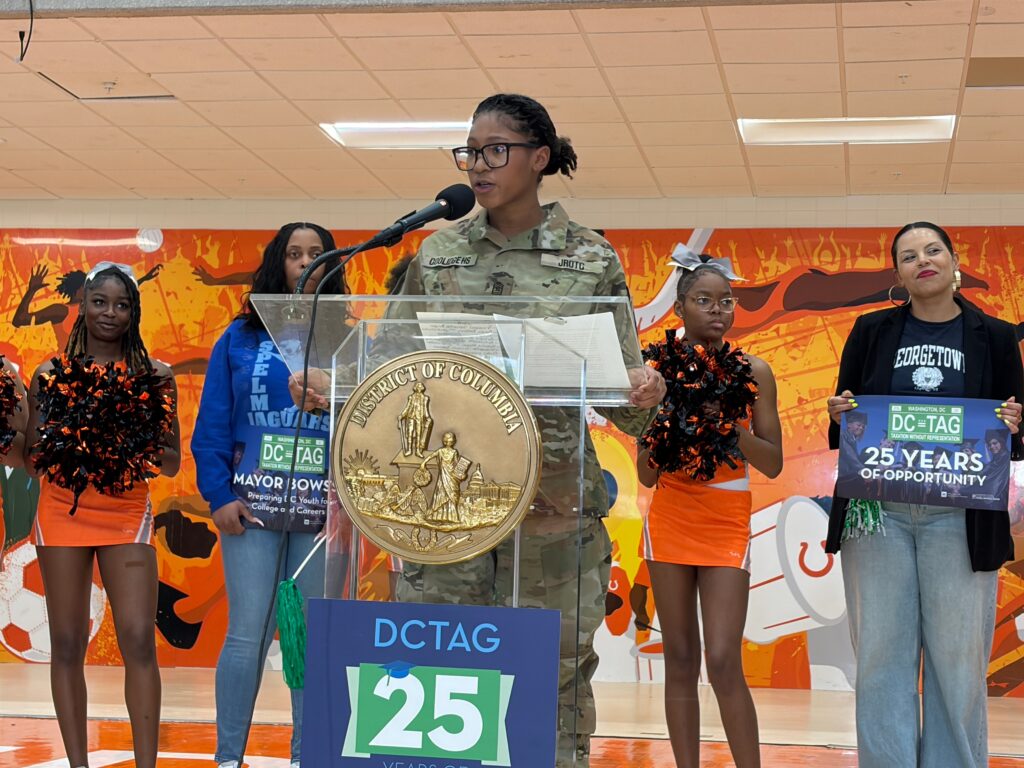
“Prices on everything have gone up over the last 10 years, but DCTAG stayed the same,” D.C. Mayor Muriel E. Bowser (D) said at an event Thursday at Calvin Coolidge Senior High School.
With only one public university in the city, D.C. officials created the tuition assistance program more than two decades ago to help students offset the cost of paying out-of-state tuition outside the city. Since 2000, about 37,000 students have received more than $715 million in DCTAG funding — money Congress allocates annually — to attend schools across the country, according to the Office of the State Superintendent of Education, which administers the program.
The agency plans to finance the bigger grants using reserves it has built over the past decade. Although the program’s congressional allocation has remained at $40 million a year, the agency has typically spent about 75 percent of that amount, allowing it to accumulate some $71 million in unspent funds.
State Superintendent Antoinette Mitchell said the agency now feels comfortable using that cushion to increase awards.
“This is a game changer,” Mitchell said in an interview.
For Monroe-Evans, the grant covered much of the tuition gap. The $40,000 her son Arturo Evans Jr. received over 4½ years allowed him to study at the University of Nevada at Las Vegas’s hospitality program; he hopes to one day own a hotel. But the Evanses still had to pay $3,000 per semester, forcing the family to seek help from relatives and hold fundraisers. A higher ceiling, she said, would have eased that strain.
Monroe-Evans attended Thursday’s event with her husband and three children.
Arturo Evans Jr. spoke to the hundreds of high school students who had packed into the gym. He told them that, given his family’s financial woes as he graduated from Cesar Chavez Public Charter Schools for Public Policy, he considered giving up on college.
But the D.C. tuition grant kept his plan alive. Now 30, Evans has returned to D.C., where he runs his own housing inspection business.
His baby sister, 18-year-old Armoni Lynn Evans, is in the middle of her second semester at Norfolk State with the help of $10,000 in grant money. She has already applied for a grant for her sophomore year — this time, for $15,000.
“Remember, DCTAG is here just for us in D.C.,” Evans Jr. told the high school students, adding: “The resources are there. Just ask.”
Victorya Evans, a 17-year-old senior at Calvin Coolidge, said she applied for a tuition grant about a month ago.
Evans, who is not related to Monroe-Evans, has been accepted at Virginia Tech, where she plans to enroll in the fall, the next step toward medical school and a career as a family doctor. Raised by a single mother, Victorya said choosing a college means balancing what’s best for her academically with what her mother can afford.
The grant money would make that decision easier. Without it, Evans said, she would have to scramble for scholarships and grants — or go to a less expensive school.
“It would not be within reach without DCTAG,” she said.
The post D.C. families can now get thousands of dollars more for college through this program appeared first on Washington Post.