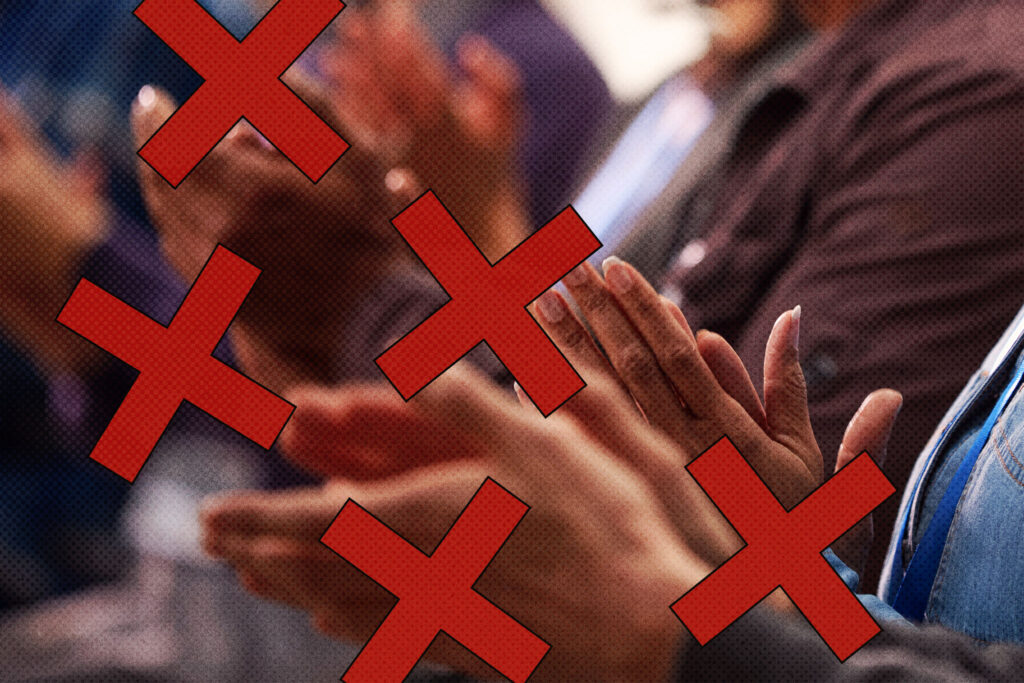
The crowd at the city council meeting did not protest when the mayor asked that they refrain from booing or cheering as she invited the public to speak on any topic.
But no clapping?
“A violation of free speech!” someone called out.
“You’re not the dictator!” someone else shouted.
This was in Takoma Park, Maryland, a deep-blue suburb on the border of Washington where local leaders achieved a level of fame decades ago by branding their town a nuclear-free zone. Residents like to express themselves in myriad ways, whether dressing up as Uncle Sam for the city’s July Fourth parade or banging pots to protest President Donald Trump or, as it happens, applauding a speaker at a council meeting whose views they support.
Mayor Talisha Searcy’s recent no-clapping order caused the kind of tempest that other places around the country have experienced after local officials sought to impose controls on public discourse that in recent years has grown more contentious.
Applauding someone’s remarks may seem like the most routine of gestures. But in a polarized America, where political leaders are caught in a seemingly unending rhetorical war, even the most mundane expression — holding up a sign, for example, or cheering, or clapping — can take on freighted meaning.
Searcy’s call for no clapping — her first in more than three years as mayor — occurred at a Feb. 11 council meeting, as lawmakers prepared to discuss a study about the city’s rent stabilization laws.
“I just want to make sure I’m learning about how to facilitate civility within a community,” the mayor said after instructing the audience to “refrain from cheering, booing, signs, all that good stuff.”
She did not mention applause until after a smattering of people clapped for the first speaker.
“Again, respectfully, I’ve asked for people to not clap, not boo, not make gestures or signs,” she said.
There was more applause for the second speaker, after which Searcy again admonished the crowd. When a spectator shouted that banning clapping was “undemocratic,” the mayor countered that “clapping for some and not all is not democratic” and that “we have to allow for people to feel safe to say what they feel.”
The mayor’s attempt at enforcing her idea of civility only prompted more shouting, after which she said: “I’m not going to argue. If I hear any more clapping or disruption from the crowd, I will have to unfortunately have you all removed.”
“Do it now! Do it to me!” David Reed, 77, a Takoma Park resident, yelled, according to the city’s video recording of the meeting.
More applause followed.
“You’re not the dictator of the council!” Paul Huebner, 75, a retired project manager, shouted. “This is outrageous!”
The mayor, seated at the center of the dais beneath the city’s seal, bowed her head, seemingly exasperated.
The kerfuffle prompted a robust discussion among the lawmakers about civility and First Amendment rights that spilled into subsequent meetings and online discussions over the next two weeks.
It also provoked mockery.
On Fox 5’s “The Take,” the host introduced a segment about the incident, saying: “Clapping! Also apparently divisive these days! You can’t clap anymore!”
“This is freedom of speech!” another host said. “This is America! This is where we clap and yell!”
The fracas inspired the Takoma Torch, a local humor website, to publish the headline: “Takoma Park Residents Trapped in Extended Council Meeting After Outbreak of ‘The Clap.’”
Eric Saul, the Torch’s publisher, said the outrage spurred by the mayor’s no-clapping directive is consistent with Takoma Park’s history as a hotbed for activism, which “is woven into the DNA of everyone in town. You protest and debate.”
But a storm over the right to clap?
“Trivial nonsense,” said Saul, 46, an architect. “There’s a vocal minority in Takoma Park who have gotten their way, and now they don’t feel they’re getting their way, and they pretend to feel oppressed. There’s order in government meetings. To act like it’s oppressive is nonsense.”
Searcy did not eject anyone from the meeting for clapping. She said she had intended her no-clapping order not as a standing policy but just for the meeting that night, which she expected to draw a long line of speakers talking about rent stabilization.
“I was more or less worried about time,” she said in an interview with The Washington Post. “The goal was to say: ‘Hey, I don’t know how many people are coming in, there’s a possibility of a lot of new people. Everyone be nice. No booing, no cheering, no clapping. Let’s get through this.’ And it was, ‘You’re a dictator.’”
The meeting’s tone became uglier when a man identifying himself only as “Good Citizen” — unaffiliated with those who had been clapping — stepped up to the mic and shouted profanities at the mayor and council members as he spoke of a sexual harassment case involving the police department. As he departed, the man raised his middle finger in the direction of the lawmakers.
“And you wonder why I said no clapping,” the mayor said. Addressing the audience later that night, she said, “What I witnessed tonight was blatant disrespect of me and my role as the presiding officer.”
“Disrespect breeds additional disrespect,” she said.
Opponents of Searcy’s no-clapping order, a group that included people who identified themselves as members of the Democratic Socialists of America, said their applause was not intended to disrupt the meeting. They suspected that the mayor was trying to stifle their expression of support for those speaking in favor of maintaining the city’s rent regulations.
“We can’t clap? I can’t believe I’m hearing that from our mayor,” Karen Elrich, a Takoma Park resident for 45 years, told the lawmakers. “I understand where you’re coming from, but it’s not — I don’t think — legal. I would like to have proof that it is. And if it is, I will be fighting to make sure we overthrow that.”
Kevin Goldberg, a First Amendment expert at the Freedom Forum, a nonprofit that educates the public about issues relating to free speech, said government bodies can have “neutrally applicable rules to ensure that meetings continue smoothly.”
At the same time, Goldberg said that banning polite applause could encroach on First Amendment rights. “Really, is clapping all that disruptive?” he asked. “Is it reasonable to say they can’t even clap for their neighbors?”
Clapping bans exist in various locales around the country, including at D.C. and Boston council sessions, as well as legislative meetings in towns such as Amarillo, Texas, and San Jose. The village of Yellow Springs in Ohio has barred applause, as well as the displaying of signs.
An organization known as UNITE, a nonprofit dedicated to reducing political rancor, has gone so far as to suggest that local governments adopt what it calls the Dignity Index to help guide public discourse (the lowest scores, 1 to 4, are reserved for divisive language and the highest, 5 to 8, for “language grounded in dignity”).
Heckling and booing are obviously divisive, said Tami Pyfer, the index’s creator. But she said applause for a particular viewpoint is also problematic because it may make people with less-than-popular opinions shy away from expressing them in public.
“It can be intimidating when you have created, unintentionally, an us-versus-them culture,” said Pyfer, who has been invited to speak about the Dignity Index to lawmakers in more than a half-dozen states, including Maryland. “Democracy thrives on debate. We’re asking that in those debates, when we have the disagreements, that we make space for people to express themselves.”
In Takoma Park, there was no shortage of expression about the pros and cons of clapping in the weeks after the issue arose.
Council member Roger Schlegel put the question to his constituents in an online survey — to clap or not to clap — and said he received 75 responses, a majority of them in support of applause.
And what is his position?
“I don’t have any problem with the mayor trying to maintain decorum,” he said. At the same time, he’s concerned that “civility can be invoked to shut down the exchange of ideas.”
Another council member, Amy Wesolek, addressing the audience at a council meeting a week after the incident, said that the important question is not whether clapping should be allowed but whether the audience is obligated to follow the mayor’s direction. “The question is, should we actually listen and follow the rules?” she said.
At another point, council member Cara Honzak bemoaned that Searcy had been the target of name-calling and said, “I’m tired of seeing my mayor get bullied.”
“Are we really the progressive community that we think we are?” she asked the audience. “Because I don’t see it.”
The mayor, for her part, said in the interview that she had no regrets about her handling of the clapping issue and that she can withstand the barbs.
“I don’t know which is worse, having people scream at me or having people pity me,” she said. “I can handle it. It’s par for the course. It’s what we do.”
The post A mayor ordered no clapping at a city meeting. Applause did not follow. appeared first on Washington Post.