There’s an expression that fraud experts use all the time to warn people about a suspected scam: If it sounds too good to be true, it probably is.
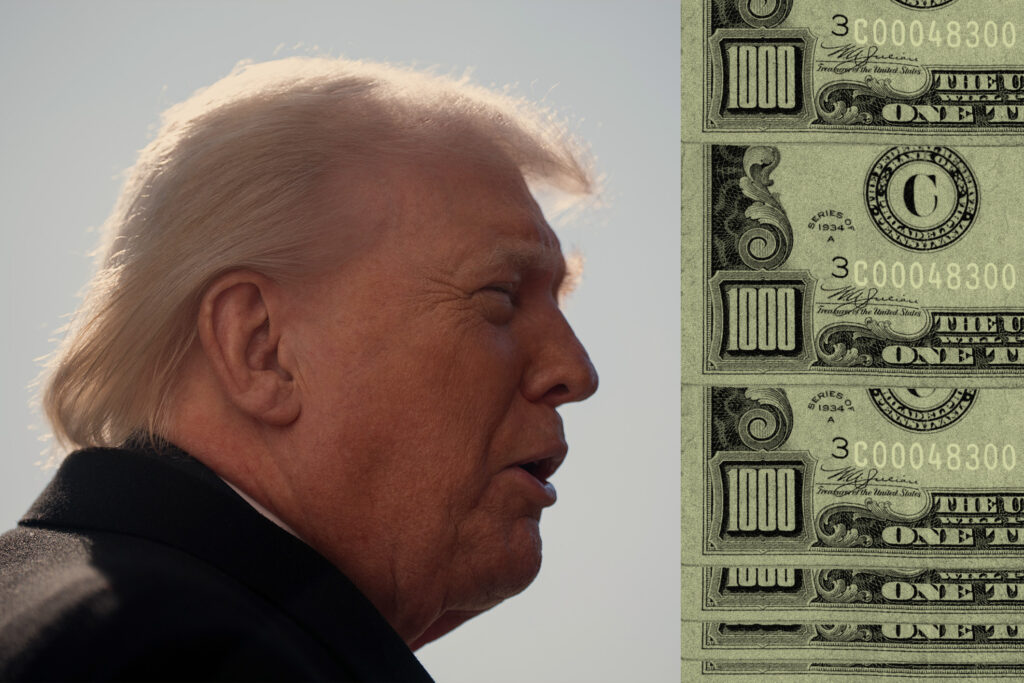
That’s how I feel about President Donald Trump’s proposal to give millions of workers $1,000 a year to boost their retirement savings.
In his State of the Union address this week, Trump trumpeted the creation of retirement accountssimilar to the Thrift Savings Plan (TSP) offered to federal workers. Addressing the millions of Americans currently shut out of workplace savings, the president said he wanted to “remedy this gross disparity.”
He said he was going to “ensure that all Americans can profit from a rising stock market.”
On paper — or his teleprompter, in this case — expanding the TSP, the federal government’s low-fee workplace investment program, sounds like a savvy policy move. While individuals can always build a nest egg on their own, we know that automatic payroll deductions through an employer-sponsored plan significantly boost participation rates.
However, given Trump’s poor track record for helping low-wage workers, I’m highly skeptical this promise will ever materialize. Or, if the program is implemented, that it would make a long-term difference.
Recent policy shifts under the current administration have further frayed the social safety net for working-class families. Many of these changes were imposed in the One Big Beautiful Bill Act.
The Supplemental Nutrition Assistance Program (SNAP) will reduce both the number of eligible people and the level of funding, according to an analysis by the Urban Institute.
Trump’s tariffs have raised prices on many consumer goods.
Over a million people have abandoned Obamacare this year following the Republican-led expiration of premium subsidies, which is estimated to increase payments by an average of 114 percent, according to a January report from KFF, a nonpartisan health policy organization.
While the administration’s policies squeeze the monthly budgets of working-class families, the proposal for a new retirement plan asks those same struggling households to focus on their financial needs decades from now.
A “Trump TSP,” because we know the president likes to name things after himself, would require funding for the $1,000 match. But there’s a bigger issue. Would workers struggling to pay for housing and health care have the extra money to get the match?
To qualify for the full match, they have to save $2,000 a year. However, if low-income families are having affordability problems with their grocery bill, rent and health insurance, they certainly won’t have the funds to stash in a retirement plan.
There is someone I respect who is hopeful this new plan might work, especially if there is an auto-enrollment feature.
Trump’s proposal mirrors a long-standing framework championed by Teresa Ghilarducci, who has spent years advocating for a government-backed universal retirement account for workers without employer-sponsored plans. She calls her proposal the Guaranteed Retirement Account.
Ghilarducci, a professor at the New School for Social Research, points to what she calls a “fatal flaw” in our current defined-contribution system. In this model, retirement security depends entirely on a worker’s ability to set aside and invest their wages. The problem, she argues, is that millions of people lack access to an employer-managed savings vehicle at their jobs to help make that happen.
According to the Pew Charitable Trusts, nearly half of all private-sector employees — about 57 million people — work for companies that don’t provide a workplace retirement account.
Ghilarducci is hopeful because Trump’s plan piggybacks on a new retirement savings program established by the bipartisan Secure 2.0 Act of 2022.
Starting in 2027, the federal government is set to provide a 50 percent match for up to $2,000 in employee cash contributions, meaning the government would provide a maximum of $1,000. That money would be deposited directly into the retirement accounts.
The match was created to help low-to-moderate income earners. Single filers would get the match if they make less than $20,500. It phases out completely by $35,500. For married filers, the phaseout begins at $41,000 and ends at $71,000.
Ghilarducci said using the TSP model is a smart way to maximize retirement returns for low-income workers.
“I’m optimistic,” she said.
I’d like to have as much hope as she has. But it’s unclear where the money for the match would come from or whether Congress would support the funding long term. A similar effort to boost retirement savings for lower-age workers was scuttled during Trump’s first term as president.
President Barack Obama had authorized the Treasury Department to create the MyRA (as in “my retirement account”) program for workers without access to an employer-sponsored plan. After a trial run, it was rolled out nationwide in 2015. The account was similar to a Roth IRA. People could contribute earned income after taxes, and their earnings wouldn’t be taxed. It also wasn’t linked to any employer.
Under Trump, the Treasury claimed the program was too costly and unpopular.
Could the same happen to Trump’s initiative in a future administration?
We need to figure out how to help lower-wage workers save for retirement. But Trump should be just as fixated on fixing the Social Security safety net.
As of last year, 62 percentof U.S. retirees reported relying on Social Security as a major source of income, according to Gallup’s most recent poll.
The Old-Age and Survivors Insurance Trust Fund, which pays retirement and survivor benefits, will be able to pay 100 percent of benefits until 2032, the Congressional Budget Office said in a report released this month. That’s a year earlier than the trustees of the Social Security and Medicare trust funds said in their annual reportlast year.
Money will still be coming in, but a shortfallthat isn’t closed will require a cut to scheduled benefits.
If Trump were really committed to helping workers, he would be working with Congress to make fixing Social Security a priority.
A $1,000 bonus to millions of workers sounds like it can make a difference, but it’s a hollow promise if the government lets a tried-and-true safety net falter. Closing the retirement wealth gap should start with protecting the Social Security system, a program people actually count on to survive.
The post Trump wants to give workers $1,000 for retirement. Can it work? appeared first on Washington Post.