El Mencho, arguably the world’s most powerful criminal, did not have a cellphone.
Worried the devices would expose his location, he relied on human messengers to manage a sprawling criminal organization that stretched across Mexico and into 40 countries, senior Mexican officials said. He issued his orders from shifting encampments in the wooded hills of western Mexico, surrounded by what the authorities say were at least 60 men and an arsenal of military-grade weapons.
His life hiding in the forest belied the fact that he was one of Mexico’s richest men. Such discipline kept El Mencho — a former police officer turned hit man whose legal name was Rubén Oseguera Cervantes — at large for two decades.
That was until last weekend, officials said, when the Mexican authorities took advantage of a weakness: the women in his life.
Mr. Oseguera, 59, wanted to see his adult daughters, they said. So he recently moved into a home in a gated community outside Tapalpa, a touristy Mexican ranch town, bringing a much smaller set of bodyguards.
Then he invited over one of his lovers, officials said — unaware that Mexican intelligence had been tracking her.
On Thursday, Feb. 20, Mexican and U.S. intelligence agents watched the woman and two young children travel to a house in that community.
The next day, a U.S. surveillance drone hovering overhead recorded the woman and children leaving the house, according to two senior Mexican officials and another person briefed on the operation, some details of which are reported here for the first time.
It remained unclear who was inside, until the drone’s infrared camera detected another figure emerging. The person hugged the woman and two children goodbye.
The authorities made a calculation: The only person who would dare to hug the cartel boss’s lover was the cartel boss himself.
El Mencho was home. Mexican authorities immediately began planning an operation.
Less than 48 hours later, Mexico’s most wanted man was dead.
In a fierce firefight on Sunday, Mexican forces ended one of the most consequential criminal careers in Mexico’s modern history. His journey from farm boy to cartel boss left a trail of thousands of corpses, billions of dollars in illicit profits and a criminal enterprise that reaches from Mexico to Asia.
It also opened a new chapter for the country. The Jalisco New Generation Cartel that he led, widely considered Mexico’s most powerful criminal group, is now headless. Such power vacuums have often led to turbulent stretches of violence as deputies and rival cartels battle for control.
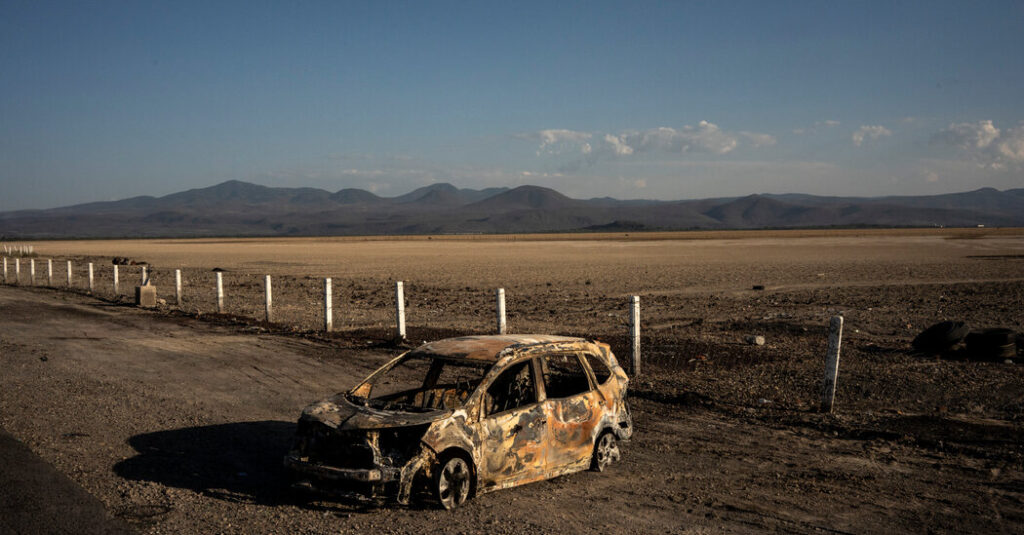
Mexicans quickly got their first taste of the fallout from Mr. Oseguera’s death. Jalisco cartel operatives rampaged across 20 states, setting cars and buildings ablaze, blocking roads and gunning down 25 Mexican soldiers. The show of force rattled the nation, shut down businesses, disrupted travel and trapped tourists.
President Claudia Sheinbaum of Mexico has been facing intense pressure from President Trump to defeat the cartels or face unilateral U.S. military strikes on the criminal groups. Some Mexican officials hoped that killing Mr. Oseguera would have bought her some good will.
But Mr. Trump called her the next day, worried and irritated by the scenes of mayhem, according to four people with knowledge of the call who were not authorized to speak publicly.
Mr. Trump called “to ask me what was happening in Mexico, how things were going, are you OK?” Ms. Sheinbaum told reporters this week. “I told him how the operation had gone, that we had received intelligence support from the U.S. government, that the coordination was going very well.”
The same day, Mr. Trump posted that “Mexico must step up their effort on Cartels and Drugs!”
In his State of the Union address on Tuesday, Mr. Trump took credit, without mentioning the Mexican government: “We’ve also taken down one of the most sinister cartel kingpins of all.”
‘Just a thug’
The son of avocado farmers, Mr. Oseguera grew up poor in a scorching region of western Mexico. He dropped out of primary school to take his first job: guarding fields of marijuana, then the primary business for Mexico’s emerging cartels.
Like many men in his town, as he approached his 20s, Mr. Oseguera headed north. He illegally crossed the border into California in 1980s, arriving just as synthetic drugs were gaining a foothold there, particularly methamphetamine.
Mr. Oseguera spotted opportunity, according to court records, officials and analysts who have studied his life. Cocaine and marijuana required vast tracts of land, time and an army of crop pickers. Meth could be cooked up quickly in a kitchen with cheap chemicals.
Mr. Oseguera began selling meth and other drugs across California, until he was caught by an undercover police officer in a Sacramento bar in 1992. He spent three years in prison and was deported.
Back in Mexico, though fresh off a drug conviction, he joined the police force in Jalisco state, according to Ralph Villarruel, a former Drug Enforcement Administration agent who tracked Mr. Oseguera. At the time, parts of Jalisco were controlled by a criminal group called the Milenio Cartel. Mr. Oseguera briefly colluded with the cartel before deciding to quit the police and join them.
He soon made a name for himself as a ruthless hit man. But it was romance that shot him up the ranks: He married one of the commander’s sisters, Rosalinda González Valencia.
“Until he married Rosalinda, he was just a thug,” Mr. Villarruel said. “By marrying into the family, it gave him access to a sophisticated money laundering operation.”
The cartel liked his knowledge of both sides of the border and his experience with meth, just as traffickers were trying to push the drug on the East Coast. To hook new clients, Mexican cartels sent meth to cities like New York for free.
“El Mencho became this valuable person within the cartel because of his experience in the United States,” said Carlos Pérez Ricart, a Mexican security analyst. “Meth is having a huge boom in the United States, and he understands it.”
At some point, like many cartel operatives, he began going by a nickname. El Mencho is believed to be a derivative of another adopted name he used, Nemesio.
By 2009, the Milenio Cartel fractured. Mexican forces arrested and killed two top leaders, setting off a war for power.
‘They were like ISIS’
During a Tuesday rush hour in 2011, two trucks were abandoned on a highway in the Mexican state of Veracruz. Inside were 35 corpses, many of them bound and tortured.
It was Mr. Oseguera’s first big, bloody performance, analysts said, and the effective arrival of what would become the Jalisco New Generation Cartel.
With sheer brutality, Mr. Oseguera defeated his former allies in the Milenio Cartel. That gave his new cartel a notorious reputation, which it began to exploit.
Mr. Oseguera’s forces began invading territory and telling local gangs — and politicians — that they could either join forces or be killed.
“They were like ISIS,” said Eduardo Zerón, a former Mexican security official. “They would arrive at a municipality and say, ‘The Jalisco cartel is here, and whoever isn’t with us, we’ll destroy them.’”
From 2013 to 2017, the Jalisco cartel expanded its presence in Mexico to 20 states from four, Mr. Zerón said.
Unlike some rivals, who focused on trafficking drugs, Mr. Oseguera built the Jalisco cartel into a sprawling, diversified empire.
It has sold enormous amounts of fentanyl and meth, particularly in the United States. But it also has smuggled migrants, extorted businesses and invested in a vast portfolio, including hotels, casinos and racetracks.
The cartel has also built an arsenal that resembles a small army’s. It has land mines, rocket-propelled grenades and armored trucks mounted with heavy machine guns, officials say. In recent years, the group has expanded into improvised explosive devices and drones that carry toxic chemicals or makeshift bombs.
The Jalisco cartel’s heavy weaponry has become the stuff of legend. In one narcocorrido — a type of Mexican ballad that celebrates drug cartels — about the group, the singers belt out over an accordion: “We’ve swapped pocketknives for AR-15s and AK-47s, for .50 calibers and antiaircraft guns.”
When the Mexican Army moved to capture Mr. Oseguera in 2015, his henchmen shot down an Army helicopter with a rocket-propelled grenade, killing three soldiers. He got away.
Over the next decade, at least 400,000 people were killed or disappeared in Mexico, according to conservative estimates. Analysts say Mr. Oseguera’s cartel may have killed more of those people than any other group.
‘Hiding in the brush’
Since his escape in 2015, Mr. Oseguera remained mostly a ghost to the Mexican authorities. Only a few public images of him exist.
Yet in the rural hills of Jalisco, local residents said he was sometimes spotted among the blaring music and flowing beer of cockfights, a sport he loved so much that he was nicknamed “lord of the roosters.”
Mexican officials believe he was largely estranged from his wife and had several lovers, including the woman who unwittingly led the authorities to him, whom officials did not identify.
Early Sunday morning, Mexican Special Forces — who had been trained by their U.S. counterparts — stormed Mr. Oseguera’s hide-out. They were backed by six helicopters.
As Mr. Oseguera’s men fired on the soldiers, he and his inner circle slipped out the back, officials said. “Special Forces personnel pursued them,” Gen. Ricardo Trevilla Trejo, Mexico’s defense secretary, told reporters. “They located them hiding in the brush.”
Mr. Oseguera was shot. Officials said that he and two body guards died during a helicopter ride to a hospital.
The authorities had not seen Mr. Oseguera for years. His corpse revealed an aging man who had taken steps to look younger. His hair and mustache were dyed, an official said, and his teeth were capped with veneers.
The operation was violent, with 13 people killed, but better than officials had expected. Because of the setup of his encampments, Mexican authorities had long worried that killing Mr. Oseguera could leave maybe 80 dead.
But the backlash by his cartel after his death was worse than officials had feared. Across Mexico, Jalisco cartel members created more than 250 roadblocks and burned more than 500 cars, targeting supermarkets and state-owned banks. More than 70 people died in the operation and its aftermath, including 47 cartel members, 25 Mexican soldiers and one pregnant civilian caught in a shootout.
Now, Mexico is bracing for what may come next.
According to an internal Mexican government document viewed by The Times, at least seven men currently sit atop the Jalisco cartel, many of them hardened hit men with nicknames like The Gardener and The Toad.
Perhaps the most likely successor is Juan Carlos González, known as El 03. His mug shot shows a young man with a buzz cut and a smirk.
He has at least one advantage over the others: El Mencho was his stepfather.
Julian E. Barnes and Zolan Kanno-Youngs contributed reporting from Washington. Miriam Castillo contributed research from Mexico City.
Jack Nicas is The Times’s Mexico City bureau chief, leading coverage of Mexico, Central America and the Caribbean.
The post The Bloody Rise and Fall of Mexico’s Top Crime Boss appeared first on New York Times.