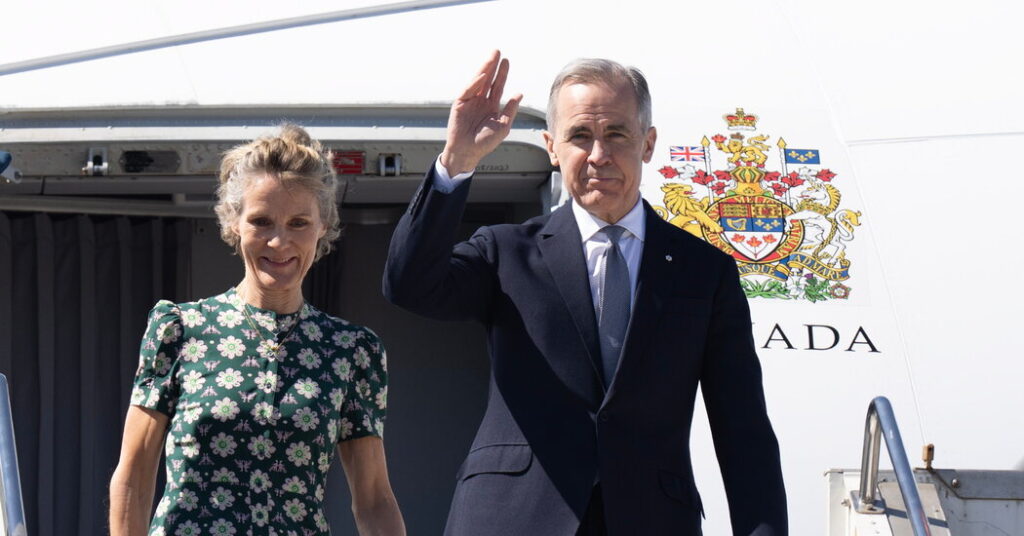
Prime Minister Mark Carney of Canada, in a high-profile speech last month, described the Trump era as a rupture for countries like his, and called on global “middle powers” to band together to survive in the tumult of a changing United States.
This week, he is building on his plan to construct a middle-power sphere of trade and deep bonds by visiting India, Australia and Japan.
Accompanied by several ministers and provincial leaders, Mr. Carney wants to seal agreements to sell more oil, gas, and other natural resources abundant in Canada, secure investments and finalize defense deals with key Indo-Pacific countries.
The nine-day trip comes after Mr. Carney’s January visit to China, where he struck a limited but important agreement on tariffs, and his middle powers speech in Davos, Switzerland, which was widely praised as a landmark moment in recognizing the impact Mr. Trump’s second term is having on the global order.
Mr. Trump’s erratic tariff policies, as well as his reconsideration of who the United States’ allies are, have thrown Canada and other nations into a costly and confusing limbo. Canada currently enjoys the lowest effective tariff rate with the United States globally, while still seeing some key industries suffer from Mr. Trump’s levies on autos, steel, aluminum and lumber.
But Canada also faces a review by this summer of its free-trade agreement with the United States and Mexico, which Mr. Trump is considering abandoning, at least in part.
In response to this volatility and Mr. Trump’s suggestions that the United States take over Canada, Mr. Carney was elected to find a new normal in the important relationship, but also to strengthen Canada’s links to other economies around the world.
Mr. Carney has traveled relentlessly — more than most Western leaders, a New York Times review shows — to secure investments and build relationships with countries in Europe and in Asia.
India: Bygones be bygones?
Mr. Carney’s first stop is in Mumbai, where he lands Friday to meet business leaders before heading to New Delhi to meet with Prime Minister Narendra Modi on Monday.
It’s the most important and hardest part of his three-stop tour.
Just over a year ago, Mr. Carney’s predecessor, Justin Trudeau, disclosed that Canadian intelligence services and law enforcement believed that Indian diplomats in Canada, under orders from the government in New Delhi, had helped orchestrate political assassinations, extortions and intimidation campaigns targeting Sikhs on Canadian soil.
Three Indian nationals have been charged in the assassination in June 2023 of the Sikh activist leader Hardeep Singh Nijjar in British Columbia — a killing Mr. Trudeau said had been carried out on orders by the Indian government. The case is pending before the courts, and India has denied any involvement.
The two countries nearly suspended diplomatic relations after Mr. Trudeau’s 2024 statement, and expelled each other’s top diplomats. But after Mr. Carney’s election last spring, a thaw began, culminating in this visit.
Canada is home to the world’s largest Sikh community outside India, and some advocate for a free Sikh homeland, Khalistan, carved out of India’s Punjab region.
Experts point out that Sikhs have diverse views on their relationship to India, and the independence movement is not prominent within India’s borders — in part because many Sikhs who were targeted for supporting independence left India over the past few decades and pursue their activism outside its borders. The Indian government views Sikh activism as a terrorist cause, but it has a history of targeting and oppressing the Sikh religious minority.
Sikh nationalists were implicated in Canada’s deadliest terrorist act: a 1985 suitcase bombing of Air India Flight 182 from Montreal to India via London that killed all 329 on board. Twenty years later, a judge acquitted two Indian-born Sikh nationalists who lived in Canada of murder charges. A third man had earlier pleaded guilty to manslaughter.
On Wednesday, a senior Canadian official said that the government believed India was no longer orchestrating intimidation and violence in Canada. But Sikh communities have criticized that claim and Mr. Carney’s warming up to Mr. Modi, insisting that continued violence targeting Canadian Sikh communities are the work of the government in New Delhi.
Mr. Carney is trying to set all that aside as he seeks to announce important agreements with Mr. Modi, particularly to sell oil and uranium to India, officials said. India is a big potential market for Canadian oil, the vast majority of which currently goes south to the United States.
Australian Cousins, Japanese Partners
Mr. Carney’s Australia visit is likely to be more like a family reunion. The two countries’ bonds run deep (people joke that Canada is “Australia with snow,” or that Australia is “Canada with sand”) as former British colonies and core Commonwealth members at opposite ends of the world.
Those familial ties also extend to other areas, including a similar federal structure and political system, as well as economic traits, such as important mining sectors.
Mr. Carney, who leads Canada’s Liberal Party, enjoys a warm, close relationship with Prime Minister Anthony Albanese of Australia, another centrist leader who, like his Canadian counterpart, heads the center-left Labor Party (confusingly, the Liberals in Australia are actually the country’s conservative party).
But some business is on the table in Australia, especially around investment prospects for each nation’s well-endowed and mighty pension funds.
Mr. Carney’s final stop is Japan, an important defense partner for Canada in the region, and joint pursuit of stability in the Indo-Pacific is likely to be high on the agenda.
Canadian Armed Forces participate in numerous joint exercises and missions alongside Japanese counterparts.
The two countries, which are quintessential “middle powers” and both members of the Group of 7 biggest industrialized economies in the world, have long enjoyed a close relationship. But Mr. Carney is eager to pursue more economic cooperation with Japan, which has also expressed interest in buying more Canadian natural gas.
And while the trip is devised to offer routes away from a dependency on the United States, Canada’s relationship with its top trading partner is expected to loom large in Mr. Carney’s meetings with leaders this week.
The future of the United States-Canada-Mexico trade agreement is of key interest to Japan, said a Japanese official, who was not authorized to publicly discuss diplomatic matters. Japanese automakers Toyota and Honda are by far the two largest vehicle manufacturers in Canada, and their continued ability to export to the United States from there will be at the top of the agenda in Tokyo.
Matina Stevis-Gridneff is the Canada bureau chief for The Times, leading coverage of the country.
The post Canada’s Leader Heads to Asia and Australia to Build ‘Middle Power’ Bonds appeared first on New York Times.