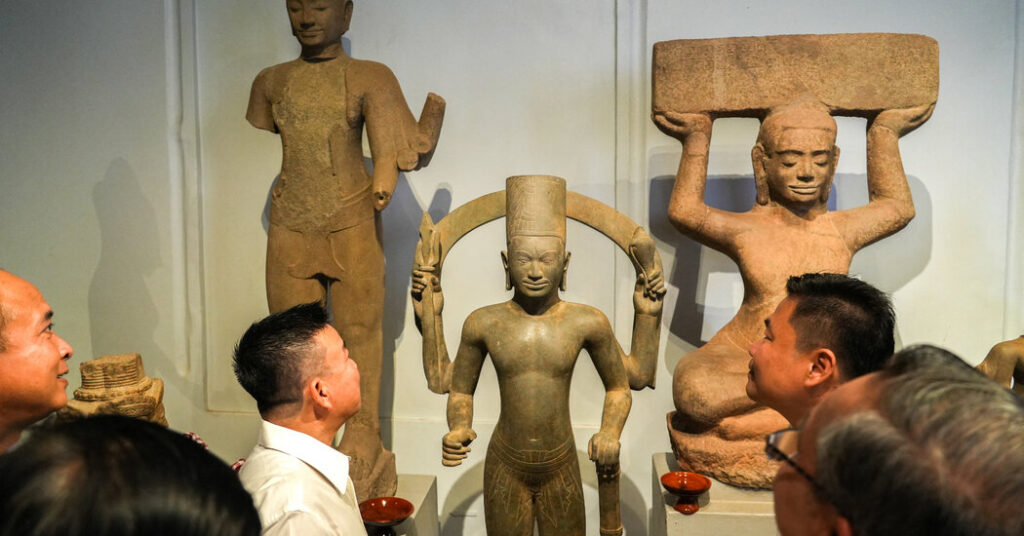
Dozens of statues and relics that were looted from Cambodia during its decades of civil strife and for years adorned the London townhouse of an accused British antiquities smuggler were returned to their homeland this week after more than five years of delays.
The 74 objects, many of which date back a thousand or more years to the glory days of Cambodia’s Khmer Empire, had been in the hands of Douglas A.J. Latchford, a prolific art dealer who was accused by U.S. investigators of running a multiyear scheme to sell looted Cambodian artifacts on the international market.
Mr. Latchford was indicted in 2019 on wire fraud charges by federal officials in New York but died in 2020 before the case went to trial. The items came from his estate and were returned as part of a September 2020 agreement between his daughter and sole heir, Julia Latchford, and the Cambodian government.
Bradley J. Gordon, Cambodia’s lawyer, said the final return had been accomplished after longstanding bureaucratic delays were overcome and disagreements over shipping and storage costs were resolved.
“It has been a difficult journey,” Mr. Gordon said.
In a statement, Ms. Latchford said: “Even before my father died, I became persuaded that all items of his collection had to return to the ownership of the Cambodian people. I am pleased that they are home, and available for everyone to see.”
The items were received with excitement and fanfare in Phnom Penh, the Cambodian capital.
“These 74 sacred items are not merely works of art,” Cambodia’s minister of culture and fine arts, Phoeung Sackona, said in a statement on Friday, adding, “They are living witnesses to the genius” of the nation’s Khmer ancestors and “the spiritual heart of Khmer civilization.”
Most of the statues depict Hindu and Buddhist deities and mythical creatures. Especially significant, Cambodian experts said, is the “Kulen Couple,” described as “powerful male and female figures” that date back 1,200 years and are seen as a “rare masterpiece.” They also pointed to a “Head of Brahma,” a four-faced representation of the Hindu god of creation, stolen from a temple complex known as Koh Ker.
The Khmer culture built scores of sprawling temples filled with thousands of intricately carved sandstone and bronze statues, and is famed for creating the Angkor Wat complex in northwestern Cambodia, near the city of Siem Reap. Thousands of Khmer works were plundered and sold abroad while the nation grappled with genocide, civil war and political upheaval from the 1960s to the 2010s.
Investigators and Cambodian officials have said that, although Mr. Latchford presented himself as a dealer and a scholar of Khmer sculpture, he was fully aware that many items he sold or collected had been illegally excavated.
Investigators said that he had repeatedly falsified paperwork in an effort to dupe buyers into paying millions for the stolen statuary. At least a dozen museums, including the Metropolitan Museum of Art, have returned items to Cambodia in cases where Mr. Latchford had played some role in the transactions.
With the transfer announced on Friday, all of the items that were part of the 2020 agreement have been returned. They went back in three phases. In October 2021, the British government helped repatriate five statues to Phnom Penh. In February 2023, Ms. Latchford handed over 77 pieces of gold jewelry and other royal finery — a recovery that Cambodian officials likened to “getting back the crown jewels of the Angkor Empire.”
And earlier this week, officials began uncrating dozens of carefully packed statues, which Cambodians see as living entities that carry the auras of their gods and the souls of their forebears. Also included were several dozen ceremonial items, like incense burners and candle holders.
Cambodian officials said many of the relics from the Latchford trove were one-of-a-kind works whose existence they had learned of only while leafing through a book titled “Adoration and Glory: The Golden Age of Khmer Art,” which Mr. Latchford and his co-author, Emma C. Bunker, published in 2003.
The book featured 180 color photos of rare Khmer objects, most of them owned or sold by Mr. Latchford. In the book’s captions, Mr. Latchford identified some items he possessed as belonging to a “private collector.”
Mr. Gordon, who has led the global investigation into Cambodia’s lost relics, said the photos had become a sort of breadcrumb trail to the Latchford loot.
“It has been a long road to bring these treasures home,” he said.
One tool that helped investigators was Mr. Latchford’s laptop, which contained information about his transactions and methods. Mr. Gordon said one file listed prices for the statues and other items returned this week that, he assumed, had been circulated among potential buyers.
The list price for the “Kulen Couple” was $23 million, which Mr. Gordon described as wildly inflated. All told, the list shows that Mr. Latchford valued his Cambodian inventory at nearly $180 million.
In a note at the bottom of the list, Mr. Latchford wrote: “Nothing like them have been seen before. They are undoubtedly the best that exist of the period they represent.”
The post Cambodia Celebrates the Return of Looted Artifacts From a Tainted Dealer appeared first on New York Times.