The Trump administration has delayed announcing a package of arms sales to Taiwan valued at billions of dollars to avoid upsetting Xi Jinping, China’s leader, ahead of President Trump’s planned trip to Beijing in April, U.S. officials said.
The weapons sale, which includes air-defense missiles, is in an advanced stage. Senior Republican and Democratic lawmakers approved the package after the State Department sent it to them in January for informal review.
However, since then, the sales package has languished in the State Department, the officials said. Administration officials have told some involved in the approval of the sale that the White House ordered agencies not to move forward to ensure that Mr. Trump has a successful summit with Mr. Xi, one official said.
Another official said the package has a total value of about $13 billion, compared with the $11 billion sale that the Trump administration announced in December. The U.S. officials spoke to The New York Times on the condition of anonymity to discuss sensitive diplomatic and security matters.
The State Department said it does not comment on pending arms sales. “This administration has been very clear that the enduring U.S. commitment to Taiwan continues, as it has for over four decades,” it said in a statement.
The White House referred questions to the State Department.
The topic of U.S. arms sales to Taiwan came up in a Feb. 4 call between Mr. Trump and Mr. Xi, according to a summary of the conversation from Chinese state news organizations.
“The U.S. must handle arms sales to Taiwan with extreme caution,” Mr. Xi told Mr. Trump, according to the summary. Mr. Xi also warned Mr. Trump that the U.S. position on Taiwan was “the most important issue in China-U.S. relations” and that China “will never allow Taiwan to be separated from China.”
In a social media post that day, Mr. Trump listed the issue of Taiwan among more than a half-dozen topics, and said the call was “all very positive.” The two leaders have been planning to meet in Beijing this spring, which would be the first time since they talked in person last October in Busan, South Korea. They agreed in Busan to a yearlong truce in a trade war that Mr. Trump had started. The thorny subject of Taiwan, a democratic island with de facto independence that is claimed by China, did not come up.
On Feb. 16, Mr. Trump told reporters that he was considering what to do about arms sales to Taiwan, given that Mr. Xi opposes them.
“I’m talking to him about it,” he said aboard Air Force One.
Mr. Trump did not clarify what he meant by that. Some experts on U.S.-China policy said Mr. Trump could be violating a diplomatic agreement called the Six Assurances, a pillar of U.S.-Taiwan and U.S.-China policies. Those assurances were sent by the Reagan administration to Taiwan’s president in 1982, and one is generally understood to say that the U.S. government would not consult with China before an arms sale to Taiwan.
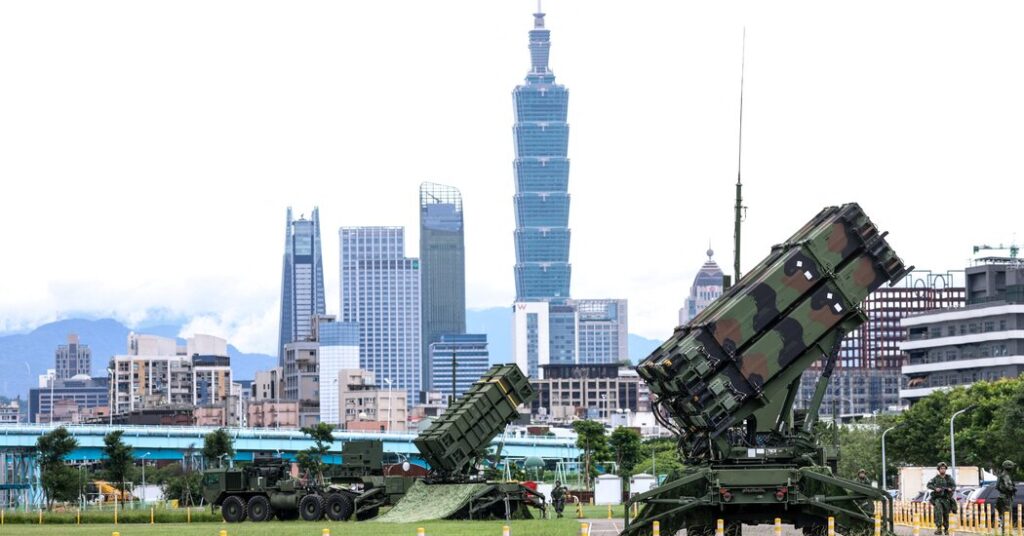
The proposed package includes interceptor missiles for Patriot air-defense launchers, anti-drone equipment and NASAMS, another missile-based air-defense system, an official said. There are also small arms and maintenance and sustainment items.
The Financial Times first reported on the compiling of an arms package, and The Wall Street Journal later reported on hesitation among U.S. officials to move forward with it.
The fact that the Trump administration has halted the package at an advanced stage of the process, after informal approval from Congress, has not been previously reported.
In general, the State Department sends proposed arms packages to a Senate committee and a House committee to be reviewed by the top lawmakers from both parties on those panels. If the lawmakers grant informal approval, then the department generally announces the sale publicly soon afterward and sends the package to Congress for pro forma official approval.
The informal approval stage is significant. For example, Democratic congressional officials have spent weeks or months scrutinizing arms sales to Israel in recent years, as criticism has grown of the Israeli military’s killing of civilians in Gaza during a retaliation campaign against Hamas for its October 2023 attacks. The Trump administration has bypassed Congress three times to expedite arms shipments to Israel.
U.S. arms support for Taiwan has strong bipartisan support in Congress, and the 1979 Taiwan Relations Act obligates administrations to sell weapons of a defensive nature to the island. Lawmakers often quickly give approval to such packages.
Although senior U.S. officials pushed in the first Trump administration to bolster ties to the island, Mr. Trump has been dismissive of Taiwan in private, according to a memoir by John R. Bolton, a national security adviser in the first term.
By contrast, Mr. Trump has consistently expressed admiration for Mr. Xi, whom he calls a “very good friend,” even as he views China as a formidable trade rival. At the urging of U.S. businesses, he recently eased restrictions on the export of advanced semiconductor chips to China.
Edward Wong reports on global affairs, U.S. foreign policy and the State Department for The Times.
The post Taiwan Arms Sale Approved by Congress Is Delayed as Trump Plans Visit to Beijing appeared first on New York Times.