A U.S. military attack on Iran could result in regime change, President Donald Trump said Friday. “Nobody knows. … It would be nice if we could do it without” military force, Trump said, “but sometimes you have to do it with.”
Trump, speaking with reporters before his morning departure from the White House for Texas and Florida, said he was “not thrilled” with how negotiations with Iran were going over his demand that it “not have nuclear weapons.”
Amid rising hints that war might be imminent, Omani Foreign Minister Badr Albusaidi, who mediated a Thursday negotiating session between the U.S. and Iran in Geneva, later said in an interview with CBS’s “Face the Nation” that substantial progress had been made on key U.S. demands and a deal on the broad parameters “actually can be reached tomorrow.”
Iran, he said, had agreed to “irreversibly” dilute its stockpile of near-weapons grade uranium, highly enriched to 60 percent, to “a neutral level, a natural level.” CBS released a transcript of the interview, scheduled for Sunday broadcast, on Friday afternoon.
Albusaidi said agreement had also been reached on Iran’s “zero accumulation” of enriched material in the future and submission of all of its nuclear facilities to international inspection. A plan that Iranian Foreign Minister Abbas Araghchi brought to Geneva on Thursday had proposed allowing uranium to be enriched to 1.5 percent to fuel a civil research reactor, according to people familiar with the proposal.
But Trump, around the time that the CBS transcript became public, said in Texas that he wanted “no enrichment. … I’m not happy.”
Asked when he would make a decision on whether to attack, Trump declined to say, telling reporters that “you’d have the greatest scoop in history.”
The ongoing U.S. deployment of air and sea military assets to the Middle East — the largest since the 2003 invasion of Iraq — continued Friday. Israeli media reported the arrival of nearly a dozen air refueling tankers at Ben Gurion Airport in Tel Aviv, following the positioning of F-22 fighter jets at a base in southern Israel.
Trump has never specifically cited removal of Iran’s Islamic theocracy as a goal of U.S. military action. But he has often spoken of the need for a new government there and said two weeks ago that regime change would be “the best thing that could happen.”
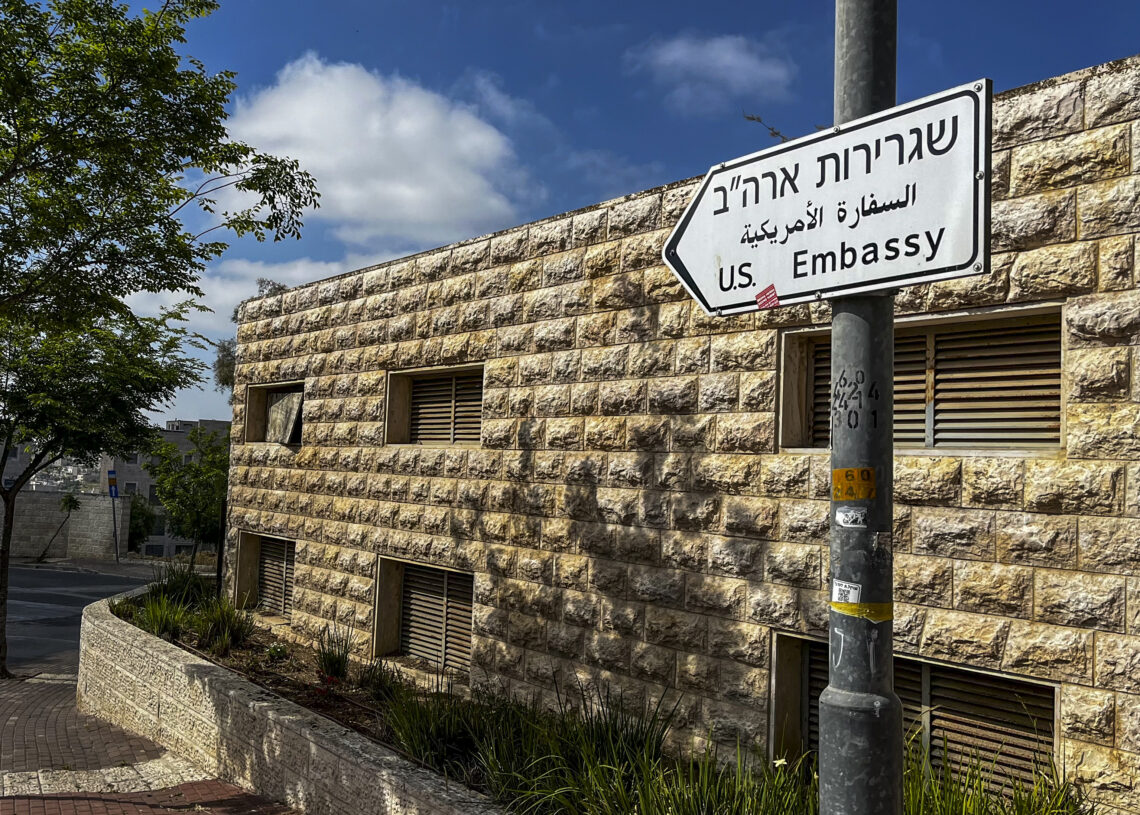
Earlier Friday, the State Department authorized nonemergency staff and family members at the U.S. Embassy in Jerusalem to leave Israel, warning that they should consider acting “while commercial flights are available.”
An updated travel advisory posted on the embassy website said that further alerts may be issued “in response to security incidents and without advance notice.”
Iran has warned that any attack on its territory would be met with retaliation against Israel and U.S. forces in the region.
The departure notice made no direct mention of Iran, instead speaking of rising “terrorism and civil unrest” in Israel and the West Bank. It also referenced “terrorism and armed conflict” in Gaza and along its border with Israel, and on the tense frontiers with Syria and Lebanon.
In a separate email to embassy staff Friday, Ambassador Mike Huckabee said those wishing to leave should do so “TODAY,” booking any flight available to any other country, according to a U.S. official who spoke on the condition of anonymity to discuss internal communications.
“Focus on getting a seat to anyplace from which you can then continue travel to DC, but the first priority will be getting expeditiously out of country,” Huckabee wrote.
He added that the government would cover evacuation costs under a policy that applies when “U.S. national interests or imminent threat to life requires it,” said the official. Huckabee’s email to the staff was first reported by the New York Times.
During his first administration, Trump authorized moving the embassy in Israel from Tel Aviv to Jerusalem, parts of which are claimed by both Israelis and Palestinians as their capital. Although it initially occupied a small Jerusalem footprint, plans were authorized in 2021 to significantly expand the facility.
The encouragement of embassy staff’s departure came as the State Department announced that Secretary of State Marco Rubio will visit Israel on Monday and Tuesday to “discuss a range of regional priorities including Iran, Lebanon, and ongoing efforts to implement President Trump’s 20-Point Peace Plan for Gaza.”
Following Thursday’s negotiating session in Geneva — the third indirect, Omani-mediated meeting in recent weeks — Araghchi said that “good progress” was made during two lengthy sessions in Geneva and that the two sides achieved a “close understanding” despite remaining differences in some areas.
During his State of the Union address Tuesday, Trump spoke briefly about the Iranian nuclear threat, repeating the claim that U.S. airstrikes in June had “obliterated Iran’s nuclear weapons program” but warning that the Iranians were starting to rebuild it and “are at this moment pursuing their sinister ambitions.”
On Friday, Iranian military spokesman Brig. Gen. Abolfazl Shekarchi called Trump’s threats against Iran “baseless, boastful and delusional,” according to Iranian media reports. He described the U.S. military presence in the region as “psychological warfare, blackmail and bullying.”
In an interview Thursday with The Washington Post, Vice President JD Vance said that he did not know whether Trump would decide to attack Iran but that the U.S. would not become involved in a drawn-out war.
While regional experts and some lawmakers have warned that a U.S. attack could spark widespread regional conflict, Vance said, “The idea that we’re going to be in a Middle Eastern war for years with no end in sight — there is no chance that will happen.”
Prior to the CBS interview, Albusaidi, the Omani minister, met with Vance at the White House. An official Omani statement following that meeting said that Albusaidi had “clarified” to Vance “that the negotiations have thus far achieved significant, important and unprecedented progress, which could form the cornerstone of the desired agreement.”
The House and Senate are considering measures that would attempt to block the administration from attacking Iran without lawmakers’ consent — with at least one bill coming up for a vote next week. Congress has already voted down half a dozen such war powers resolutions in the past year, including one this past summer focused on Iran.
In a statement Friday, Sen. Jack Reed (Rhode Island), the senior Democrat on the Armed Services Committee, called on Trump to explain the risks and costs of U.S. military action in Iran.
Trump’s “saber-rattling for war … is taking the country down a dangerous path without a clear strategy or endgame,” Reed said. Noting that the president “barely mentioned Iran during the longest State of the Union speech in history,” he said Trump “failed to define the objective. Congress has received no real briefings or intelligence, and it is hard to justify action without rationale.”
Trump and administration officials have charged that Tehran is intent on building a nuclear weapon and is developing an intercontinental ballistic missile capability to reach U.S. territory. The Iranian government has said for years it has no intention of producing a nuclear bomb, and international inspectors have said they detect no active plan to do so. U.S. intelligence assessed last year that it would take until 2035 for Iran to build an ICBM “should Tehran decide to pursue the capability.”
The International Atomic Energy Agency has said it has no evidence or reason to believe that Iran has an active nuclear weapons program or has restarted uranium enrichment at nuclear facilities struck by the U.S. attacks this past summer.
But according to news accounts from Vienna, where the IAEA is headquartered, a confidential new report circulated Friday among member states said that Tehran has not allowed IAEA inspectors access to those facilities. The agency, it said, “cannot provide any information on the current size, composition or whereabouts of the stockpile of enriched uranium in Iran.”
The possibility of imminent war between the U.S. and Iran has overshadowed other conflicts over the past several weeks in Gaza, in the West Bank and on Israel’s other borders. While steps have been put in place to move forward with Trump’s ambitious Gaza peace plan, few have been implemented beyond the release of hostages and a ceasefire that has been repeatedly violated by both sides, with more than 600 Palestinian deaths from Israeli attacks since the truce was declared in October, according to Gaza health authorities.
Amid an increase in settler attacks in the West Bank and military restrictions on Palestinian civilians there, Israeli Prime Minister Benjamin Netanyahu’s government has taken steps to annex more of the occupied territory.
“The security environment is complex and can change quickly,” the U.S. Embassy update said, “and violence can occur in Israel, the West Bank, and Gaza without warning. Increased regional tensions can cause airlines to cancel and/or curtail flights into and out of Israel.”
Meanwhile, as the sun set in Washington on Friday, the State Department designated Iran a “State Sponsor of Wrongful Detention,” saying that “anyone who uses an American as a bargaining chip will pay the price.” At least four Americans are believed to be wrongfully detained in Iran.
Matt Viser, Susannah George, Noah Robertson and Adam Taylor in Washington; Lior Soroka in Tel Aviv; and Suzy Haidamous in Beirut contributed to this report.
The post Trump moves toward Iran attack as mediator says nuclear deal is close appeared first on Washington Post.