NASA is overhauling and accelerating Artemis, its program to send astronauts back to the moon, the head of the space agency announced on Friday.
The agency is aiming to launch more often, more closely following the approach that NASA took in the 1960s during the Apollo program.
“No one at NASA forgot their history books,” Jared Isaacman, the NASA administrator, said during a news conference on Friday. “They knew how to do this. They’ve had plans like this for a long time. Now we’re putting it in action.”
The sweeping changes are the biggest move yet by Mr. Isaacman, who has been administrator of NASA for a little over two months and has talked about focusing the agency on doing the “near impossible.”
Artemis III, which had been scheduled for late in 2028, was supposed to land NASA astronauts on the surface of the moon for the first time in more than half a century. Now, it will launch in mid-2027, and not even travel to the moon. Instead, it is set to serve as another test flight during which astronauts will practice rendezvousing in low-earth orbit with one or both of the lunar landers that are under development by SpaceX and Blue Origin.
That would set up two landing attempts, Artemis IV and V, in 2028, which would meet President Trump’s goal of sending NASA astronauts back to the moon before the end of his second term.
“It’s ambitious, but with this course correction, we are on a more stable foundation, a more realistic path to the milestones we have ahead,” Amit Kshatriya, NASA’s associate administrator, said during the news conference.
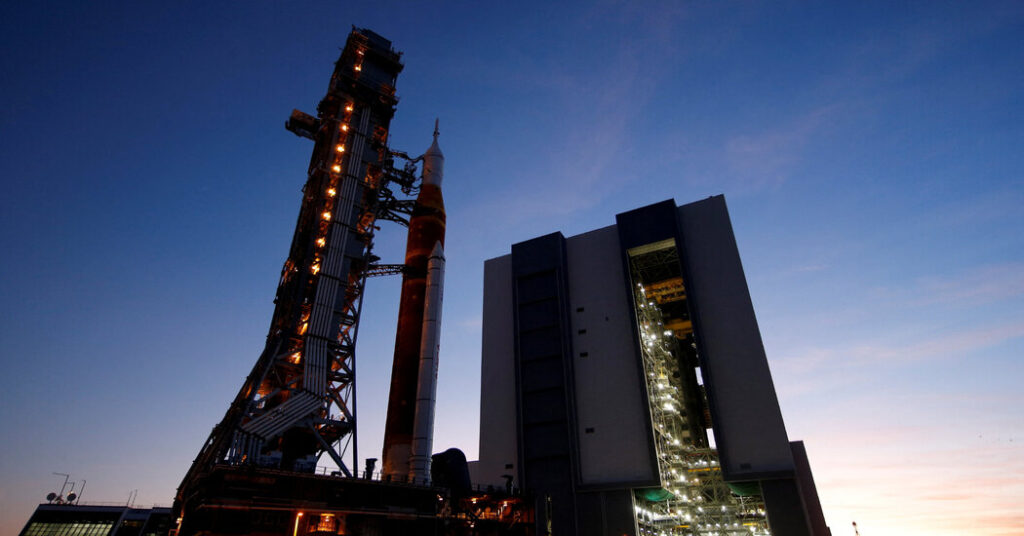
What will not change is the plan for Artemis II, which is set to send four astronauts on a swing around the moon without a landing. NASA, however, had to take Artemis II off the launchpad this week because of a problem with the upper stage of the Space Launch System rocket. It was rolled back to the giant hangar known as the Vehicle Assembly Building for repairs, eliminating the possibility of a launch in March.
If repairs and other work can be completed in time, the next launch opportunities will run from April 1 through April 6.
The shifts in the Artemis schedule are a bold step taken early in the tenure of Mr. Isaacman, a billionaire entrepreneur and private astronaut who had a bumpy path to NASA headquarters. Mr. Trump withdrew his initial nomination in May, then nominated him again in November, and he won confirmation in the Senate a month later.
After a whirlwind tour of the agency’s facilities around the country, he called for NASA to hire more engineers so that the agency could perform more work in-house instead of relying on contractors.
Last week, he minced no words in discussing a report that cataloged the shortcomings of a troubled flight in 2024 of Boeing’s Starliner spacecraft to the International Space Station. Two NASA astronauts, Suni Williams and Butch Wilmore, ended up staying in orbit for eight months, far longer than the eight to 14 days originally planned. Eventually they came home on a different spacecraft, a SpaceX Crew Dragon capsule.
Problems with decision-making and leadership at NASA during the Starliner episode “if left unchecked, could create a culture incompatible with human spaceflight,” Mr. Isaacman said during an earlier news conference.
Two top NASA officials have since been shuffled.
“This is what a competent NASA administrator looks like,” said James Muncy, a space policy analyst, in an interview.
One motivation for the transformed Artemis schedule is to decrease the time between missions to less than one year, Mr. Isaacman said. More than three years have passed since Artemis I, an uncrewed mission, circled the moon in 2022, and under the previous schedule, almost another three years would pass until Artemis III.
“Launching a rocket as important and as complex as S.L.S. every three years is not a path to success,” he said, referring to the Space Launch System rocket.
The long gap between launches gave NASA few chances to learn whether fixes to problems actually worked. Both Artemis I and Artemis II experienced recurring problems including hydrogen leaks and helium system malfunctions. Diagnosing and fixing the problems caused monthslong delays to both missions.
Simplifying the Artemis III mission will allow NASA to test out docking procedures and the lunar landers before a moon landing attempt.
“It’s easier,” said Mr. Muncy, a co-founder of the Space Frontier Foundation, a nonprofit organization that promotes space exploration and which has been critical of the Space Launch System. “It’s less risky. It’s just more serious.”
A report by the NASA Aerospace Safety Advisory Panel this week warned that the Artemis III plan was “high risk,” because it was attempting too many unproven technologies and procedures for the first time, during a highly complicated mission to land near the moon’s south pole.
Both SpaceX and Blue Origin, the companies building the lunar landers for NASA, reacted enthusiastically.
“We look forward to working with NASA to fly missions that demonstrate valuable progress towards establishing a permanent, sustainable presence on the lunar surface,” SpaceX, the rocket company run by Elon Musk, posted on X.
Dave Limp, the chief executive of Blue Origin, the space company started by Jeff Bezos, said succinctly on X, “We’re all in!”
The revised plan will put pressure on SpaceX, Blue Origin and Boeing, the maker of the core stage of the Space Launch System, to accelerate their work in order for Artemis III to fly next year.
Mr. Isaacman also said NASA would standardize the design of the Space Launch System rocket, which probably eliminates any planned upgrades.
“We want to reduce complexity to the greatest extent possible,” he said.
“Everybody agrees this is the only way forward,” said Mr. Isaacman. He said he had discussions with the companies building the spacecraft and with members of Congress, and all were supportive of the new approach.
Mr. Isaacman and Mr. Kshatriya declined to say whether the standardized design meant that a contract with Boeing for an upgraded second stage would be canceled.
The sweeping tax law signed by President Trump last year included a provision that mandated the use of the Space Launch System through Artemis V. It also included additional money for NASA that would pay for the accelerated schedule, Mr. Isaacman said.
Some critics of the Space Launch System have called for its immediate cancellation. But Mr. Muncy said the revised plan made sense, describing it as “reform on the installment plan.”
He added, “They’re making a lot of change with this first step. Other changes will become available down the line.”
Mr. Isaacman said that launching moon missions more often would also increase support for the program.
“I do believe it helps keep the public engaged,” he said. “We want to see a lot more kids dressing up as astronauts on Halloween. Inspiring the next generation to take us a lot farther than the moon is part of the plan.”
Kenneth Chang, a science reporter at The Times, covers NASA and the solar system, and research closer to Earth.
The post NASA Shakes Up Artemis Schedule, Aiming for 2 Moon Landings in 2028 appeared first on New York Times.