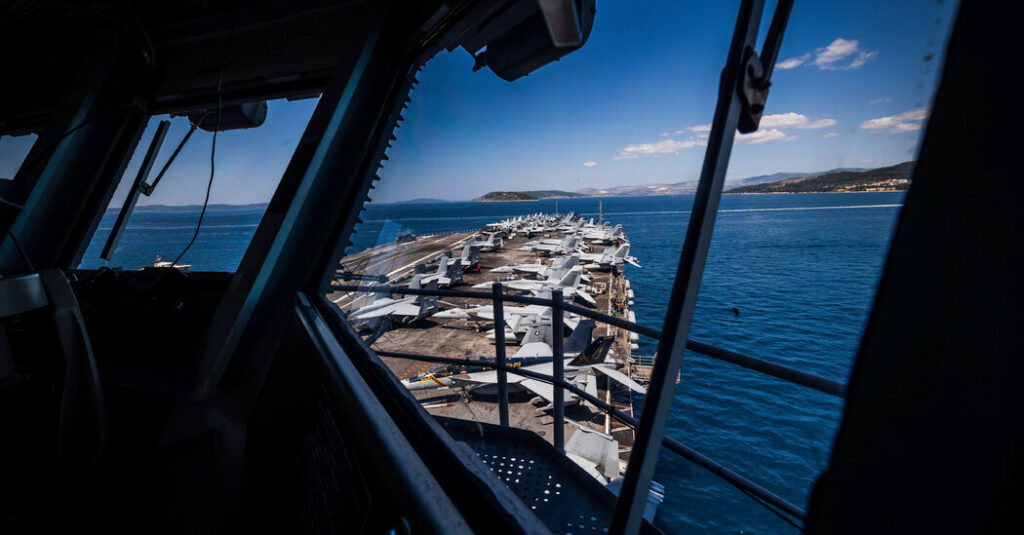
The U.S.S. Gerald R. Ford, the Navy’s newest aircraft carrier, has had a difficult few months at sea.
On Oct. 24, the Ford, with its 4,500 sailors, was redirected to the Caribbean Sea from a planned six-month European deployment. Then on Feb. 12, the Pentagon sent the ship to the Middle East as part of the Trump administration’s pressure campaign against Iran.
The Navy typically schedules ships for six-month deployments and tries to avoid having them go longer than seven. This week, however, the Ford marked its eighth month on deployment.
Members of the crew have told The New York Times that morale on the ship dipped after their deployment was first extended and has cratered since it was ordered to the Middle East.
At 1,106 feet long, the Ford is the Navy’s largest aircraft carrier. It was designed with new technologies that replaced steam and hydraulic systems for launching and recovering aircraft with electronic systems run by software.
But according to current and former Ford sailors, equipment problems limited the ship’s ability to carry out its most basic mission: sending warplanes into combat.
However, two senior Navy officials said on Thursday that the Ford’s radars, catapults and arresting gear for recovering planes had been fixed.
This week, the Ford docked in Souda Bay off the Greek island of Crete, taking on supplies and ammunition and repairing broken equipment.
Here’s a look inside the warship:
4,500 sailors are the lifeblood of the ship.
The Ford was designed to need about 1,000 fewer sailors than its predecessors, bringing the number deployed aboard down to roughly 4,500.
But even with the new technology, most of the jobs that sailors perform on the Ford are the same as on earlier carriers.
The ship still has nuclear propulsion engineers, sailors who run the machines that turn seawater into potable water, quartermasters who navigate, cooks who feed the crew, hull technicians who weld and fix sewage problems, aviation mechanics and dozens of other specialties.
According to the Navy, the Ford has “improved berthing compartments, better gyms, and more ergonomic work spaces” for the crew as well.
Just below the flight deck is the Ford’s cavernous hangar bay.
There, sailors do maintenance on airplanes and helicopters in two separate bays that can be walled off from each other in case of a fire.
With Ford’s larger flight deck, the ship can carry 75 aircraft while its predecessors typically carry 70.
New features on the ship require advanced nuclear reactors.
The Navy had to design new kinds of nuclear reactors to generate more electricity for the Ford, to power systems that had been run by steam on earlier carriers.
The reactors installed on Ford create 25 percent more electrical power than earlier nuclear power plants on carriers, while requiring about half the number of sailors to run them, according to the Department of Energy.
Fighter jets are the key offensive weapons onboard.
The main offensive firepower on the Ford comes from four squadrons of F/A-18 Super Hornet fighters, which can carry a mix of guided bombs, rockets, and anti-ship and air-to-air missiles. A squadron of EA-18G Growler jets can carry out airstrikes as well.
The Ford, however, would need to be retrofitted to carry the Navy’s stealth warplane: the F-35 Joint Strike Fighter, whose design was finalized after the ship was completed.
Machine guns are used to protect the Ford from small enemy boats.
To protect the ship from small enemy boats, the Ford carries .50-caliber heavy machine guns as well as more powerful 25-millimeter chain guns that can fire explosive projectiles.
While a carrier’s warplanes provide its first line of aerial defense, the Ford and other carriers also have launchers for two kinds of short-range antiaircraft missiles.
As a last-ditch defense against incoming enemy weapons, the Ford carries 20-millimeter Phalanx guns that fire thousands of tungsten projectiles per minute.
Bombs are stowed onboard for combat missions.
The primary weapons for the Ford’s warplanes are Mark-80 series airdropped bombs in the 500, 1,000 and 2,000-pound versions.
They contain the equivalent of 192 pounds, 445 pounds and 945 pounds of TNT high explosive.
Each bomb can be fitted with a laser- or GPS-guidance kit for more accurate delivery of the weapon.
Exactly how many of them Ford or any other carrier has in its magazines is classified.
As those munitions are used up in combat missions, carriers like the Ford can receive additional weapons from supply ships — either via trolleys that move along metal cables between the two ships, or suspended under helicopters ferrying loads.
An electromagnetic catapult is one of the Ford’s greatest technological advancements.
But the catapult, which launches aircraft, has also proved to be one of its biggest weaknesses.
Carriers of the past used steam generated by boilers or nuclear reactors to sling warplanes off their decks at speeds of more than 200 miles per hour.
But current and former crew members have said that, as the first carrier outfitted with the new catapult system, the Ford has struggled to maintain both the hardware and the computer software that controls it.
To keep the Ford’s catapults in operation, the Navy has cannibalized parts from the U.S.S. John F. Kennedy, a Ford-class carrier that is still under construction.
With a slightly larger flight deck than previous carriers, the Ford was supposed to be able to launch roughly 30 percent more sorties per day than its predecessors.
Problems with the electromagnetic system prevented the ship from reaching that level, according to current and former sailors. But a senior Navy official said on Thursday that the Ford’s sortie rate had improved and now exceeds that of previous carriers.
This equipment helps planes safely land on the deck.
In another update to the decades-old technology used to “trap” warplanes landing on a carrier’s flight deck, the Ford debuted a modified version of a system first used by the Navy on land, calling it Advanced Arresting Gear.
Older carriers used a manually controlled hydraulic system to slow the planes down after their tailhooks caught one of the four wires stretched across the flight deck. But on the Ford, each wire is connected to devices under the flight deck called “water twisters” — liquid-filled turbines that can electronically adjust how much resistance they offer for heavier or lighter aircraft.
The Ford also uses electromagnets in elevators.
The elevators bring munitions from magazines deep in the ship’s hull up to the flight deck. From the flight deck, the weapons can be loaded onto jets for combat missions.
It is one area where Ford has a clear advantage over the Navy’s previous carriers. The ship has 11 ordnance elevators, each of which can lift 24,000 pounds of weapons at a time to the flight deck, compared to nine elevators on the Nimitz-class carriers that are rated for only 10,500-pound loads.
The Ford has been fitted with a unique air-search radar.
Instead of a traditional radar that rotates and requires maintenance to keep it spinning, Ford uses a series of flat radar panels that don’t move but constantly emit a bubble of radio waves around the ship.
Called Dual-Band Radar, it was originally meant to be installed on a few dozen other ships. But when the Navy later scrapped that plan, it meant that spare parts for the Ford’s were harder to get and more expensive.
Helene Cooper contributed reporting.
John Ismay is a reporter covering the Pentagon for The Times. He served as an explosive ordnance disposal officer in the U.S. Navy.
The post U.S.S. Ford Steams Toward a Possible War appeared first on New York Times.