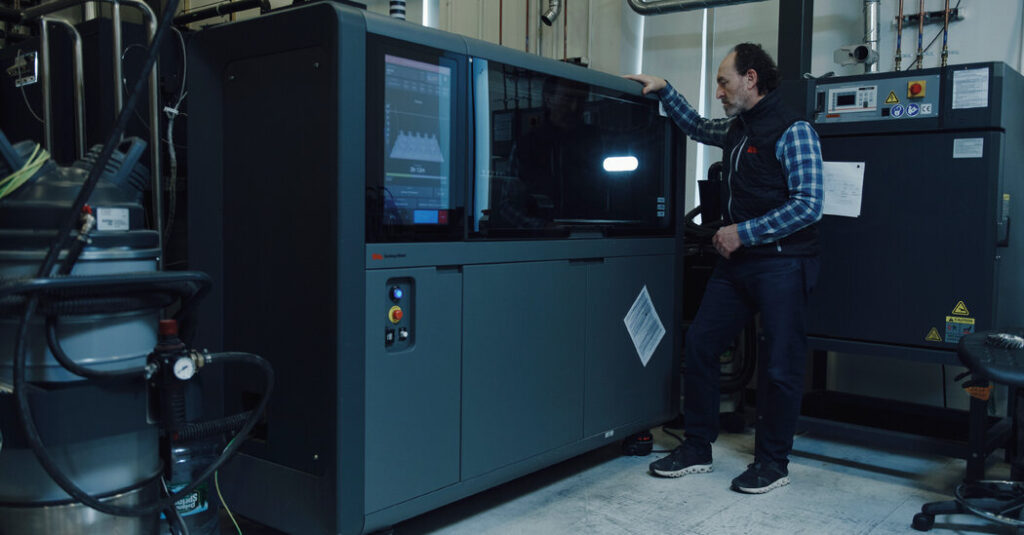
In the winter of 2020, Desktop Metal, a high-flying start-up just outside Boston, unveiled an industrial 3-D printer so powerful that it sounded like magic. The printer could make metal parts for jet engines, trucks and medical implants “at speeds so unheard-of,” one commercial declared, “that some people thought it wasn’t possible.”
There was just one problem: That printer, the P-50, never worked well enough to sell.
It was quietly shelved after going out to only a few customers, an early warning of how much the 3-D printing industry’s rapid growth relied on promises that have not come to fruition.
For decades, people in the 3-D printing world heralded a new industrial revolution that would replace old machines on factory floors with sleek new printers that could cheaply and efficiently transform the way that nearly everything was made.
While 3-D printers have become indispensable for certain products — customized dental implants and satellite components, for instance — adoption of the technology has lagged expectations. High interest rates, costly raw materials used by the machines and the sheer complexity of the printers have made many companies shy away from buying them.
The global market for additive manufacturing, a term for industrial 3-D printing, was $24.2 billion in 2025, according to Wohlers Associates, an industry advisory firm. That was nowhere near the $47.7 billion the industry was expected to be when Desktop debuted the P-50.
Today, the industry focuses less on moonshot products and more on making sure customers are getting good use out of the machines they already have.
“The companies that remain are generally more focused on operational execution than on visionary projections,” said Alison Wyrick Mendoza, a consultant with Wohlers Associates, which is now a part of the standards organization ASTM International.
The struggling industry got a pep talk on Wednesday from Yoav Zeif, chief executive of Stratasys, which pioneered the sale of 3-D printers in the 1990s.
“It takes years to adopt new technologies,” he said at the keynote address of the industry’s main conference, in New York. “What we are experiencing is a normal course of an industry that is maturing. There is maybe one big difference: We had a lot of hype.”
Unlike traditional manufacturing, which carves shapes out of raw materials, additive manufacturing prints products layer by layer using plastic, metal, ceramic or other materials. While the process can create complex geometries impossible to achieve with older machines, the technology tends to be slower, more expensive and prone to mechanical glitches that have hindered its leap into mass production.
Wall Street’s new favorites are companies like VulcanForms and Hadrian, the latter of which just started an additive manufacturing arm. Both sell 3-D printed precision parts for aerospace and defense, and their printers incorporate artificial intelligence to guard against glitches and to allow one operator to oversee many machines.
Globally, much of the momentum in the industry today comes from China, where Bambu Lab, a company that sells affordable desktop 3-D printers, is taking market share from established American firms.
When Desktop Metal was founded in 2015, the industry was growing at an annual rate of more than 25 percent — more than twice the rate it grew in 2025. China had not yet broken into market, and the idea of a machine that could churn out metal parts in an office setting was still revolutionary.
Ric Fulop, a media-savvy entrepreneur and investor, pulled together a dream team of M.I.T.-affiliated professors. They included Emanuel Sachs, known as Ely, who invented a technology called binder jet in the 1980s that made it possible to replicate metal parts faster than the more common laser-based metal printers.
The company became known for its office-friendly 3-D printers, which are ideal for prototypes. It also rolled out a midsize industrial printer as well. But Mr. Fulop poured resources into the P-50, the now-shelved industrial printer that he had hoped to sell to Ford Motor and Apple. The machine needed more time, said Jonah Myerberg, co-founder and chief technology officer at Desktop.
“We have learned so much from that failure,” he said. “It was something that you go through and never forget.”
Much of the company’s value stemmed from Mr. Fulop’s ability to communicate the big dream of 3-D printing’s potential. The company was valued at $1 billion before it ever shipped a product. Then the pandemic gave a new sense of urgency to making parts on American soil, creating a frenzy on Wall Street.
Desktop went public in 2020 via a special purpose acquisition company, or SPAC, a risky investment vehicle. An investor presentation predicted that Desktop would earn nearly $1 billion in revenue in 2025, much of it from selling the P-50.
The company’s competitors, Markforged and Velo3D, also went public with SPACs. All three companies were valued at well over $1 billion in 2021, only to run into financial trouble.
Desktop used investors’ capital to snap up 11 other companies, but it collapsed last year when it was forced to file for bankruptcy. Its core business sold for $7 million, a brutal reckoning not just for the company, but for the sector as a whole.
“Desktop’s bankruptcy ended a time of easy money, limitless promise and limitless promises,” said Joris Peels, an industry consultant who chaired this week’s conference, which included a session on Desktop’s future.
Some blame the costly and distracting expansion for Desktop’s demise, along with the aborted P-50, which cost the company nearly $100 million in research and development.
But Mr. Fulop said the whole industry had become unprofitable in an era of high interest rates and unfair competition from China.
“The biggest issue is that we thought the market would grow at a certain rate,” Mr. Fulop said.
As the company ran short of funds, Mr. Fulop tried to sell it to competitors, first Stratasys and then Nano Dimension. But Stratasys shareholders rejected the deal, as did an activist investor who took over Nano. After a court battle with Nano, Desktop ended up in bankruptcy court last summer. Debt holders began to sell off its assets and threatened to shut the doors on the core business in Burlington if they couldn’t find a buyer.
Then customers started calling. Where would they get the metal rods they needed to feed into the machines? Their businesses depended on a reliable supply. It reminded Desktop’s leaders why the company had to survive.
They started calling investors, trying to find a savior. They found one: Arc Public Benefit, an investment firm that prioritizes social progress alongside financial returns. In September, Arc bought what was left of the company, giving Desktop a second chance.
“Something special did happen in all that darkness,” said Thomas Nogueira, Desktop’s former chief operating officer, who now serves as chief executive of Arc Impact, the entity that owns Desktop’s brand.
Mr. Fulop insists that his vision for 3-D printing will eventually come true. But he’s already on to his next venture: General Flash, a start-up that he says is developing a new way to refine metal. It’s so new that there isn’t a sign on the door yet. But it has already raised $25 million, he said.
Farah Stockman is a Times business reporter writing about manufacturing and the government policies that influence companies that make things in the United States.
The post The Rise and Fall of a 3-D Printing Empire appeared first on New York Times.