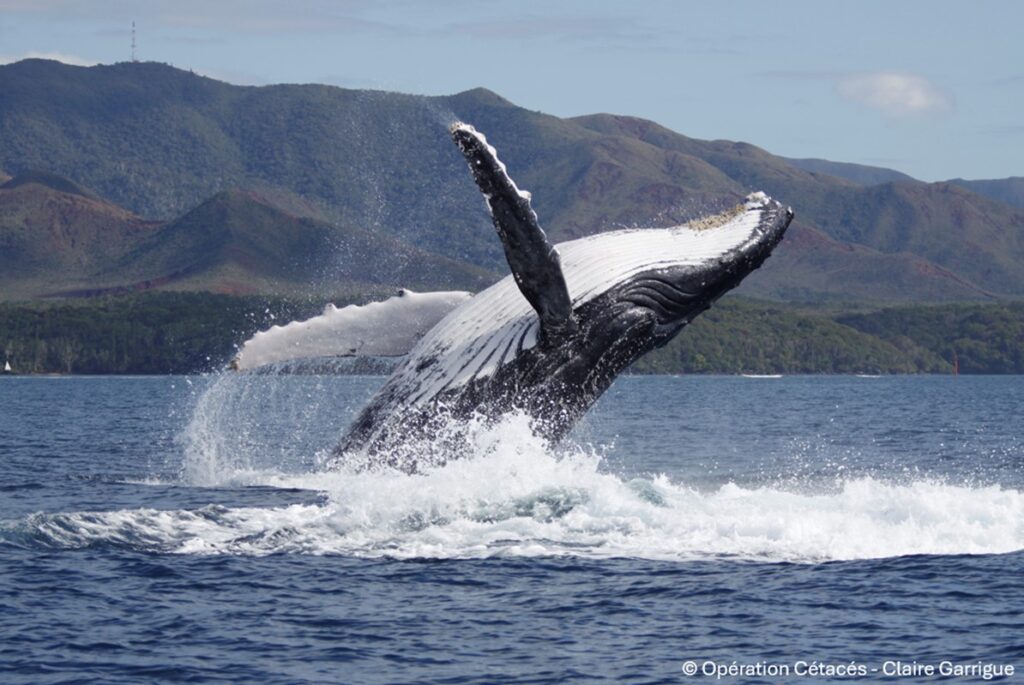
Scientists following humpback whales once brought to the brink of extinction in the South Pacific made a fascinating discovery: Older males were more likely to become fathers and younger males were less likely to do so.
The new study, published Friday in the journal Current Biology, sheds light on the illuminating, sometimes counterintuitive dynamics of mating and how species survive. It also reveals how uncontrolled hunting can leave decades of damage, long after populations replenish, and warps our understanding of typical animal behavior.
Researchers reviewed nearly two decades of data from whales in New Caledonia east of Australia, comparing a 2000-2008 period when the population was smaller and a 2009-2018 stretch when it rebounded.
As male numbers grew, age-related mating competition intensified. In later years, males 16 and older were more likely than expected to become fathers and disproportionately engaged in mating behaviors such as singing and escorting females.
Scientists believe widespread whaling in the South Pacific, which continued into the 1970s and left fewer than 200 humpbacks, ultimately drove the shift in the age of whale fathers. With generations decimated among animals that can live as long as a century, female whales were most likely to encounter younger mates. As whales aged and new ones migrated into the region, younger males were increasingly bested by older ones.
“The consequences of whaling are so much bigger and more long-term than we thought,” said Franca Eichenberger, the study’s lead author and a post-doctoral researcher at the sea mammal research unit at University of St Andrews in the United Kingdom.
David Coltman, who has separately studied age and sexual selection in other species including big horn sheep, described the whale research as a “remarkable piece of work” that illustrates the perils of human interference in natural selection.
“We can mess things up in a hurry, but it takes a long time to recover,” said Coltman, a professor at Western University in Ontario who specializes in wildlife genetics.
How the study was done
Reproduction is at the heart of understanding how to save species. And scientists knew little about which humpback whales were more likely to reproduce.
Determining how old whales were was difficult without tracking them as calves. Unlike other whales, humpbacks don’t have teeth with layers that reveal age à la tree rings.
Then came epigenetic clocks. With a piece of skin collected by crossbows, scientists have tools to estimate age by measuring chemical modifications to DNA that change over time.
They collected samples from 485 male whales in a region with an estimated 2,000 males. They tracked them between 2000 and 2018 to investigate mating behavior.
The methodology was among the most striking parts of the study, according to experts who were not involved, saving up to decades of work.
“You are able to assess the age structure of a population by looking at all the individuals, not just the ones you are able to track over time,” said Angela Sremba, a research associate at the marine mammal institute at Oregon State University.
Using genetic testing of males, compared to mother-calf pairs, as paternity tests, researchers confirmed 56 fathers. Most were between the ages of 9 and 23, and the oldest was 43. They compared the distribution of ages in the 2000s and 2010s against an estimated distribution that assumed age didn’t matter.
No whales older than 23 were identified as fathers when the population was smaller, but seven older fathers were documented once whale numbers rebounded. Across all age groups, the analysis showed that older whales had an edge — and that advantage grew as the population grew.
Better game or better mates?
Researchers don’t have definitive answers for why older whales seemed to have an advantage over the younger ones.
Experience matters in a sexual partner for many species (and many humans for that matter). But are the older whales more desirable? Do they have better game?
Scientists have a few ideas. They could have more practice perfecting the gentle croon of their song as a mating call or warning to males. They could have more stamina to follow females until they’re ready to breed. Their size could give them an edge in competition pods to fight for the same mate. Perhaps bigger is better for females picking mates.
The study showed the whales that sung and escorted females alone were often older than expected in 2010s’ group, but that’s not enough to conclude how their age gave them an advantage in that behavior.
“We think that experience could play a role in how whale males are competing against each other,” Eichenberger said. “Once you have more whales, you can also be more picky in choosing with whom you want to mate.”
Answering these questions will require more studies tailored to unpacking them.
(Side note: Scientists still don’t know exactly how these whales actually have sex. Even though whales are as big as a bus, their intimacy seems to happen in the dark depths of the ocean and has never been documented.)
Pros and cons of older fathers
Age bias in parenthood could have downsides.
Even in a growing population, reproduction dominated by certain age groups means fewer whales contribute to the gene pool. That can increase the risk of inbreeding and limit genetic traits that can be passed on.
Authors noted that the North Atlantic right whale population struggled to recover and lost genetic diversity after whaling, but unlike humpback whales, had an age bias favoring males when their numbers were low. They theorize that the weaker role of age in male reproduction when the humpback whale population was small could have helped its recovery while maintaining genetic diversity.
“These species were resilient from the effects of commercial whaling because they escaped a greater loss of genetic diversity due to their long lifespans in relation to the relatively short duration of exploitation,” said Sremba, who has studied genetic diversity across whale species.
That doesn’t mean genetic diversity through age diversity is always a good thing, especially as a population grows and stabilizes. Coltman, the wildlife genetic specialist, said early fatherhood can cost an animal energy and encourage risks that cuts their lives short. Survival of the fittest often favors animals who live longer and outcompete others.
Decimation of older males “removes the highest quality animals from the gene pools so they don’t pass on the genes that might make them what they were,” Coltman said.
Lasting effects
Modern whale research, which came after the start of whaling and in a distressed and recovering population, may offer a distorted view of the sea giants. And it still may.
While researchers expect older males to maintain their sexual advantage as the population grows, more tracking is needed to see if the trends hold, or if new patterns emerge as whales age further.
The study offers an immediate lesson for understanding species big and small, land and sea. Behavior, reproductive patterns and other takeaways from research can change over time and be strongly influenced by human disruption to habitats and populations. The world faces a mass extinction event with 1 million plant and animal species in peril, according to a 2019 United Nations report.
“Now there is climate change and we are still doing so much to harm wildlife,” Eichenberger said. “It’s not just today, but so many more years down the line.”
The post Why older whale dads are now winning the mating game appeared first on Washington Post.