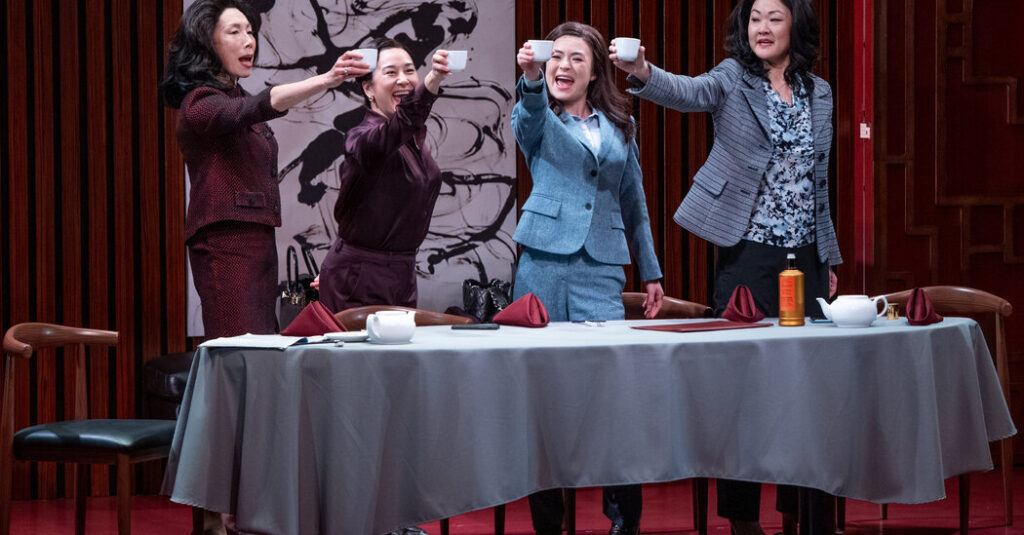
The world of finance can be a high-stakes game of professional snakes and ladders. When racism and misogyny are added to the working day, the battle to survive and thrive becomes even more perilous. Alex Lin’s satire “Chinese Republicans,” a Roundabout Theater Company production directed by Chay Yew, focuses on a group of four women — three Chinese Americans and one Chinese immigrant — caught in such a gyre at a large bank, the fictional Friedman Wallace.
Once a month the women gather as an “affinity group” in a Chinese restaurant to share experiences around work, identity, assimilation, sexism, generational difference — and, threaded throughout their zinger-peppered exchanges, the cost of professional ambition.
This play set in 2019 initially unites the women in pursuit of wealth and success: Earn big, strategize, don’t show weakness, and beat white men in positions of power at their own game. Is that “Republican”? Are they? The play’s title is a puzzle: Despite an occasional reference — criticizing President Obama’s “weird P.C. crap” and a character once voting Democrat — the play doesn’t dwell on ideology or political identities.
The group — they call themselves “Asian Babes Changing the Game” — is led by the briskly intense Ellen (Jennifer Ikeda), a 48-year-old managing director of the bank’s South American trading division. She’s also mentor to Katie (Anna Zavelson), a peppy 24-year-old senior research associate in wealth strategies who’s going places (seemingly without any need of Ellen’s help).
The imperiously chic Phyllis (Jodi Long), 65, was once Ellen’s mentor, and in a flashback we see this trailblazer telling a younger Ellen to jettison her Chinese-sounding first name, Ailin, and to quit wearing her “bleeding heart” on her sleeve.
Long plays Phyllis with a deliciously icy hauteur. “Are you sure she’s Chinese?” Phyllis asks of Katie. “She has a habit of being tardy.”
Iris (Jully Lee), a lead software engineer on an H-1B visa, seems to play the group’s Rose Nylund, but like her scatty “Golden Girls” counterpart, she’s also unexpectedly sharp, criticizing Ellen’s command of Mandarin as “so bad. It sounds like diarrhea in your mouth.” A flustered waiter (Ben Langhorst) is a sole, briefly seen man.
Wilson Chin’s austere design is enlivened by Hana Kim’s projections, especially effective when — in a quiz-show dream sequence — Ellen is introduced as “a proud divorcee and friendless since 2002,” who “loves spending her nights working in her office alone until her eyes bleed! In spite of single-handedly closing multimillion-dollar deals for Friedman Wallace, Ellen has never made partner. And she never will!”
Embracing and disavowing various identities proves pivotal in a play about how the women have managed their careers with a mixture of compromise, complicity and ruthlessness. Ellen sees something of herself in Katie and imagines a future firm led by them, though the dream quiz master, played by the excellent Lee, derides Ellen’s fantasies. “Look at her — tall, skinny, pretty,” she says of Katie. “She doesn’t even look Chinese! She looks French! You can still see the stench of Chinatown hovering around you.”
When Katie implausibly becomes a placard-waving, strike-supporting activist, inspired by a #MeToo experience endured by Ellen, Ellen isn’t thankful and instead sees it as a betrayal of her mentorship. But who and what is Ellen scheming so relentlessly for? Phyllis reaches her own moment of no return, after years of rationalizing and maneuvering around sexism and racism. She invokes the maxim, “You can have it all,” then adds mordantly, “As if somebody ever could.”
The play, first featured in Roundabout’s Underground Reading Series in 2024, suggests that sisterhood and shared heritage can be cherished, then too easily obliterated by ambition and professional survival.
For a satire, “Chinese Republicans” is told disappointingly straight. Stiffly mounted, it doesn’t fully explore its own extremes, especially in Ellen’s swings of behavior and belief. The formation and dynamics of a group of true “Chinese Republicans” would make for a more intriguing show. Instead the play fillets its important, though well-worn, themes of racism and misogyny rather than examining the grit and nuance of characters and relationships.
A quietly powerful final scene — revealing the reassertion of white patriarchy alongside one character’s weary determination to maintain her place within it — means “Chinese Republicans” concludes with a resonantly meaningful thud.
Chinese Republicans Through April 5 at the Laura Pels Theater, Manhattan; roundabouttheatre.org. Running time: 1 hour and 35 minutes.
The post ‘Chinese Republicans’ Review: These Women Are Playing to Win appeared first on New York Times.