Colman McCarthy, who trained as a Trappist monk before embracing a more worldly calling as a journalist and teacher, championing peace and nonviolence in a long-running Washington Post column and in classes he taught at high schools, colleges and a juvenile prison, died Feb. 27 in La Romana, a city in the Dominican Republic. He was 87.
The cause was complications from pneumonia, said his son Jim McCarthy. Mr. McCarthy, a longtime Washington resident, had moved to La Romana in recent years to live with another son, John.
Amiable and bespectacled, with the trim physique of a scratch golfer and 18-time marathon runner, Mr. McCarthy was among the more unorthodox journalists of his day. By the time he joined The Post in 1969 as an editorial writer, he had overcome a childhood stammer, played in two PGA tournaments as an amateur, spent five years in a monastery and worked as a speechwriter for Sargent Shriver, an architect of President Lyndon B. Johnson’s War on Poverty.
Over the next three decades, he gained a reputation as the “liberal conscience” of The Post, as Washingtonian magazine once put it, writing a syndicated column in which he urged readers to protest war, protect the environment, help the homeless and curb violence wherever they found it.
“He wrote about principles — peace and nonviolence — and he lived by those principles,” former Post publisher Donald E. Graham said in an email. “He made The Post better.”
He also had unusual range. Mr. McCarthy was the rare journalist who could share firsthand impressions of Thomas Merton, the Trappist theologian, and Arnold Palmer, the golf champion. He wrote a dozen graceful editorials about the changing of the seasons — one piece for each month, even dreary February (“a month not even the weathermen try to figure, much less the poets”) — and dispensed wry and gentle advice on golf, including in his book “The Pleasures of the Game: The ‘Theory Free’ Guide to Golf.”
But his primary focus remained peace, at home and abroad. Encouraged by editorial page editor Philip L. Geyelin, he sought to highlight solutions to society’s ills, rather than simply point out its problems.
“What should be the moral purpose of writing if not to embrace ideals that can help fulfill the one possibility we all yearn for, the peaceable society?” he wrote in his farewell column in 1996. “Peace is the result of love and if love were easy, we’d all be good at it.”
Mr. McCarthy profiled the condemned on death row and reported on midwives working with low-income families. He interviewed humanitarians and peace activists, including Mother Teresa and Desmond Tutu, and wrote many of their Washington Post obituaries.
A proud leftist — on the speaking circuit, he introduced himself as a pacifist, anarchist and vegetarian — he wrote with indignation about the country’s political establishment, referring to President Bill Clinton and American weapons manufacturers as “warlords.” Years earlier, he had decried the Persian Gulf War as “a coward’s war,” assailing the U.S. military for an aerial bombardment that was “about as surgical as operating on a cornea with machetes.”
“We say we love peace and democracy, but we are delusional, kidding ourselves,” he told Post columnist Courtland Milloy in 2020. “We are the world’s leading purveyor of violence, as Martin Luther King noted back in 1967. And it’s still true today. We have a violent government and endless wars. On the dollar bill, we put ‘In God We Trust.’ But that is a lie. It ought to read, ‘In Bombs We Trust.’”
Mr. McCarthy was a steadfast opponent of the death penalty and, to the consternation of allies on the left, abortion. He remained seated for the national anthem, which he considered “a war song,” and abstained from alcohol and coffee. On Halloween, he skipped the sweets, handing out potatoes, carrots or okra. Rather than drive to work, he biked, making his daily 10-mile commute on a Raleigh three-speed that he found as “sturdy as a Clydesdale horse.”
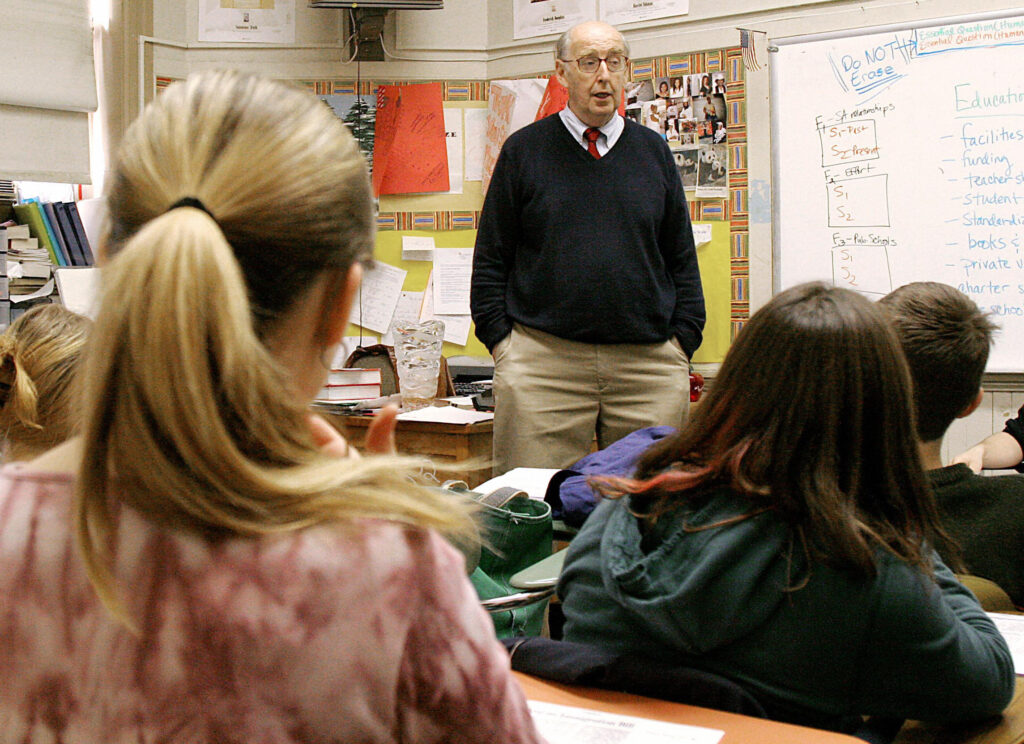
By the early 1980s, he had come to believe that American schools were failing children, teaching them about generals and military history instead of humanitarians and peace. While still writing, he began volunteering as a teacher, leading courses on peace studies at Washington-area colleges and high schools, including Bethesda-Chevy Chase High in Maryland and the School Without Walls in D.C.
“If we don’t teach our children peace,” he argued, “somebody else will teach them violence.”
To promote his ideas, Mr. McCarthy started a nonprofit, the Center for Teaching Peace. Although he continued to write, including through a column for the National Catholic Reporter, the organization became his primary focus after he left The Post in 1996, when the paper dropped his column. (Editors cited a decline in syndication numbers, which Mr. McCarthy seemed to take in stride: “Work for a corporation, and you play by its rules.”)
For years, Mr. McCarthy taught his peace courses at schools including the University of Maryland and Georgetown University Law Center, as well as the Oak Hill juvenile detention center in Maryland. Visiting speakers included his friend Joan Baez, the singer, as well as Nobel Peace Prize laureates Muhammad Yunus and Mairead Corrigan Maguire. Others were less heralded, such as a school maintenance worker who recounted how she had fled El Salvador when she was 14.
The classes, like Mr. McCarthy’s columns, proved to be an irritant for conservatives and other skeptics, even as Mr. McCarthy found plenty of well-placed backers. When American University announced in 1986 that it would drop him as a guest professor, 18 members of Congress wrote a letter to the school’s president defending the teacher, whose political views were said to have made faculty and administrators “uncomfortable,” according to a New York Times report. (He later resumed teaching at the school.)
“All I want to do is share my love of peace and offer my students the option that nonviolence is the most effective way to achieve it,” Mr. McCarthy said at the time. “I don’t care about producing smart kids, get-the-big-job kids, or be-famous-and-rich kids.”
He still turned out plenty of students who fit those categories. Mr. McCarthy’s pupils included future politicians such as Jim McGovern, a Massachusetts Democrat considered one of Congress’s most liberal members, as well as Mark Gearan, who became the director of the Peace Corps and president of Hobart and William Smith Colleges.
Mr. McCarthy “was one of the sturdiest and steadiest nonviolent activists I would call, either to give me inspiration or just to joke. He was a pillar,” Baez said in a phone interview. “Justice, peace, freedom — they can all get in a little pocket where you’re not living what you’re talking about. But with Colman, it’s just what he did.”
The youngest of four brothers, Colman Joseph McCarthy was born in Glen Head, New York, on March 24, 1938. He grew up in nearby Old Brookville, on the North Shore of Long Island, where his father represented working-class immigrants — many paid their legal fees with vegetables from their gardens — and served as the city attorney in Glen Cove.
When Mr. McCarthy was 16, his father died of a heart attack. Engulfed in grief, he took time off from school and adopted an ascetic lifestyle, paring down his diet and focusing on running and biking. When he resumed his studies, he concentrated on becoming a writer — a job that offered a quiet escape, as he saw it, from the stammer he had battled since childhood.
Mr. McCarthy inherited a love of golf from his father and earned a scholarship to Spring Hill College, a Jesuit institution in Mobile, Alabama, with 18 holes on campus. He studied English, though, by his own acknowledgment, he was a fitful student. After receiving a bachelor’s degree in 1959, he visited a Trappist monastery in Georgia, thinking he would stay a few days so that he could read in seclusion and go through some of the books he had skipped in college.
Instead, he stayed for five years of contemplation and silence, talking only to the dairy cows he was charged with milking twice a day. When he decided to leave and go into journalism, he got help from the abbot, who arranged a meeting with Atlanta newspaper editor Eugene Patterson — a future senior editor at The Post — that resulted in Mr. McCarthy’s getting hired on the sports desk of United Press International.
It was not an easy transition. Mr. McCarthy had been isolated for so long, according to family lore, that when he was working on a wrap-up of major league baseball games, he turned to a colleague and asked, “What are the Dodgers doing in L.A.?” (The team had moved from Brooklyn years earlier.)
Mr. McCarthy later reported on the civil rights movement, living out of a beat-up car while freelancing for the National Catholic Reporter. One of his articles was critical of Shriver, the director of the federal Office of Economic Opportunity, who spotted it and, according to Mr. McCarthy, sought him out for a job as an assistant. He was hired after a four-hour interview over dinner, during which they mostly talked theology — Merton, Pope John XXIII, Saint Teresa of Ávila.
Shriver became “my closest friend over four decades,” Mr. McCarthy said. He also introduced Mr. McCarthy to his eventual wife: Mavourneen “Mav” Deegan, a nurse he married in 1967. They shared an abiding Catholic faith but were an unlikely match, according to their son Jim, who described his mother as more of a “country club conservative.”
“They had a joke when people would ask them for an explanation, that their marriage was a kind of act of mercy, because ‘my spouse was so out of their mind that if it weren’t for me being married to them, they would be lost to this world,’” Jim McCarthy said. “We’d have Thanksgiving dinner, and my mom would be having turkey, scotch and a cigarette, and my dad would be talking about the ‘turkey holocaust’ with students who wouldn’t eat off a paper plate for fear of the forest. Radically divergent views were always tolerated.”
Mav McCarthy died in 2021. Survivors include their three children, Jim, John and Edward; and six grandchildren.
By 2020, when Mr. McCarthy’s teaching was interrupted by the coronavirus pandemic, he had reached more than 30,000 high school and college students through his classes, according to CBS News. He was still following the same method he had used for decades, giving no grades or exams but requiring students to perform a take-home assignment after each class.
“Your homework is to tell someone you love them today,” Mr. McCarthy would say. “And if you can’t find someone to tell ’em that you love them, look a little harder. And if you still can’t find ’em, call me up. I know where all the unloved people are. They’re everywhere.”
The post Colman McCarthy, who preached peace as a Post columnist and teacher, dies at 87 appeared first on Washington Post.