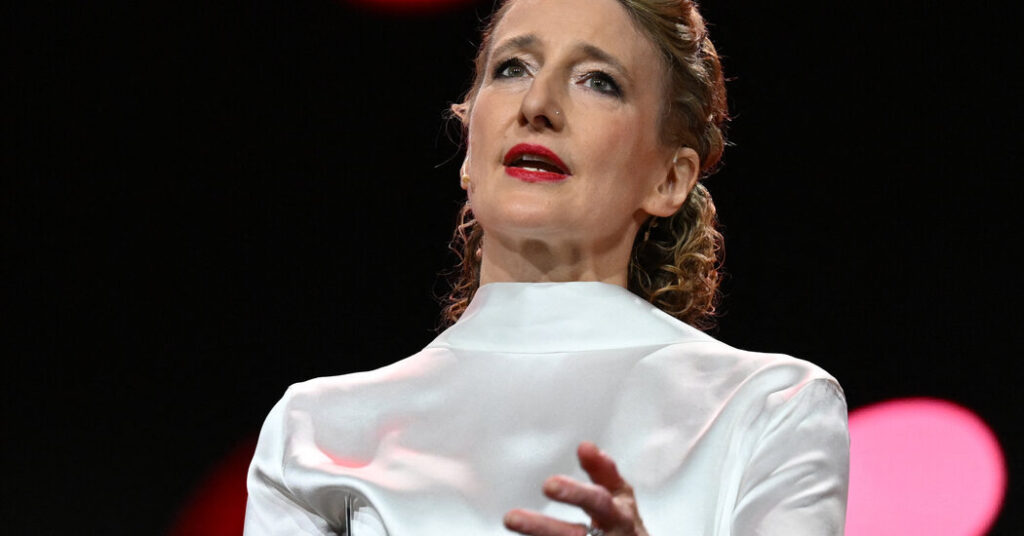
When Tricia Tuttle took over as the director of Berlin International Film Festival two years ago, it was clear that she faced a politically fraught task. The soft-spoken American, who had previously helmed the London Film Festival, was meant to revitalize the sprawling event, which has long been known for its politically minded program but had struggled to replicate the glamour of its main competitors in Cannes and Venice.
On one issue in particular, Israel’s military campaign in Gaza, Tuttle has had to walk a tightrope. Because the Berlinale, as the festival is known, is largely funded by the German government, she has had to navigate calls by lawmakers to limit attendees’ criticism of Israel’s actions, remarks that some officials see as antisemitic. At the same time, many artists were upset that the festival did not officially condemn atrocities against Palestinians like it had denounced Russia’s invasion of Ukraine and crackdowns against protesters in Iran.
This week, after several winners at the Berlinale’s weekend award gala criticized Israel during speeches, that tightrope threatened to snap. On Wednesday, the country’s news media reported that Culture Minister Wolfram Weimer had called an extraordinary meeting of the festival’s supervisory board, with many speculating that Tuttle would be fired over the comments at the gala.
The episode has thrown the Berlinale into one of its biggest crises in decades, with some observers arguing that Tuttle’s removal would irreversibly taint the festival’s reputation for free expression. Others wonder if the German government’s views on permissible speech, shaped by its sense of responsibility for the Holocaust and desire to stop antisemitism, make it impossible to run top-tier cultural events in the country.
A brief statement from the minister’s office on Thursday confirmed that the board had met and said that discussions with Tuttle “about the direction of the Berlinale will continue in the coming days.” It did little to assuage concerns, with some worried that the damage to the festival’s reputation is already done.
Karim Aïnouz, an Algerian Brazilian director whose “Rosebush Pruning” played in competition at this year’s festival, said the events reflected a “major crisis” for Germany’s cultural landscape. “It reflects the shaky ground in which critical cultural dialogue is happening right now in Europe and Germany.” He added that if Tuttle were let go, it could lead to a “boycott of the festival altogether.”
A culture ministry spokesman said that the meeting had been called for “multiple reasons,” but German media outlets speculated that it was prompted by remarks made at the closing gala by the Syrian Palestinian director Abdallah Al-Khatib, whose film “Chronicles From the Siege” won the top award in a section dedicated to debut films.
Onstage, Al-Khatib accused the German government of being “partners in the genocide in Gaza by Israel.” He said, “Palestine remembers,” and “we will remember everyone who stood with us, and we will remember everyone who stood against us.”
Carsten Schneider, the environment minister, left the event in protest. And Berlin’s mayor, Kai Wegner, later told the city’s Parliament that although the “Berlinale is a political festival,” in his view “antisemitism and hatred of Israel and Jews are not a political opinion.” He added that the ceremony “should not be used for such propaganda.”
A backlash was further stoked after Bild, a tabloid, published a photo of Tuttle with the “Chronicles From the Siege” team taken during the festival in which some of the filmmakers hold Palestinian flags and wear kaffiyehs, the traditional checkered scarves that are widely seen as badges of Palestinian identity. Although it is customary for festival staff members to be photographed with filmmakers at premieres, the tabloid called it a “propaganda photo.”
Tuttle declined an interview request via a Berlinale spokeswoman.
The mood at this year’s festival had already been tense, with its news conferences dominated by pointed questions about Gaza and the rise of the far right in the United States and Europe. That led Tuttle to release a statement reaffirming the event’s commitment to political dialogue but calling for a more respectful tone.
“People have called for free speech at the Berlinale,” it read. “Free speech is happening at the Berlinale.”
The speculation about Tuttle’s possible firing prompted swift responses from film and cultural organizations in Germany and abroad, including an open letter in support of the Berlinale as a “place of exchange” signed by figures including Tilda Swinton and the director Todd Haynes.
PEN Berlin, an organization dedicated to free speech, said in a statement that Tuttle’s dismissal would represent the “wanton destruction of the German cultural scene.”
Matthijs Wouter Knol, the director of the European Film Academy, which is based in Berlin, said in an email that even the discussion of Tuttle’s firing was “an absurd and dangerous signal.”
The German director Ilker Catak, whose movie “Yellow Letters” won the Berlinale’s top prize on Saturday, said in an interview that Tuttle had navigated political pressures with “fairness and grace” and that politicians who cannot “tolerate dissent” were “out of place in a democratic landscape.”
Catak said that if Tuttle were let go, he would never show another film at the event and the Berlinale would become a “government festival” that would likely be widely shunned. He added: “I guess they could show, I don’t know, harmless Bavarian movies of people yodeling or whatever.”
The post Are Germany’s Top Cultural Events Becoming Impossible to Run? appeared first on New York Times.