It’s my favorite “Star Trek” moment:
Shields are down, captain! We can’t take another hit!
In what seems like every movie or episode, whenever a federation starship is engaged in battle, its deflector shields are being raised or dropped or damaged by enemy fire to some oddly specific level (47 percent, say). It’s the stuff of high drama, when risk meets strategy to force a life-or-death decision. When shields are down, will the captain surrender, call for a shipwide evacuation or launch an ingenious counterattack?
I do not claim full Trekkie status, but I’ve been thinking about those shields as I watch President Trump’s second term. Trump seems to have his own set of deflector shields: his cabinet secretaries and other top officials, whom he uses to absorb some of the blowback from his most contentious policies.
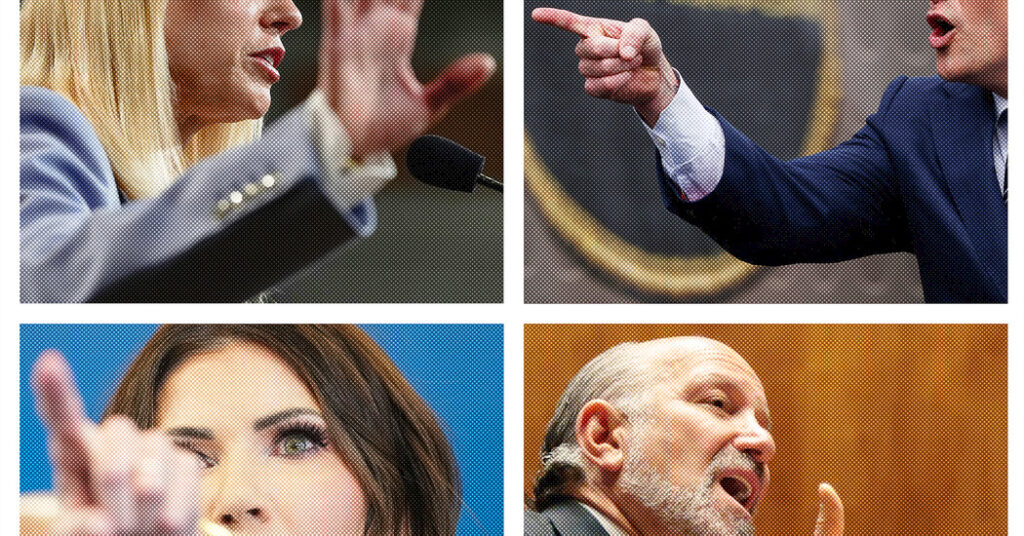
Kristi Noem, the secretary of homeland security, is a shield for the Trump administration’s brutal, sometimes fatal, immigration enforcement. Pam Bondi, the attorney general, is the face of the president’s efforts to exact prosecutorial vengeance upon his antagonists and to bypass such punishment for his allies. Pete Hegseth, the secretary of defense, embodies the administration’s crusade against diversity programs and its faux tough-guy persona. And Howard Lutnick, the commerce secretary, is the administration’s “tariff dealmaker in chief,” as The New Yorker put it, the implementer of the president’s stubbornly unpopular trade policies.
When the shields are at reasonable strength, they can keep taking fire, and the ship of state continues flying. But when the shields are battered and begin to malfunction, the entire enterprise is exposed. And right now, a lot of Trump’s shields seem to be faltering at once.
Cosplaying with cowboy hats and bulletproof vests, Noem oversees and defends the excesses of ICE and the border patrol, personifying all that has gone wrong with the Department of Homeland Security. The Wall Street Journal recently published an embarrassing exposé, which featured Noem feuding with senior officials and obsessing over her television appearances; and this week The Intercept reported that a story Noem has told repeatedly about an immigrant cannibal who began eating himself on a deportation flight was fabricated, citing federal law enforcement sources. The knives are out for Noem, not only from Democrats hoping to impeach her but from within the administration itself.
At the Justice Department, Bondi has done precisely as the president has demanded — investigating or indicting his political enemies, whether they are members of Congress, prosecutors, a former F.B.I. director or another official who served in Trump’s first administration. Yet the saga of the Epstein files hovers over her. In a spectacularly combative House hearing this month, Bondi refused to turn and face victims of Epstein’s who were present and apologize to them, and she derided members of the Judiciary Committee as “a failed politician” in one case and a “washed-up loser lawyer” in another. While the Justice Department can’t hire enough prosecutors willing to pursue her partisan agenda, Bondi melts down on live television.
Hegseth was damaged early on — by the damning personal revelations that surrounded his nomination, by the Signal-group-chat fiasco, and by his hectoring of top military officers regarding fitness and haircuts. But more recently, his missteps have escalated. First, with the strikes against suspected drug boats in the Caribbean (including a potential war crime that Hegseth blamed on the “fog of war”), and second, with the Pentagon’s approval of the use of a laser weapon by border protection agents, which resulted in the brief shutdown of El Paso International Airport. The “warrior ethos” that Hegseth purports to represent is morphing into the incompetence that one would expect when a Fox News host is tasked with running the Pentagon.
And Lutnick, already charged with pursuing the Trump administration’s tariff policy — which 60 percent of Americans dislike — is now known to have misled the public about his connections to Epstein, which were more extensive than the secretary had previously stated. (It seems Lutnick visited Epstein’s island and did business with him after he had supposedly cut off ties.) When Representative Thomas Massie, Republican of Kentucky, calls this government “the Epstein administration,” this is the sort of thing he’s talking about.
During his first term, Trump was quick to eject top officials who displeased or embarrassed him. By this point in his first administration, the president had already moved on from the national security adviser; the F.B.I. director and deputy director; the White House chief of staff, press secretary and chief political strategist; and the secretary of health and human services. (Soon to go were his secretary of state, his top economic adviser, his secretary of veterans’ affairs and another national security adviser.)
In the second term, by contrast, Trump has endured few major personnel losses. Mike Waltz was ousted as the national security adviser last year but received a consolation prize as the ambassador to the United Nations, while Elon Musk, who caused so much harm in his brief tenure as the head of the Department of Government Efficiency, departed the unpaid post when his time as a so-called special government employee ran out.
So, why does Trump seem less willing to dismiss top officials and advisers this time around?
Part of it may be pique. After Trump gave up on Matt Gaetz, his initial choice for attorney general, who withdrew from consideration in response to allegations of sex trafficking and drug use, the president became reluctant to buckle again. Backtracking on other cabinet choices, even dubious picks such as Hegseth for the Pentagon or Tulsi Gabbard as the director of national intelligence, might have signaled weakness, which we know this president cannot abide.
But there’s another explanation. When Trump cut loose senior officials during his first term, it was often because they espoused worldviews or priorities different from his own; in some cases, they obstructed his decisions or subscribed to norms he found useless and constraining. Remember Jeff Sessions, the attorney general whose unforgivable sin was to recuse himself from oversight of the Russia investigation, leading to the appointment of Robert Mueller as a special counsel? Or Rex Tillerson, the secretary of state who repeatedly clashed with the White House over policy? “We were not really thinking the same,” Trump explained to reporters when he pushed out Tillerson.
The offenses of Trump’s second-term cabinet members tend to be ones of loyalty or sycophancy, rarely of independent thought. Whatever damage the secretaries inflict on their country or their reputations is done on the president’s orders and on his behalf. In Trump’s first term, sacrificing cabinet members meant firing them, or pushing them to resign. In the second term, it means keeping them in the job for as long as those shields retain even marginal power.
The cabinet secretaries understand their purpose. Marco Rubio, the secretary of state (and national security adviser and onetime national archivist), is among the more respected members of the administration; he was confirmed in the post by a unanimous Senate vote, as Trump recalled in his State of the Union address this week. “People like you,” the president marveled, to Rubio, perhaps thinking of the contrast with his own weak approval ratings. But Rubio knows the deal, which Trump made clear when he mused about retaking the Panama Canal during his address to Congress last year. “Good luck, Marco,” he said. “Now we know who to blame if anything goes wrong.”
Cabinet secretaries have often taken the fall for the president they serve. Jimmy Carter’s entire cabinet and senior White House staff offered to resign in July 1979, hoping to re-energize his troubled presidency. (Carter accepted a handful of resignations and reorganized the White House, but he still lost to Ronald Reagan the next year.) And after the Republican Party suffered “a thumping” in the 2006 midterm elections, as President George W. Bush memorably put it, Donald Rumsfeld, the defense secretary overseeing the unpopular war in Iraq, quickly stepped down. (Stuff happens.)
Trump himself seems to be tiring of the cloying cabinet meetings, a staple of both terms, in which officials take turns gushing over their leader. (Personnel once meant policy; now it means flattery.) After he appeared to doze off at a recent gathering, Trump explained that it had gotten “pretty boring.” If affordability worries or violent immigration enforcement continue undercutting Trump’s standing, producing another midterm thumping for the Republicans this November, perhaps some of the cabinet secretaries will find the exits, no matter how fawningly they’ve praised Trump in public.
After all, it’s nice to have people to blame if anything goes wrong.
For the moment, though, Trump is sticking by his team, even those members who seem especially vulnerable. “Secretary Lutnick remains a very important member of President Trump’s team,” Karoline Leavitt, the White House press secretary, recently declared. “The president fully supports the secretary.” And at Homeland Security, a top spokeswoman, Tricia McLaughlin, is leaving, but not yet Noem herself, no matter that the department is so toxic on Capitol Hill that Democrats have blocked its funding.
The president can afford to dangle these battered shields by his side a little longer because he still has others at his disposal: a subservient congressional majority; a Supreme Court that, no matter its ruling on tariffs or on the deployment of National Guard troops in U.S. cities, still granted him “absolute immunity” from prosecution for official acts; and a vice president who will remain a trolling Trump loyalist as long as he thinks it will get him the Republican nomination in 2028.
For all the attention devoted to Trump’s deteriorating popularity, his public standing may not matter that much to him. Trump knows he is not going to appear on a ballot again; whatever the price for the incompetence of his cabinet or the venality of his administration, he will not be the one to pay it.
Trump’s approach to governance is entirely self-referential. His best protection may be his indifference to the plight of his party, of his potential successors and of his fellow citizens. That shield is always at maximum strength.
Source photographs, clockwise from top left, by Julia Demaree Nikhinson/Associated Press, Evelyn Hockstein/Reuters, David Dee Delgado/Reuters and Chip Somodevilla/Getty Images
The Times is committed to publishing a diversity of letters to the editor. We’d like to hear what you think about this or any of our articles. Here are some tips. And here’s our email: [email protected].
Follow the New York Times Opinion section on Facebook, Instagram, TikTok, Bluesky, WhatsApp and Threads.
The post The Shields Are Down, Mr. President appeared first on New York Times.