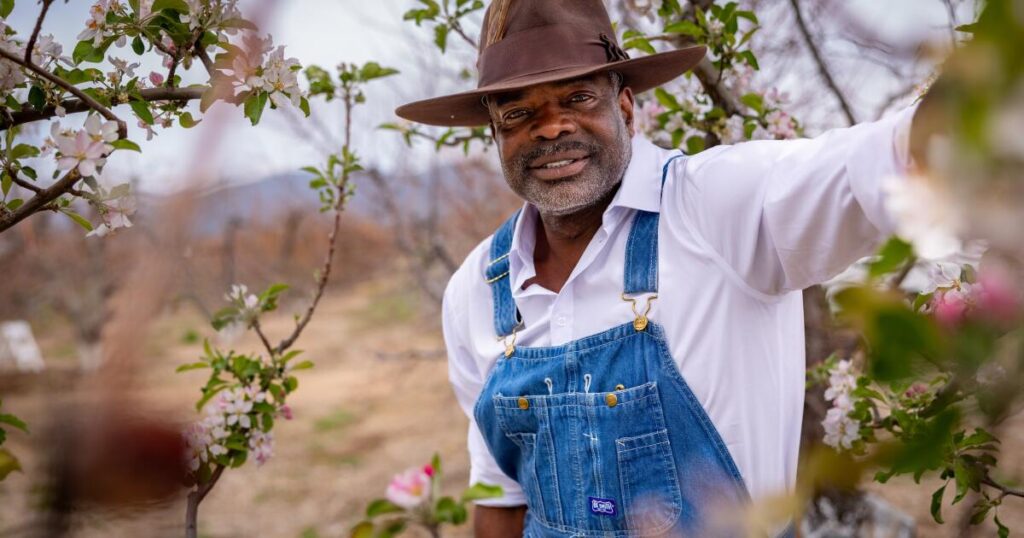
Upon exiting the 14 freeway to Bloom Ranch in Acton, a small unincorporated community on the northeastern edge of L.A. County, the landscape opens into high-desert quiet. Nestled here, amid dusty roads and long stretches of land punctuated by an occasional home, lies Bloom Ranch, a 250-acre expanse that became the largest Black-ownedfarm in the county when Dr. Bill Releford purchased it in 2023.
Neat rows of collard greens and kale stretch across irrigated beds, while orchards of peach trees — the ranch’s signature fruit — appear throughout the property. In just two years, the farm has become a beacon for Black Angelenos and visitors seeking community and a deeper understanding of farming.
The farmland was established in 1891 by Swiss stonecutter George Blum, and stayed in his family for five generations until 2018. Another farming family, the Zieglers, operated the ranch until Releford purchased it, and changed its name to Bloom Ranch in honor of the original owner.
Releford, a podiatric surgeon, singer and author committed to reconnecting communities to land and food, often reflects on whether his ancestors would be proud.
“The economic strength of this country was built on the backs of enslaved Africans,” he says. “As the third steward of this land, I think about in 1891, what was the condition of my people at that time? What was my great-great-grandfather’s life like? And I think, would they be proud of me knowing that their great great grandson, or child, has had the baton passed to him to manage a land of this magnitude?”
Visitors can explore Bloom Ranch through guided walking and driving tours that wind through orchards and fields while tracing the ranch’s layered history. Releford, or another team member leading the tour, shares stories of the original homesteaders, Black agricultural innovators and the land’s evolution over more than a century. Guests often reflect on their own family histories — land lost, traditions carried forward — and leave with a renewed sense of stewardship, Releford says.
Lavender grows in thick, fragrant patches along the tour route and is infused into soaps sold at the on-site store. Chickens roam a fenced enclosure, laying eggs that appear in dishes at Sunday brunch. Depending on the season, fields are filled with a variety of greens, cucumbers, eggplants, tomatoes and peppers, while herbs like basil, black sage, rosemary and marjoram perfume the gardens.
According to the 2022 USDA Census of Agriculture, Black farmers made up roughly 1.5% of all U.S. farms and operated about 0.6% of the nation’s farmland, a dramatic drop from about 15% in 1920. In California, the same census recorded only a few hundred Black farm operators statewide, among more than 60,000 farms.
The decline did not happen by chance. For over a century, Black farmers have been systematically denied loans, excluded from federal relief programs and pushed off their land through discriminatory policies and legal loopholes. At the same time, many Black neighborhoods were gravely impacted by redlining, divestment and freeway construction, severing economic stability and reducing access to green spaces and fresh food.
Against that backdrop, Releford’s stewardship of 250 acres carries meaning beyond agriculture. It reads as restoration.
“The innovations of Black agriculturalists like George Washington Carver and Fannie Lou Hamer inspire me every day,” he says. “Their work was always about more than crops. It was about empowerment and survival. Bloom Ranch embodies that legacy, honoring and applying practices like Carver’s crop rotation and soil health techniques.”
A family farm for the community
Born in Oklahoma on “a little cotton-picking town between Tulsa and Muskogee,” Releford was raised on a farm by his parents, grandparents and uncle. He made his first quarter picking cotton as a child.
“I remember my grandmother raising the chickens and the cows and the horses, and growing the greens, beans and sweet potatoes,” he says. “From a very early age, I was introduced to farming, having no idea I would lean into it the way I have.”
Releford later moved to Los Angeles, where, as a podiatric surgeon specializing in amputation prevention and limb preservation in high-risk populations, he saw firsthand how diet shapes long-term outcomes.
It’s an observation that later informed his book, “The Real Farm-acy: 5 Colors a Day to Better Health.” While hosting health fairs across Los Angeles County, Releford began incorporating farmers markets into the events, working with Black growers to increase access to fresh produce in neighborhoods where it was often limited. Those efforts eventually led him to purchase Bloom Ranch.
“One of the most unique things about Bloom Ranch is that in our entire 135-year history, pesticides have never been used here,” he says. “Our fruits and vegetables are grown naturally using time-tested methods like companion planting, selecting plant combinations that naturally deter pests and enrich the soil.”
The farm has inspired countless visitors to reimagine their relationship to food, such as one group of women who visited the farm to support a friend’s health journey after a breast cancer diagnosis. They all committed to sourcing their vegetables from Bloom Ranch as part of her healing process.
“Stories like that are just priceless to me,” Releford says.
The ranch offers produce boxes for purchase onsite and online, including subscription options, plus house-made pantry items — extra virgin olive oil, artisanal soaps, peach-and-vanilla spread, sun dried tomatoes, seasoning blends, essential oils and a variety of vinegars, all using ingredients grown on the ranch.
April Marie Holland, a self-care coach and host of the “Handle Her With Care” podcast, has found spending time at Bloom Ranch deeply restorative since her first visit in 2024.
“Being outside — with nature, food, and seeing all the different aspects of farming on the tours — it feels like warmth, it feels like care, and like this is a safe space for us to just be,” Holland said. “It’s deeper than just a shopping experience or a hangout. It feels like acceptance — like this is my family farm.”
Not only has Holland felt better physically, she credits grocery shopping at the ranch with sparking new excitement and creativity in her cooking routine. “I’ve never had a peach so good — they’re perfect. I made peach turnovers.”
Dr. Releford also runs the Food Is Medicine program, a collaboration with UCLA and Charles R. Drew University of Medicine and Science, which provides specialized produce boxes targeted to specific clinical needs. For example, a “stone box” for urology patients is packed with vegetables to help prevent kidney stones.
Jeron “Jax” Jackson, owner of Jax the Barber Lounge in Inglewood, drove more than 200 miles round trip from Moreno Valley with his wife to attend Bloom Ranch’s weekly Sunday jazz and Champagne brunch.
“I’ve never been to an establishment where the owner comes out and greets you and makes you feel welcome like you’re family,” says Jackson. “Just being able to relax and not have our guards up was really amazing.”
Bloom Ranch is a family affair. Releford’s children, nieces, nephews and cousins all contribute to its success. His daughter Akilah Releford-Gould, who has a thriving social media presence showcasing her homemaking and winemaking adventures, has become an integral part of Bloom Ranch’s online reach.
“Not everyone may have access to a ranch, but I feel like it could encourage people to say, ‘Hey, why don’t I check out my neighborhood farmers market or the closest farmers market by me?’” Releford-Gould says. She also lends her expertise to the family winery, Casa Locé in Ojai, which produces rosé and sparkling Chardonnay under her Lucky Girl label.
Every year, the ranch honors Black history with a Juneteenth celebration — Leimert Park drummers blessed the land during the 2025 event. Last year, the ranch threw a juke joint-themed Halloween party in honor of Ryan Coogler’s “Sinners.”
When contemplating the future of Bloom Ranch, Releford leans on the wisdom of the land. During moments of solitude, he says he feels the presence and wisdom of those who came before him.
“The guidance I need for the future is often already there, provided by generations past,” he says. “That living connection shapes everything we do and reminds me that farming is as much about memory and legacy as it is about food.”
The post At L.A. County’s largest Black-owned farm, healing grows from the ground up appeared first on Los Angeles Times.