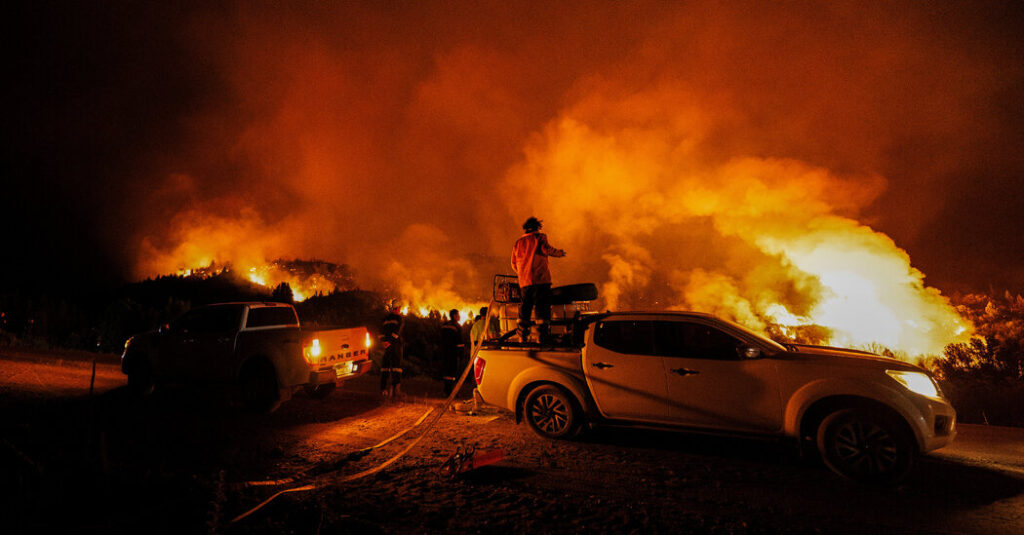
Converging wildfire seasons around the world are increasing the risk that firefighting agencies will be less able to share resources like ground crews and water bombers, according to a new study.
The study, published this month in the journal Science Advances, found that the extreme weather conditions that stoke wildfires around the world are happening on more days each year, causing fire seasons in different regions to overlap more.
“If a fire season is increasing and eventually overlapping, it will shrink the window of opportunity to help each other in terms of firefighting,” said Cong Yin, a climate scientist at the University of California, Merced, who led the new study. “These changes are attributable to climate change, so we need to mitigate climate change if we want to avoid this future.”
Different parts of the world have historically had wildfire seasons at different times, which has meant that states, provinces and countries can share firefighting resources. In January 2025, when wildfires burned around Los Angeles for three weeks, Canada and Mexico contributed firefighters and other resources. When Spain and Portugal were burning in 2023, countries as far-flung as South Africa sent help.
“Resource sharing can be quite beneficial,” said John Abatzoglou, a climate scientist at U.C. Merced and an author on the new paper. “If you’re unable to deal with a fire surge within a country, it provides some flexibility, a little insurance.”
Earlier research on how fire weather patterns have changed, and the consequent effects on firefighting, focused on specific regions or countries. The new study focuses on global patterns.
Dr. Yin and his collaborators used weather data from 1979 to 2024 and computer modeling to assess how many days per year different regions of the world had severe fire weather, when and where it overlapped, and what factors were responsible.
Overall, the number of days per year with extreme fire weather increased over the study period. South America saw the biggest increase in the number of severe fire weather days per decade, at about 17 days. The Middle East, North Africa and Central Africa also saw double-digit gains per decade.
Additionally, more regions were seeing severe fire weather simultaneously. Northern boreal regions have the highest number of days of severe fire weather that overlap with similar conditions in other regions. South America and Africa were the two areas with the biggest increases in simultaneous days of severe fire weather. And overall, North America, Europe, the Middle East and South America all saw big increases in the number of days with severe fire weather overlap, averaging 15 days of overlap per year.
The researchers attributed most of the patterns to human-caused climate change.
“Global warming is increasing the synchronicity of fire extremes at the global scale, that’s the main message,” said Andreia Ribeiro, a climate scientist at the Helmholtz Center for Environmental Research in Germany who was not involved in the study. “This is quite important for the management of firefighting resources.”
For now, the findings serve primarily as a warning, experts said; most country-to-country requests for firefighting resources can be met.
“We haven’t yet seen the full impact of climate change on fire because we’ve been quite successful in managing fire risk,” said Francesca Di Giuseppe, a meteorologist at the European Center for Medium-Range Weather Forecasts. “But the projections are for increased fire weather, even in moderate scenarios. So, whether our approaches are sustainable remains to be seen.”
The United States has already run into internal firefighting issues as a result of fire seasons overlapping.
“We’ve hit that limit a number of years, where we run out of resources and we have to say no,” said George Geissler, the top forester in Washington State who leads a national committee on managing wildfires. “You can only fight so much fire.”
A strain on resources inside any single country can easily ripple into others, in a kind of domino effect. If the United States doesn’t have enough resources to spread around internally, it wouldn’t be able to help if another country came calling. Extending that effect to every country that deals with wildfire reveals the scope of the problem.
Studies like Dr. Yin’s can improve fire forecasting and early warning systems, although local-scale modeling is typically required to make short-term predictions. They can help fire managers place teams where they need to be, before the first fires start, and inform investments in more firefighting resources. The European Union, for example, established its own fleet of firefighting aircraft and other resources after the devastating 2017-18 wildfire season that stretched country-to-country sharing thin.
The studies also serve as a warning about looming risks and the need to think proactively, not only reactively, when it comes to firefighting. As fire seasons get longer, the fire preparation season gets shorter.
Diversifying sources of firefighting crews and equipment, investing in more local firefighting resources that can quickly fight ignitions, and mitigating fire risk by managing flammable vegetation, building fire breaks and making homes more resilient to fire can all help states and countries stay ahead of the curve.
“The pressure is real and here, now,” Mr. Geissler said.
The post Wildfire Seasons Are Starting to Overlap. That Spells Trouble for Firefighting. appeared first on New York Times.