Hi, readers. We are taking a new approach to this long-running streaming list. Instead of four recommendations, I will look at a recent, buzzy true-crime documentary, docuseries, scripted series or podcast, and discuss what sets it apart, its turning point or its defining moment. Some spoilers below.
True-crime storytellers have long contextualized crimes through the places where they happened because exploring a crime’s physical surroundings is among the most accessible ways to offer depth.
But in recent years, the backdrops have become more like central characters in such documentaries, sometimes as much as the perpetrators and victims.
This shift helps to satisfy the fascination of true-crime enthusiasts who have always been drawn to the sites where terrible things happened, particularly when they are private homes: whether it be John Wayne Gacy’s house of horrors outside Chicago in the 1970s, the Los Angeles homes where the Manson family killed nine people in 1969, or the Ramsey home in Boulder, Colo., where JonBenét’s body was found in 1996. As distasteful as it might be, the addresses can become recognizable bits of pop culture.
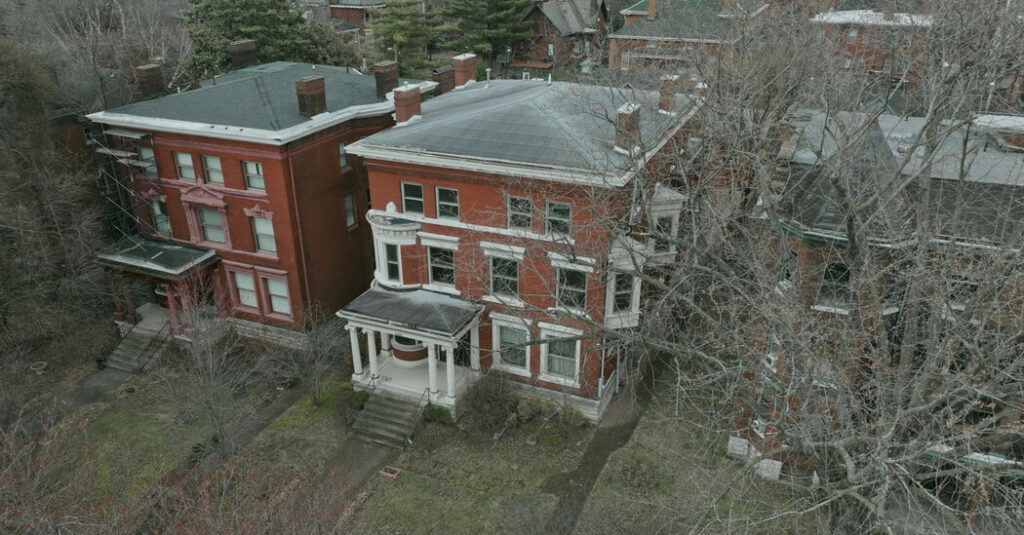
“Murder in Glitterball City,” a new two-part film on HBO from the directors Fenton Bailey and Randy Barbato, takes this phenomenon to a different level. The documentary is as concerned with telling the story of a bizarre crime as it is with painting a portrait of Louisville, Ky., particularly the Victorian neighborhood of Old Louisville and, more specifically, 1435 South Fourth Street.
It’s in that home where the body of James “Jamie” Carroll was found in 2010, entombed in a rubber bin buried deep in the dirt floor of the basement. Soon after the discovery, the homeowner, Jeffrey Mundt, and his ex-boyfriend, Joseph “Joey” Banis, were charged with Carroll’s murder. We learn a lot about Mundt and Banis’s destructive relationship and witness each accuse the other of the killing — first in footage from police interrogation rooms and then from the witness stands in each other’s trials.
This case, though, is only part of what the documentary is about.
Pegged to the book “A Dark Room in Glitter Ball City: Murder, Secrets, and Scandal in Old Louisville,” by David Dominé, we spend much of this film in Old Louisville, a neighborhood that has for decades served as an enclave for the city’s L.G.B.T.Q. community, which was rocked by the murder.
We meet a cast of eccentric characters who play an outsize role in the film even though most of them hardly, if at all, knew Mundt or Banis. At one point, the men are referred to as ghosts who had been living among them.
There is much talk of Old Louisville’s spooky past. During a scene filmed amid the neighborhood’s annual Victorian ghost walking tour — created by Dominé (another of his books is titled “Haunts of Old Louisville”) — amateur actors embody those who’ve died there. The event underscores the enthusiasm the locals have for its history and, maybe more so, its legends.
Information about the history of 1435 South Fourth Street itself is particularly haunting, quite literally. Though, as we quickly learn, when it comes to the area’s lore, facts are liberally embellished.
Perhaps the most confounding narrative is the not-insignificant amount of time we spend with the owners of a quirky Louisville institution: Little John’s Derby Jewelry. The couple, who are introduced in the first chapter of “A Dark Room,” have nothing to do with the case, but everything to do with the vibe — offering a gritty counterpoint to the manicured mansions of Old Louisville (though just as flush with Southern charm).
Still, the documentary checks many of the necessary boxes. We learn about Carroll himself, and visit his painful beginnings in an impoverished town in the Appalachian region of Kentucky, where he was abused at home for his sexual orientation but made a name for himself as a drag queen and beautician. We hear from friends, enemies and frenemies of Mundt and Banis. We get ample footage from their trials and from unearthed digital troves, including a videotape of Banis confessing that isn’t quite what it appears.
In all, the murder of Carroll reveals the bleak reality of a toxic relationship, drug addiction and the effects of a marginalized existence. When the documentary culminates in a stunning conclusion, the inconsistencies and imbalances of the U.S. justice system are on stark display.
But it’s clear that, no matter how unusual the case or how jaw-dropping the revelations, it was the neighborhood and those who inhabit it that captivated the filmmakers, who endeavored to balance telling the story of this crime and the story of the setting in which it happened.
“How are we going to make all this fit together?” Barbato, in an interview with Variety, recalled wondering as they made the documentary, a five-year process. “I don’t know if we did, but I do know we finished it.”
Maya Salam is an editor and reporter, focusing primarily on pop culture across genres.
The post ‘Murder in Glitterball City’ and True Crime’s Obsession With Location appeared first on New York Times.