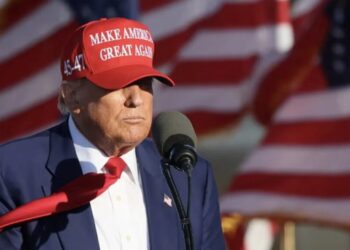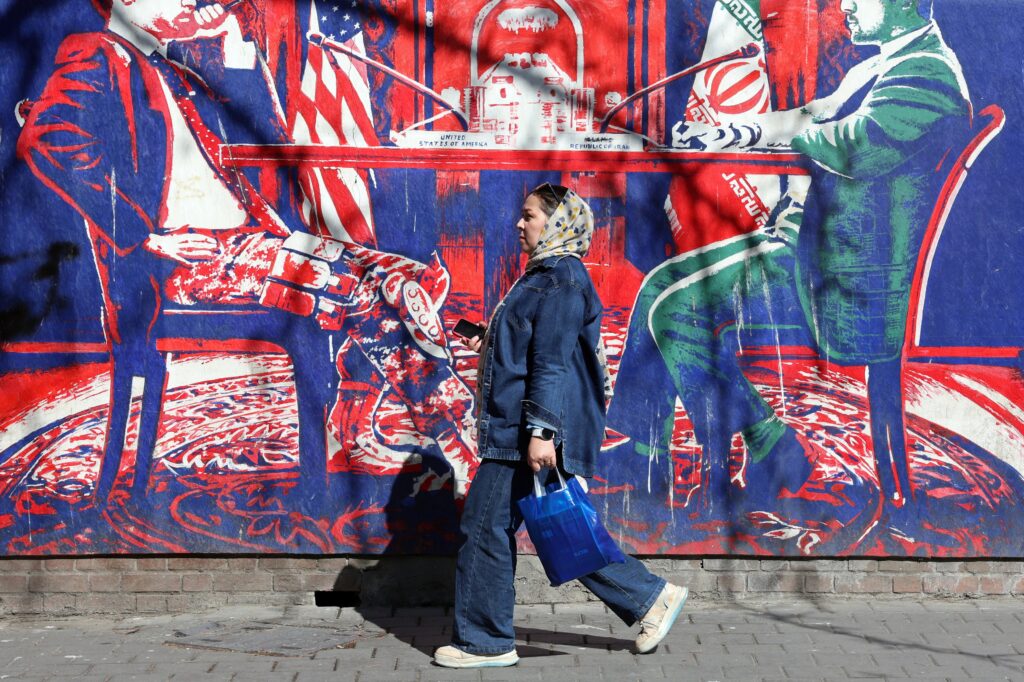
In his 1 hour, 47-minute State of the Union address, President Donald Trump spent three minutes on Iran. This is alarming because the United States seems on the verge of a war with that country, with little public discussion about it. The Trump administration has assembled the largest U.S. military force in the region since the Iraq War, deploying two carrier strike groups and at least 150 aircraft nearby. There are up to 40,000 American troops in the region. And yet the core of any successful military operation remains unclear and undefined — what is the objective?
In his State of the Union remarks, Trump seemed to suggest that the basic goal was to get the Iranians to say “those secret words: ‘We will never have a nuclear weapon.’” But the Iranians have said this repeatedly for decades. The Islamic Republic’s supreme leader issued an apparent fatwa in 2003 against acquiring nuclear weapons, and he has reiterated it many times since. That statement is reaffirmed in the first paragraphs of the Iran nuclear deal agreed to by the Obama administration and the government of Iran. If all Trump wants is a restatement of that position, this crisis should end quickly.
In fact, Trump wants something more than that. But what? Some in the administration say they want a destruction of Iran’s nuclear enrichment program. And yet, when the U.S. bombed Iran in June, the president loudly and repeatedly declared that he had “obliterated” Iran’s nuclear program. Was he mistaken? Or misleading us? If not, has Iran been able to rebuild its entire program in a few months under conditions of sanctions and bans, so much so that it requires a second set of massive bombings, these even more extensive than the first? It strains credulity to suggest that.
The Trump administration’s talks with Iran have mostly focused on the nuclear issue. The administration has had shifting red lines. Sometimes it has said Iran could be allowed to enrich — a right that many say every country has under the nuclear nonproliferation regime. Other times, top administration officials, such as Secretary of State Marco Rubio, have said no enrichment whatsoever would be acceptable. Rubio also said that the Islamic Republic’s refusal to discuss ballistic missiles — a separate issue — was “a big problem.” Administration officials have sometimes spoken of the need to limit Iran’s help to its allies like Hezbollah and Hamas. And Trump has in recent months said things that suggested his goal was regime change. What is the actual objective here?
Limiting Iran’s nuclear capabilities is one goal, which as Trump used to point out, has been substantially achieved by the bombings last summer. Hezbollah and Hamas are shadows of their former selves thanks to Israel’s devastating attacks on them. Iran’s military is in a weakened state with many of its leaders killed in the strikes. So is the real goal regime change? If so, it is highly unlikely to be achieved from the air. I cannot think of a single case in which a government fell without military forces on the ground actually doing the toppling. It is telling that longtime foes of the Islamic Republic like Saudi Crown Prince Mohammed bin Salman and the United Arab Emirates’ president, Mohammed bin Zayed al-Nahyan, have counseled caution, worried that unfocused military force could spiral out of control and destabilize the entire Middle East.
Even if the U.S. unleashes a devastating set of strikes that kill many top Iranian officials, including the supreme leader, the most likely result is that the Iranian military will take greater control of the society. In a war, soldiers rule. The mullahs may be pushed aside and Iran’s current hybrid regime — part clerical, part military — might give way to a more conventional officer-led government. That is an unlikely path to liberal democracy. But if democratizing Iran is the objective of the Trump administration, it should state it clearly, plan for it, help encourage an opposition, search for leaders and provide them with assistance. Bomb and hope is not a strategy.
The greatest theorist of war, Carl von Clausewitz, insisted that military might must be directed by a clear political objective. Fighting without that clarity, he explained, risks turning war into aimless violence whose results are decided by chance. Washington’s policymakers must pause and answer a simple question: What exact end-state are we seeking, and how will military action achieve it? Vague goals — “degrade,” “deter,” “change behavior” — invite mission creep. If the aim is to prevent Iran from developing nuclear weapons, then the goal is a deal with inspections to ensure that conditions are being met. (Yes, just like the one Trump pulled out of.) If the aim is regime change, then Washington needs to prepare for a full-spectrum strategy that accepts political responsibility for the aftermath. Anything less is a gamble with American troops and millions of people’s futures.
The post ‘Bomb and hope’ is not a strategy appeared first on Washington Post.