In the future that Elon Musk envisions, humans won’t just live on Mars.
They will also never have to work again. Money will be irrelevant. And everything they could ever want will be immediately accessible.
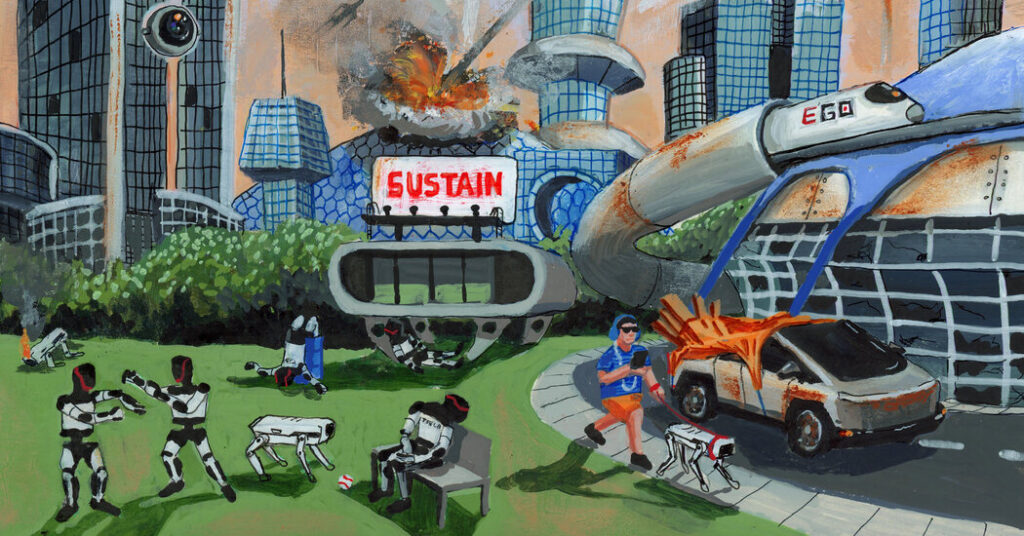
This is what Mr. Musk calls “sustainable abundance,” a post-scarcity society where humans have created technologies so ubiquitous and so powerful that they have eliminated the need for labor.
Over the past six months, the utopian phrase has become central to the billionaire’s businesses, belief system and lexicon, according to Mr. Musk’s social media posts and what he has said on podcasts and at company events. Now his electric carmaker, Tesla, is developing humanoid robots; his rocket company, SpaceX, is promoting orbital data centers; and his artificial intelligence start-up, xAI, is creating A.I. that Mr. Musk has said will solve most, if not all, of humanity’s problems.
“Sustainable abundance via A.I. and robotics,” Mr. Musk said at Tesla’s shareholder meeting in November, where he was backed by a large sign with the phrase. “That’s the future we’re headed for.”
Mr. Musk’s push for sustainable abundance is a window into what appears to be his rising techno-optimism. It is a major departure from his position a decade ago when he said unchecked A.I. would destroy the human race.
The concept gives Mr. Musk, 54, an organizing mission for his companies, which he can use to promote and expand his businesses through new technologies. It helps explain why Tesla is trying to shift from electric cars, where sales have flagged, to servant-like robots called Optimus. SpaceX, which merged with xAI this month, has said it wants to build A.I. data centers in space and “self-growing bases on the Moon,” as it prepares for an initial public offering that could take place as soon as June.
Robyn Denholm, Tesla’s chairwoman, told The New York Times in a recent interview that Mr. Musk’s goal of sustainable abundance was part of the board’s justification for awarding him a pay package that could turn him into the world’s first trillionaire.
Tesla wants to create a world where “goods and services are able to be produced in abundance,” she said. “It’s about increasing the productivity of economies.”
Not everyone is buying the billionaire’s vision.
Alex Imas, a professor at the University of Chicago’s Booth School of Business, said Mr. Musk, who ostensibly stands to benefit most from a society dependent on humanoid robots and A.I., has not explained how he plans to redistribute the supposed wealth that will be accumulated with technological developments. Eliminating people’s ability to work for income would also upend the dynamics of supply and demand, Mr. Imas said, leaving most of society reliant on the companies and executives who control the technologies.
“Who owns the capital?” he asked. “If we have the exact same policies and production frontiers expand, we would no longer live in utopia. We would be in a dystopian hellhole where demand would collapse.”
Mr. Musk did not respond to a request for comment.
Mr. Musk did not invent the concept of abundance. In the 1800s, Karl Marx dreamed of a world where capitalist principles would be transcended in favor of collective wealth generation for all, and John Maynard Keynes predicted in a 1930 essay that technological and financial advancement would usher in an era of human leisure and the 15-hour workweek.
Recently, the concept was featured in the venture capital firm Andreessen Horowitz’s “Techno-Optimist Manifesto” and by the New York Times Opinion columnist Ezra Klein, whose 2025 book, “Abundance,” written with Derek Thompson, argued that liberals should focus on big projects around housing, infrastructure and climate to unleash economic prosperity.
Mr. Musk, who is known for overly optimistic company targets and sometimes inaccurate predictions, has gone further. In September, Tesla unveiled its “Master Plan Part IV,” a road map for the company, which declared that “growth is infinite” and that its new motto was sustainable abundance.
“The tools we are going to develop will help us build the kind of world that we’ve always dreamed of — a world of sustainable abundance — by redefining the fundamental building blocks of labor, mobility and energy at scale and for all,” the document, which is light on details, said.
Since then, Mr. Musk has promoted the idea. In December, he wrote on X that the era of plenty would begin with double-digit growth “within 12 to 18 months.” At the World Economic Forum last month in Davos, Switzerland, he predicted an end to global poverty through A.I. and robotics. There will be “billions” of robots, he said, outnumbering humans on earth.
“The robots will actually make so many robots and A.I. that they will actually saturate all human needs,” Mr. Musk said. “You won’t be able to even think of something to ask the robot for at a certain point. Like there would be such an abundance of goods and services.”
Peter Diamandis, a friend of Mr. Musk’s and the founder of the XPrize Foundation, which encourages science breakthroughs through contests, said he had spoken with the tech mogul about abundance and advancing mankind.
Mr. Musk’s messaging around abundance is a push to “raise the floor” and create a more harmonious, “Star Trek”-like society through technology, said Mr. Diamandis, who wrote a 2012 book called “Abundance: The Future Is Better Than You Think.” He added that the billionaire just wanted to ensure that humans “have all the basics.” (On Mr. Diamandis’s podcast last month, Mr. Musk said that everyone would have “universal high income” and that saving for retirement would be “irrelevant.”)
“In the future, it’s OK to have multitrillionaires living on Mars, as long as there are eight billion people on the planet who have an amazing quality of life,” Mr. Diamandis said in an interview. “Will there still be a huge wealth gap? Sure. Does it matter, if everybody on the planet has access to whatever they need?”
In December, Mr. Musk changed Tesla’s mission from “sustainable abundance” to “amazing abundance” because the latter was “more joyful,” he wrote on X.
But such an era seems distant. Tesla’s Optimus humanoid robots have been displayed at company events but have shown limited mobility. SpaceX’s space data centers remain just a concept.
Senator Bernie Sanders, an independent of Vermont, said Mr. Musk had not articulated how his new society would function. If people do not work, Mr. Sanders said, there will be no way to pay taxes to fund a government or social programs that people rely upon.
“Who’s going to be distributing those checks?” Mr. Sanders asked. “Is it going to be Mr. Musk up there deciding how much you guys get? How much I get? How is that going to work?”
Jack Ewing contributed reporting from New York.
Ryan Mac covers corporate accountability across the global technology industry.
The post A World Where All Is Free? That’s Elon Musk’s Theory of ‘Sustainable Abundance.’ appeared first on New York Times.