It’s back to the repair shop for America’s lunar space program.
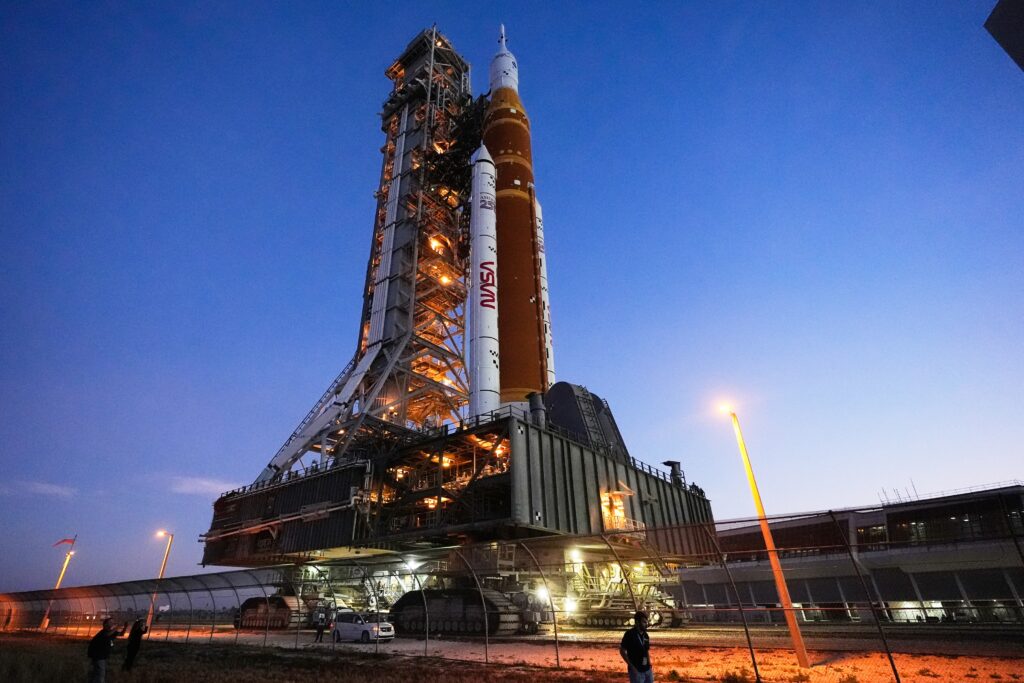
The 322-foot-tall Artemis II rocket was wheeled off the launchpad at Florida’s Kennedy Space Center this week and returned to its NASA hangar for inspections and repairs.
Plans for a March takeoff were disrupted when engineers discovered a problem with the flow of helium needed for propulsion.
NASA is now looking at an April launch at the earliest for its first crewed lunar flyby in more than a half-century.
Launch delays were widely expected for this high-risk mission, with its elaborate systems checks. Still, NASA Administrator Jared Isaacman has acknowledged that “people are disappointed.”
He noted in a Saturday message on X that NASA has previously experienced setbacks before successes, including ahead of the first moon landing in 1969. But he added that “expectations should rightfully be high after the time and expense invested in this program.”
NASA has already spent tens of billions of dollars on the Artemis program, and the agency estimated the price tag per launch at $4.1 billion.
Four astronauts are readying to travel via Artemis’s Space Launch System rocket and Orion spacecraft on a roughly 10-day mission around the moon. It is seen as a vital stepping stone for a future lunar landing — a mission that itself has been pushed back and is currently slated for launch “by 2028.”
The Artemis II rocket had been sitting on Launch Pad 39B for more than a month while NASA ran through tests known as “wet dress rehearsals.” These included fueling tests with liquid oxygen and liquid hydrogen.
Early this month, a practice countdown to launch was abruptly cut short at five minutes after the detection of a liquid hydrogen leak.
Working with hydrogen is tricky, John Honeycutt, the mission management chair, said at a press conference last week. “It likes to find leak paths. We’ve seen that throughout history.”
In 2022, NASA contended with hydrogen leaks with Artemis I — an uncrewed version of the same lunar mission. The leaks were handled, and the rocket had a successful launch. The spacecraft orbited the moon and safely splashed down in the Pacific Ocean.
For Artemis II, NASA officials said they fixed the hydrogen problem discovered in rehearsal, but by then a February launch was out of the question. The next window would be in March.
A second dress rehearsal in mid-February was a success. The Artemis II astronauts — Americans Reid Wiseman, Victor Glover and Christina Koch, along with Jeremy Hansen from Canada — were sent into quarantine to prepare for the anticipated green light.
“You know, every night I look up at the moon and I see it, and I get really excited because I can feel she is calling us and we are ready,” Lori Glaze, NASA’s acting associate administrator for the Exploration Systems Development team, said at last week’s media briefing on final preparations.
There were plenty of questions about how NASA dealt with the problems of hydrogen leaks and communications breakdowns that cropped up during the Artemis II dress rehearsals and the Artemis I mission. No one brought up any issues with helium.
But that is what ended up dashing NASA’s hopes for a March launch.
The gas is used to pressurize the rocket’s propellant tanks. It is required for the engines to function.
NASA experienced a similar problem with Artemis I, Isaacman said, but fixing “any of these issues can only be performed” in the Vehicle Assembly Building.
So Artemis II returned Wednesday to the VAB, a soaring structure that is among the world’s largest buildings.
Technicians will troubleshoot the helium issue and replace batteries throughout the rocket, NASA said.
The post What’s happening with NASA’s plans to return to the moon appeared first on Washington Post.