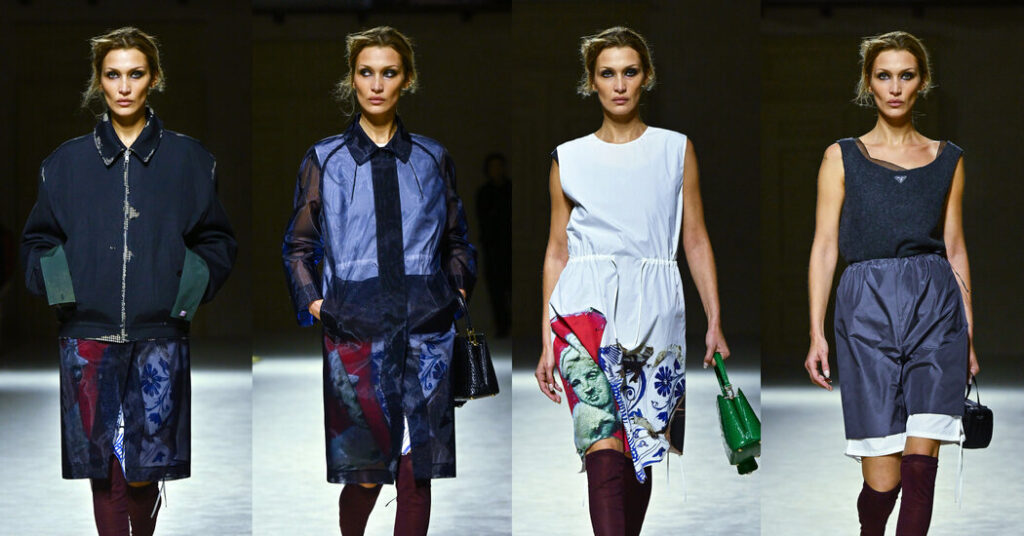
A week after testifying in a Los Angeles trial about tech addiction, the Meta maestro Mark Zuckerberg and his wife, Priscilla Chan, took their seats at the Prada show in Milan. It was their first appearance at fashion week. Speculation started almost immediately: Was this a sign of a new phase in the fashion/tech relationship?
Then the lights went down and the music came up, and afterward, all anyone could talk about was the clothes.
Not those worn by Mr. Zuckerberg or Ms. Chan. The ones on the runway. Shows can often seem like a delivery system for celebrity sightings, but this time it was the collection that mattered. That’s how good Prada was.
Come for the Marie Antoinette kitten heels dripping in beads, the chunky grandpa knits and full skirts ripped at the seams to show a second layer of florals peeking through. But stay for the ideas.
Hems were frayed and dangling threads; black dresses were ripped open to show Watteau prints underneath; wrinkles were perma-pressed into tweeds with lapels encrusted by beads. Were they fancy or falling apart? Why can’t they be both, the way a raspberry satin cocktail dress with a heavy-duty zipper up the front and what looked like sun-bleaching on one side could be utilitarian and frivolous at the same time?
Co-creative directors Miuccia Prada and Raf Simons were using a collection built in four layers to excavate the many strata of a woman’s life. Or, as Mrs. Prada said backstage after the show as she and Mr. Simons were mobbed by an over-excited crowd, “the continuous necessity of changing for all the different personalities, moments, sentiments, sexuality, a woman lives in a day.”
The result is a study of the way personal history is embedded in imperfection, how identities are built up over time and that no one is ever merely one thing or the other.
There were only 15 models in the show and each appeared four times, strutting down the runway in one outfit only to disappear backstage, shrug it off like shedding a skin, and emerge renewed to start the whole cycle again. That is, after all, how dressing works: You put on and take off a variety of pieces throughout the day depending on how you want to be seen and where you are going.
Imagine a varsity jacket worn over a floral skirt hidden beneath what looked like an overskirt of sheer black. Then imagine that the overskirt turned out actually to be a transparent black shirtdress, which turned out to be covering a Victorian cotton shift decoupaged with fragmentary images: Greek statues, Wedgwood porcelains, Art Deco etchings. That, too, covered a gray flannel tank top and gray cotton bloomers. Imagine leather car coats and tweed overcoats atop beaded skirts, and zip-up cardigans covering crisp cotton shirting. Imagine what you might add or subtract — and when.
That was just the most literal aspect of the layering, which also included meditations on rich and poor, opulence and simplicity, sportswear and couture, as well as reminders of shared history.
Those elaborately jeweled heels were worn with knee socks festooned with tiny rosebuds at the ankle and designed to be deliberately baggy at the calf; bulbous brogues had prescuffed toes; and knee-high lace-up boots were covered in feathers. Each piece on its own was compelling (OK, maybe not the undershorts, though TikTok might love them). But together they added up to something even more powerful: dress as a form of living anthropology.
“Every day, you decide: What do I do with what? What is possible? And then you do it in another way and another way,” Mr. Simons said. From that angle, every closet contains multitudes.
Vanessa Friedman has been the fashion director and chief fashion critic for The Times since 2014.
The post A Prada Show So Good, It Overshadowed Mark Zuckerberg appeared first on New York Times.