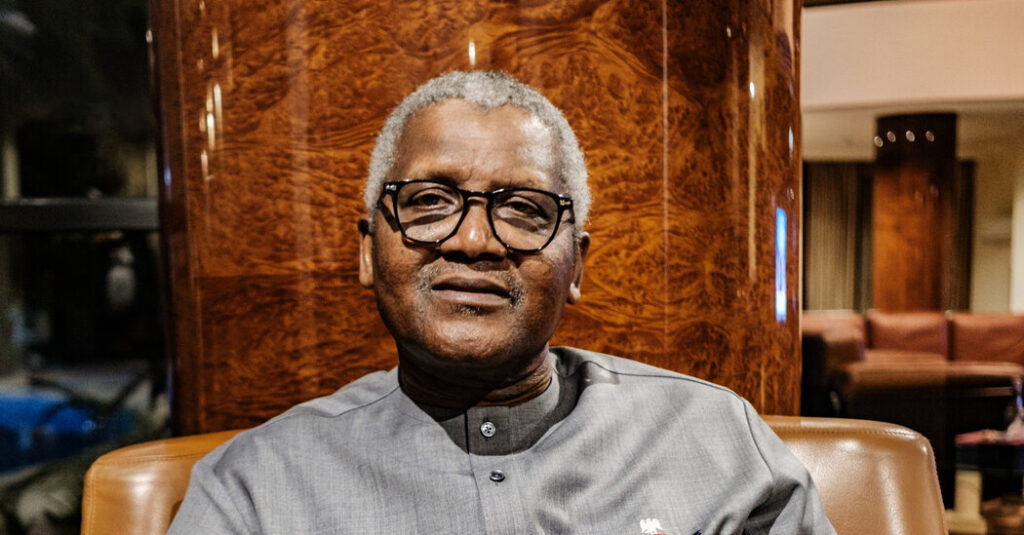
The richest man in Africa works from a construction trailer in a dusty parking lot.
The billionaire, Aliko Dangote, said he once had multiple homes in several countries, a nightlife of fancy parties, a Rolls-Royce and a Ferrari. Then, roughly two decades ago, he got serious about industrialization, he said.
Mr. Dangote, now 68, said he sold the cars and the homes abroad and built sugar refineries. He bought a majority stake in a salt-refining company. He built cement factories, first across Nigeria, then in Senegal, Ethiopia, Tanzania and beyond. Then came fertilizer and polyurethane factories.
This work of proving the continent is capable of large-scale industrialization done by one of its own was much more important to him than the life of luxury.
“Some of us,” he said, “need to rescue the country.”
Now, Mr. Dangote’s latest achievement is finally up and running: a sprawling new refinery in Nigeria, a nation that for decades has exported the vast majority of its crude oil.
Long criticized as a monopolist in the industries he focuses on, the man whose grandfather made his fortune in peanut trading doesn’t want to stop with oil, or even with Nigeria. Mr. Dangote wants to break into the steel industry, to spread electricity to more people, to build more ports — to industrialize all of Africa.
His role model for future expansion is the Indian multinational conglomerate Tata Group, which produces things like black tea and semiconductors.
His factories, he said, will also help curb joblessness amid Africa’s youth boom. In Nigeria, the most populous nation on the continent, 40 to 50 million people will need jobs by 2030, according to the World Bank.
Already, his refinery is producing 650,000 barrels of crude oil per day. Mr. Dangote says that output will be double in the next year.
He announced over the weekend plans to list shares in the refinery locally. But first, he needs to solve infrastructure problems and address corruption in the oil industry, both of which stand in the way of bringing enough of the nation’s ample supply to his refinery, he said.
Until then, his refinery, a labyrinthine behemoth on a campus about 45 miles from his company’s Lagos headquarters, has sometimes supplemented Nigerian crude with imports from the United States and other countries.
On a recent afternoon at his industrial campus, a fidgety Mr. Dangote was seated at a long table in a trailer, ushering in his next appointment before the previous one was finished. There’s not a minute to spare while trying to conquer Nigeria’s biggest problems.
Mr. Dangote dreams of a day when gasoline courses through his country’s veins so fluidly that no one has to endure the long lines that have plagued Nigeria, where gasoline deliveries are hobbled by bad roads and illicit sales.
Current and former colleagues use the same word to describe Mr. Dangote: hard-working. Bucking traditional gender norms, he has given executive-level roles to his three children, all daughters.
Some of Mr. Dangote’s indulgences come through in his work. He throws lavish company parties, where he gives away prizes like vehicles to top employees and top customers. Clips of him clapping and singing along to performers circulated online after the annual party for his cement business last month.
Mr. Dangote, who is divorced, likes to spend time with his eight grandchildren, and says his idea of a vacation is doing “normal person” things, like going for a jog or window shopping at a mall.
For years, he would unwind after the workday by inviting friends to his house, a mini-mansion on Victoria Island in Lagos, replete with mahogany-colored pillars, an aquarium in the dining room, a pool and giant terraces. (He also owns a home in Kano and rents a home in Abuja.) But recently he decided to pare back his social life to a tight, weekends-only schedule from 4 p.m. to 10 p.m. on Saturdays and noon to 10 p.m. on Sundays, he said.
“Work and fancy life, they don’t go together,” Mr. Dangote said. “So, we have to sacrifice to a point.”
His workday often continues at his home, where on a recent evening Mr. Dangote, in a gray caftan and pants with the Dangote Group logo on it, nestled in a brown leather couch pit in his living room. A box of Rice Krispies was on a dining room table, and the TV was tuned to CNN. He nibbled dates as he met with workers who oversee operations for his three corporate jets.
Mr. Dangote, whose fortune Forbes estimates at $26.2 billion, has built his empire on manufacturing the basics.
Unlike other multinational chief executives who are thinking about remaking their entire industries to support future innovations, he said he is focused on the tasks before him, skeptical of some newfangled technology. He compared the hype around artificial intelligence to the cheerleading surrounding the release of the first Nokia phones, which are becoming obsolete.
“This field is getting, you know, out of hand,” he said.
Nigerian anti-graft officials in 2023 accused Mr. Dangote’s firm, along with 51 other companies, of receiving preferential foreign exchange rates from a former Central Bank chief. Mr. Dangote himself was not implicated, and his company has denied wrongdoing.
Critics complain Mr. Dangote has a near-monopoly on many of the staples of life. Almost any construction site in the country is scattered with bags of Dangote-branded cement; grocery shelves are stocked with Dangote-branded flour and sugar. His wealth, critics say, was built on government subsidies and tax breaks.
Mr. Dangote insists he merely took advantage of what government officials offered, because he is building up the country.
“Nobody dared to do it, so we did it,” he said.
His chief example is his $20 billion refinery. The tax-subsidized zone where Mr. Dangote built the complex turned out to be swampland, something he did not know until construction started in 2016.
He pushed on, clearing the land and backfilling it with 65 million tons of sand. He imported 10,250 trucks from China after he couldn’t find a Nigerian firm with a big enough inventory, then built a jetty for ships to unload them, he said. He built a 23-mile, 10-lane expressway leading from the refinery to a port, using tax credits to finance the construction.
“The luck that we had, both me and my executive team, is that we didn’t know what we were doing,” he said. “We said that, ‘No, we cannot fail, we must deliver.’”
The poor state of Nigeria’s roads is one challenge of getting crude to the refinery. A bigger challenge, Mr. Dangote said, is corruption. Middlemen reroute crude, with trucks sometimes disappearing across the border where thieves sell the fuel and pocket the cash.
He has launched a legal and public relations battle against what he calls the “mafia situation” in Nigeria’s oil business, suing the Nigerian Midstream and Downstream Petroleum Regulatory Authority, which regulates and licenses refining activities. He said the regulator was favoring imports more than domestic production and implied that its chief executive, Farouk Ahmed, was illicitly skimming profits, which Mr. Ahmed has denied.
The public glimpsed a gloves-off side of Mr. Dangote in a December news conference, where he listed each private school that the children of Mr. Ahmed attended in Switzerland.
“Four children in the most elite schools in the world,” Mr. Dangote said, still in disbelief. “I sent my own daughters to secondary school in Nigeria.”
Mr. Ahmed, in a December statement, said the tuition was paid for in part by scholarships and with money from his own father. Mr. Ahmed said his personal and professional activities “will withstand any legitimate inquiry.”
Mr. Dangote’s oil ambitions hit a snag last year after some 800 workers were fired because of sabotage allegations, triggering union protests. The workers were eventually reinstated.
The refinery employs 30,000 people, about 80 percent of whom are Nigerian. Many managerial positions are held by international workers, which Mr. Dangote said would change in time as he trained more locals. His expansion plans will increase the work force to about 65,000 people, he said.
In December, Mr. Dangote’s foundation announced plans to offer 45,000 scholarships, 10,000 of which will be exclusively for female students in secondary school or college.
“What’s our legacy?” he asked, posing a question to himself. “Our legacy is to provide what we need.”
Dionne Searcey is a Times reporter who writes about wealth and power in New York and beyond.
The post This Billionaire Traded Glam for a Mission to Industrialize Nigeria appeared first on New York Times.