When my 89-year-old father told me that he heard I “went virus,” I gently corrected him.
“I didn’t go virus,” I said. “I went viral.”
A small distinction, the kind that usually doesn’t matter much in families like ours, where misunderstandings have had a way of calcifying into permanent shapes. But this one mattered to me. “Virus” suggested contagion, danger, something to be contained. “Viral” suggested — well, not fame, exactly, but recognition. A sudden flicker of being seen.
I had rehearsed this visit in my head on the drive from downtown San Antonio, where I lived, to his gated community 30 miles north. I always did. Keep it light. Don’t provoke. Don’t correct too much. Don’t expect anything resembling emotional fluency. The rules were internalized long ago, as reliable as muscle memory. By the time I pulled into his driveway, I felt steady. I was good at being the version of myself my father could tolerate.
As a child, I absorbed quickly what moved my father and what didn’t. He responded to achievement, order, restraint. He had little patience for emotional mess, least of all his own. When I was upset, he told me to calm down. When I was excited, he told me not to get ahead of myself. Love, in our house, arrived indirectly, through provision, rules and an insistence on self-control. I learned to translate myself into a language he might understand, and when that failed, I learned silence.
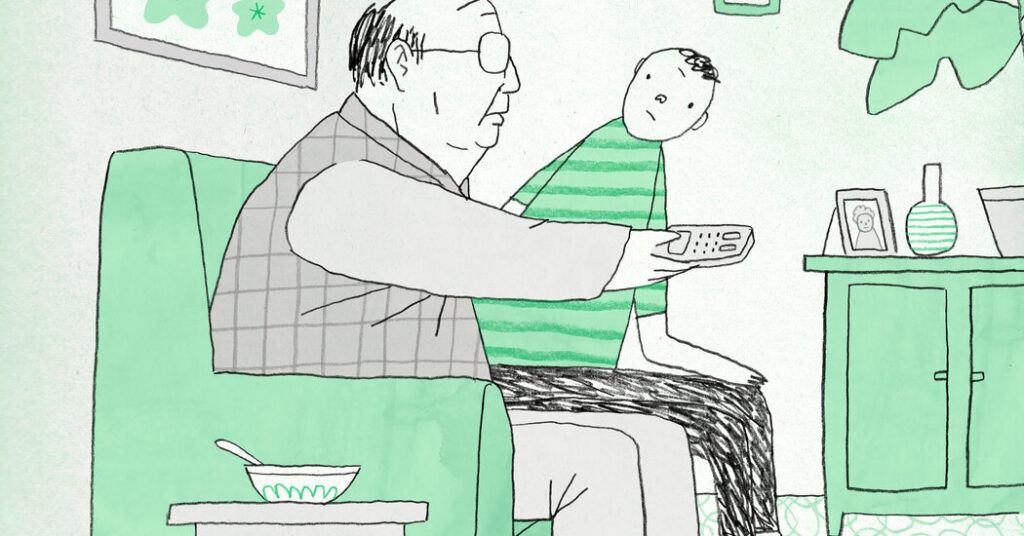
We were sitting in his living room on a Sunday afternoon, the television dark, the windows washed in thin winter light. At 89, my father’s world had contracted. The days were organized around meals, medications and the phone calls he still answered. The house, once loud with argument and authority, now felt paused, as if waiting for instructions that never came.
I had come to see him out of a sense of filial duty that I no longer tried to dress up as enthusiasm. After everything — my mother’s death, the years we didn’t speak — I had learned to manage visits carefully. I arrived with modest expectations and an exit plan. This was how love functioned now: measured, cautious, survivable.
“Your brother said you went virus,” my father repeated.
“Viral,” I said again. “On Instagram.”
That stopped him. My father, who still referred to the internet as “the web,” leaned forward slightly. “What’s Instagram?”
I hesitated. I could already feel the familiar irritation warming up, the reflexive knowledge that anything central to my life would be treated as marginal, anything emotional as indulgent. When I was young, we fought constantly. In my teens and 20s, we butted heads with more eloquence but no less force.
He had strong ideas about who I should be, how I should live and what counted as seriousness. I had equally strong ideas about his marriage to my mother, the way he spoke to her and how casually he withheld affection, as if love were something you rationed for discipline’s sake.
After my mother died in 2016, my resentment hardened into something quieter and more permanent. We stopped speaking. I told myself it was principled, necessary. I told myself that adulthood meant choosing distance over damage. Still, there were moments (holidays, birthdays, idle afternoons) when the silence felt less like protection and more like a refusal to keep hoping. And I missed him.
Over the years, I made tentative attempts to let him see pieces of my life. I downloaded books I loved to his Kindle. I shared articles that mattered to me. Once, years earlier, I tried to explain what it felt like to love another man — not politically or abstractly, but personally, bodily, with longing. Each attempt landed with a thud, acknowledged politely and then set aside. Eventually, I learned to stop offering.
“It’s not really for you,” I said finally. “Just videos.”
“What kind of videos?” he asked.
I told him about the Reel I had posted — how I’d talked about a television show that had moved me more than I expected, how I’d cried while recording it, how it had been shared and watched by tens of thousands of people. I said the show was called “Heated Rivalry,” a queer hockey romance adapted from Rachel Reid’s books, about two men whose rivalry gives way to something more vulnerable and harder to defend against.
I said this carefully, trying not to sound as if I were asking for approval. I had, I believed, given up on that a long time ago.
He listened without interrupting. When I showed him the Reel on my phone, he leaned in, squinting, his face inches from the screen. I watched him watching me — my voice, emotion and vulnerability flattened into 60 seconds. I braced myself for the deflection, the joke, the comment that would let him stay emotionally adjacent and untouched.
Instead, he said nothing.
When the Reel ended, he looked at me, not with embarrassment or confusion but with a kind of alert curiosity I hadn’t seen in years.
“What’s the show about?” he asked.
I told him again. Two men. Hockey players. Rivals. Love. I waited for the reflexive discomfort, the quick subject change. My father was a man of his era. Feeling — especially feeling that didn’t resemble his own — had always made him uneasy.
“I want to watch it,” he said.
I laughed, assuming he was kidding. He wasn’t.
A few minutes later, we were sitting on the couch, a queer hockey romance on HBO Max flickering between us like an emissary from a world neither of us had fully known how to enter. As the episode unfolded, I felt myself tense, not because of what was onscreen, but because of what was at stake. Watching meant letting him see me wanting something. Letting him see tenderness without irony. Letting him witness a version of masculinity that wasn’t armored, competitive or withholding.
The room filled with the sound of skates carving ice, the low thunder of crowds, the awkward magnetism of two men circling each other, unsure whether what they felt would be returned.
I stole glances at my father while we watched. His posture, usually stiff, softened. His face, so often armored with skepticism, began to register surprise. Halfway through, he got up to get a glass of water but came right back. I thought I, and the show, had lost him.
When one of the characters finally said what he had been holding back — said it plainly, without irony or retreat — my father made a small sound. A breath, maybe. His hand tightened on the armrest as if he needed something solid.
After the episode ended, the room felt altered.
“I didn’t know,” he said at last.
“Didn’t know what?” I asked.
“What it was like,” he said. “For you.”
The sentence sat between us, unmistakable. I thought of all the years I had spent wanting this, wanting him to see me not as a problem to be managed but as a person whose inner life mattered. I told myself I no longer needed that recognition. That I was past it. That maturity meant release.
And yet my body reacted before my philosophy could intervene.
We talked afterward about my life now and how his was slowing down. But not completely. He had gardening to do. He had brioche rolls to make. Nothing miraculous happened. The past didn’t dissolve. Our history remained complicated, incomplete. But something tiny loosened.
Later that night, after I went home, I found myself replaying the afternoon with a precision that surprised me. The way he leaned forward, how his voice softened and how he had reached for the armrest as if bracing himself against feeling. At 89, there is no illusion of endless time. There is only what can still be said and felt, and the narrowing space in which to say or feel it.
As I was leaving, my father stopped me.
“I’m glad you went viral,” he said. “I’m glad people are listening to you.”
Driving home, I thought about how love often arrives late, when both people are finally tired enough to stop defending themselves. I thought about the word virus, how close it was to viral, how both imply spread, transmission, contact. I thought about how love works the same way, as something that moves unpredictably between people, finding openings where it can.
A queer hockey romance didn’t fix my relationship with my father. But it created a moment of shared attention, a brief realignment of feeling, a recognition neither of us had known how to ask for. And sometimes that kind of love, I’m learning — the late, imperfect kind — is enough.
David Samuel Levinson is a writer in San Antonio whose latest novel is “Tell Me How This Ends Well.”
Modern Love can be reached at [email protected].
To find previous Modern Love essays, Tiny Love Stories and podcast episodes, visit our archive.
Want more Modern Love? Watch the TV series, sign up for the newsletter and listen to the podcast on iTunes or Spotify. We also have two books, “Modern Love: True Stories of Love, Loss, and Redemption” and “Tiny Love Stories: True Tales of Love in 100 Words or Less.”
The post How ‘Heated Rivalry’ Thawed the Chill Between My Father and Me appeared first on New York Times.