William Shakespeare’s “Richard III” is a brutal play — brutal to watch and just as brutal to stage.
An overwhelming handful, this early history play retains its popularity largely through the audacious villainy of its title character, one of Shakespeare’s most flamboyant sadists.
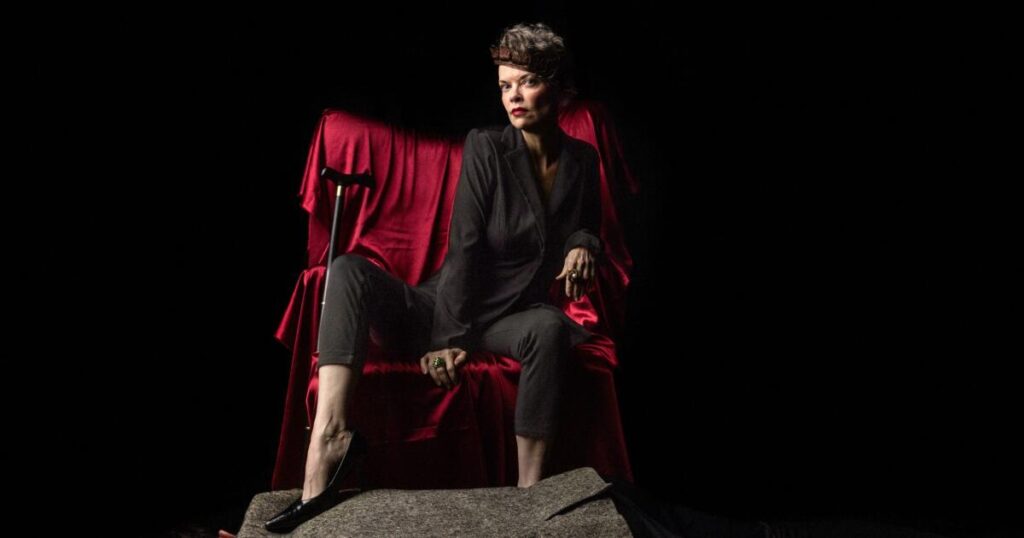
In Guillermo Cienfuegos’ enlivening, if at times unsteady, production at A Noise Within, the role is played by Ann Noble, who forgoes the outdated hunchback but adopts a seething, slithering, perversely seductive aura of menace. Smoking in a raffish suit like a film noir baddie with a shock of red hair ready to torch the world, Noble’s Richard employs a dusky, ironic voice to flaying effect.
Like Iago, Richard confides his schemes to the audience before enacting them. A master manipulator, he’s both a playwright and an actor, constructing scenes that might seem impossible to pull off, then delivering a virtuoso performance that leaves everyone flabbergasted by his success.
One such scene involves his wooing of Lady Anne (Erika Soto). During the funeral procession for King Henry VI, she is accosted by Richard, who murdered not just her father-in-law, whose coffin she’s accompanying, but also her husband.
How could this snake have the effrontery? More puzzling still, how in the world could this monster, self-described (in his opening soliloquy) as “deformed, unfinished” and so badly made up that dogs bark at him, convert her hate into acquiescence, if not lust?
Noble makes Richard’s conquest not only convincing but something of a sport. He delights in his mastery of the battlefield, military or civilian, flexing his psychological muscles with a sociopath’s defiant swagger.
The women in the cast are the great strength of Cienfuegos’ production. Noble, of course, is first in line for praise. But there’s also standout work from the actresses playing female characters, among them Lesley Fera’s bereft Queen Elizabeth, Veralyn Jones’ embittered Duchess of York (Richard’s horrified mother), Trisha Miller’s curse-spewing Queen Margaret and Soto’s self-disgusted Lady Anne.
Intimately acquainted with Richard’s malignity, these ruined royals know only too well the toll of his depraved machinations. Their grief and fury set in motion the countervailing force of justice that, no matter how belated, cannot be denied.
The staging, arranged around striking tableaux, is at once cinematic and fleetly theatrical. Christine Cover Ferro‘s costumes situate the jockeying courtiers in a vintage 20th century underworld. Projection designer Nick Santiago fleshes out Angela Balogh Calin‘s stripped down scenic design, which combines Elizabethan simplicity with modern rough edges. The scene in the final act, in which Richard, preparing for battle against his moral antithesis, Richmond (Wes Guimarães), is confronted by the ghosts of his victims, plays out like a digital nightmare.
A mountain of chairs set against the backdrop of a tarp curtain is the starting point for a production that recaps Shakespeare’s War of the Roses saga. This preface, which harks back to “Richard II” and “Henry IV, Parts 1 and 2” in addition to the three parts of “Henry VI” that immediately precede “Richard III,” crowds an already crowded plot. “Richard III” is a bear of a play and adding context that could have been bullet-pointed in the program only compounds the challenge of getting through the plot.
I appreciate the performers not wanting to belabor their lines. Mark Rylance’s complaint that Shakespeare’s words are being uttered too slowly by contemporary actors is well-taken. But the hurtling pace of the cast, combined with some misguided blocking that has characters speaking at points with their backs to the audience, makes comprehension more difficult than necessary.
But the bigger issue is the production’s staccato rhythm. There were too many styles, too many idiosyncratic approaches to the dramatic poetry. Speak the speech, I pray you, but not in such a way that splinters the overall story.
Cienfuegos is a font of directing ideas, but his work here could use more editing. He plays up the comedy, which is as much a part of the play as its violence. But sometimes the actors overdo it, as when Noble’s Richard feigns being too holy to campaign for the crown, even though he’s already killed those family members standing in the way of the throne. It was one of the few moments in her otherwise excellent performance when subtlety gives way to silliness.
I love Shakespeareas much as the next theater critic, but the text should have been more rigorously streamlined for a company that too often seems to be racing against the clock. “Richard III” isn’t “Hamlet,”and even “Hamlet” is aggressively scaled back in performance.
Yet it’s a good time to revive a play about a ruthless leader who bamboozles the public while wreaking havoc on his government. One lesson that came through loud and clear is that a tyrantwill always demand more loyalty than anyone with a working conscience can satisfy — a lesson that Samuel Garnett‘s Hastings and Lynn Robert Berg’s Duke of Buckingham learn the hard way.
But it’s Noble’s luminous way with Shakespeare, supported by an inspired company of redoubtable actresses, that redeems this production. After seeing her Richard, I’m already wondering about her Hamlet and Iago.
The post The women are triumphant in ‘Richard III,’ A Noise Within’s well-timed portrait of a tyrant appeared first on Los Angeles Times.