As they made their public case this week for another American military campaign against Iran, President Trump and his aides asserted that Iran has restarted its nuclear program, has enough available nuclear material to build a bomb within days, and is developing long-range missiles that will soon be capable of hitting the United States.
All three of these claims are either false or unproven.
American and European government officials, international weapons monitoring groups and reports from American intelligence agencies give a far different picture of the urgency of the Iran threat than the one the White House has presented in recent days.
Iran has taken steps to dig out the nuclear facilities hit during strikes last June by Israel and the United States, and it has resumed work at some sites long known to American spy agencies. But the officials said that there isn’t evidence that Iran has made active efforts to resume enriching uranium or trying to build a mechanism to detonate a bomb.
The stockpiles of uranium that Iran has already enriched remain buried after last year’s strikes, making it nearly impossible for Iran to build a bomb “within days.”
Iran has a large arsenal of short- and medium-range ballistic missiles capable of hitting Israel and American military bases in the Middle East, but American intelligence agencies believe Iran is probably years away from having missiles that can hit the United States.
The Pentagon for weeks has been moving ships, planes and air defense units to the Middle East as part of the largest American military buildup in the region in more than two decades. This escalation, along with Mr. Trump’s threats, has brought criticism that the White House has made no public case to justify a second American military conflict in Iran in less than a year.
Now, top Trump administration officials have begun to make the case, and key elements of their arguments do not hold up under close scrutiny. They have even contradicted each other in their public statements.
Mr. Trump’s statements about the urgency of the threat posed by Iran’s missile and nuclear capabilities in his State of the Union address this week had echoes of 2003, when President George W. Bush used the State of the Union to build a case for war in Iraq. During that speech, he asserted that Iraq had sought uranium in Africa to fuel a nascent nuclear weapons program. That claim, like so many other Bush administration assertions about Iraq’s weapons programs, was later proved to be false.
“I’m very concerned,” Representative Jim Himes, the top Democrat on the House Intelligence Committee, said on Tuesday after a closed-door meeting with Secretary of State Marco Rubio. “Wars in the Middle East don’t go well for presidents, for the country, and we have not heard articulated a single good reason for why now is the moment to launch yet another war in the Middle East.”
Ballistic Missiles
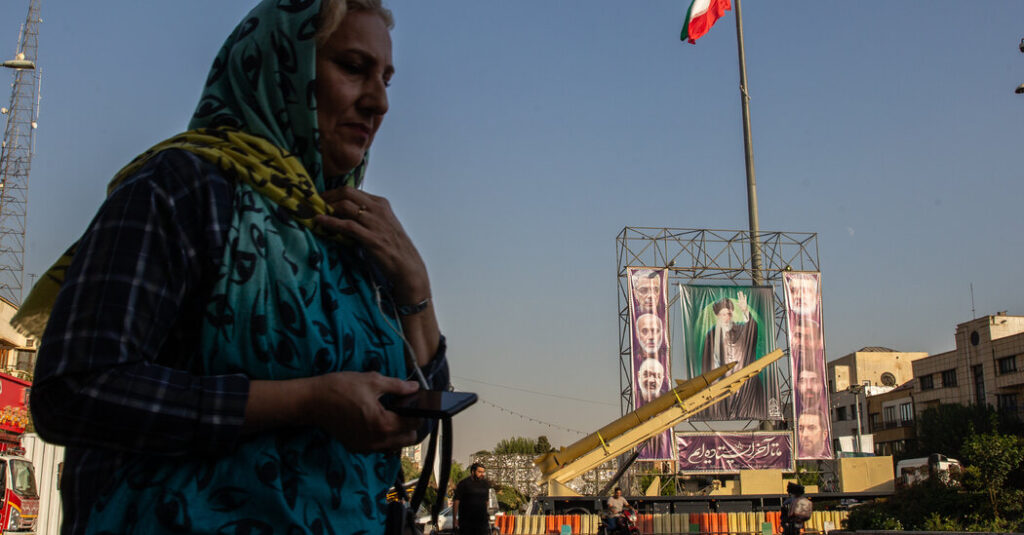
Iran is believed to have some 2,000 short- and medium-range ballistic missiles. Experts said that the country appears to have largely replenished this arsenal since firing hundreds of missiles at Israel — and more than a dozen at a U.S. military base in Qatar — last June.
Iran has steadily increased the range of its ballistic missiles, and its most powerful missiles can hit Central and Eastern Europe.
But in his State of the Union address on Tuesday, Mr. Trump made a new claim, saying Iran was “working to build missiles that will soon reach the United States of America.”
The following day, Mr. Rubio repeated the president’s assertion about Iran’s work on intercontinental ballistic missiles, although he used different language about how quickly Iran could be capable of hitting the United States. While Mr. Trump said it would be “soon,” Mr. Rubio said it would be “one day.”
“You’ve seen them increasing the range of the missiles they have now, and clearly they are headed in the pathway to one day being able to develop weapons that could reach the continental U.S.,” he told reporters on Wednesday.
Three American officials with access to current intelligence about Iran’s missile programs said that Mr. Trump exaggerated the immediacy of the threat posed to the United States. One official said some intelligence analysts were concerned that top aides have inflated the threats or that intelligence was being selectively presented or distorted as it was sent upward.
A report by the Defense Intelligence Agency last year concluded that Iran did not have ballistic missiles capable of hitting the United States, and that it might take as long as a decade for it to have up to 60 intercontinental ballistic missiles. Even to reach that number of missiles on that timetable, the intelligence agency found, Iran would need to make a determined push to develop that technology.
When asked on Wednesday about the Defense Intelligence Agency report, Mr. Rubio declined to comment.
Concern over Iranian missiles is hardly new for the U.S. government. As far back as 2010, a classified assessment released by WikiLeaks revealed that the U.S. government was secretly monitoring missile technology aid that North Korea was giving to Iran.
The missiles in question were medium-range, able to travel more than 2,000 miles, enough for Iran to hit parts of Europe. Iran obtained 19 of the missiles from North Korea, according to a diplomatic cable dated Feb. 24, 2010. At the time, American officials warned that the advanced propulsion could speed Iran’s development of intercontinental ballistic missiles.
But 16 years later, there is still no evidence that Iran has made its long-range missile program a top priority.
Instead, Iran has put far greater focus on building up its arsenal of short- and medium-range missiles, believing it could be the most effective deterrent against Israeli or American efforts to overthrow the government in Tehran.
Ayatollah Ali Khamenei, Iran’s supreme leader, has authorized government officials to negotiate with the United States over the country’s nuclear program. The missile program, he insists, is not negotiable.
Iran’s Nuclear Program
Steve Witkoff, the White House’s lead negotiator in those discussions with the Iranians, said on Fox News on Saturday that Iran is “probably a week away from having industrial-grade bomb making material.”
But American officials and international weapons inspectors said that was not the case, largely because the U.S. and Israeli strikes last June badly damaged Iran’s three main nuclear sites, Natanz, Fordo and Isfahan.
Those attacks made it far more difficult for Iran to access the near-bomb grade fuel it would need to produce a nuclear weapon quickly. Even if it were to dig it out, experts said, it would take many months — perhaps more than a year — to turn it into a warhead.
According to the International Atomic Energy Agency, most of the nearly 1,000 pounds of Iran’s 60 percent enriched uranium is buried at Isfahan. There is little evidence that the Iranians are digging out the deep-underground containers in which the uranium is stored.
And without that stockpile, which would have to be further enriched to 90 percent purity before it could be fabricated into a bomb, it is nearly impossible for the Iranian military to produce a weapon.
Even some of Mr. Trump’s allies in Congress have seemed to question Mr. Witkoff’s assertion that Iran could build a bomb so quickly.
“I can’t speak for Steve. I haven’t got those reports, and I’ve been read in on some of those programs,” Senator Markwayne Mullin, Republican of Oklahoma and a member of the Armed Services Committee, said on CNN this week. “I’m not saying he’s wrong or he’s right, I just haven’t seen those reports.”
Mr. Rubio acknowledged on Wednesday that there was no evidence the Iranians were currently enriching nuclear fuel.
In his State of the Union speech, Mr. Trump reiterated his claim that the strikes last June completely destroyed Iran’s nuclear program — “we wiped it out,” he said — but asserted that Iran had restarted the program.
“They want to start it all over again and are at this moment again pursuing their sinister ambitions,” he said.
American officials who have been briefed on U.S. intelligence assessments said that Iran has not built any new nuclear sites since last June. In recent months, however, Iranian activity has been detected at two still-incomplete nuclear sites that were not struck in last year’s war.
One is near Iran’s Natanz nuclear enrichment site, which both Israel and the United States struck. Another is near Isfahan, where most of Iran’s stockpile of near-bomb-grade uranium is now buried after the June attack.
Iranian engineers also appear to be exploring how to burrow further underground. U.S. intelligence reports have indicated that Iran could be excavating as a way to build new facilities that would be out of the reach of the most powerful conventional U.S. weapon, the Massive Ordnance Penetrator, which the Pentagon used last June against the Fordo nuclear site.
The Fordo facility remains inoperable, according to American officials.
Eric Schmitt, William J. Broad and Helene Cooper contributed reporting.
Mark Mazzetti is an investigative reporter based in Washington, D.C., focusing on national security, intelligence, and foreign affairs. He has written a book about the C.I.A.
The post In Trump’s Case for War, a Series of False or Unproven Claims appeared first on New York Times.