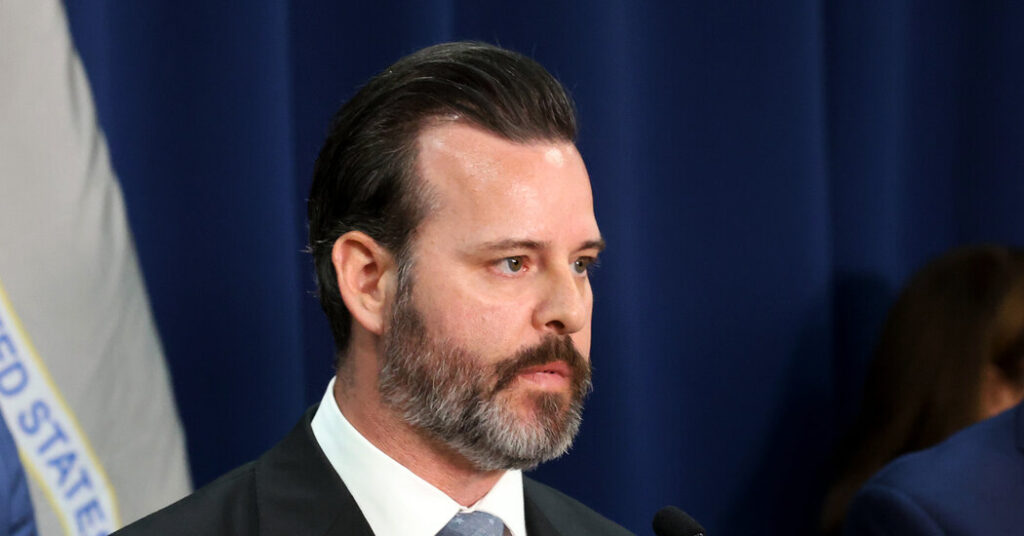
A U.S. attorney in Miami appears to be expanding the scope of an investigation into former law enforcement and intelligence officials who were involved in scrutinizing President Trump during his first campaign and term, according to people familiar with the matter.
Subpoenas issued in recent weeks from the office of the prosecutor, Jason A. Reding Quiñones, show that the office is now widening its inquiry to encompass the F.B.I.’s investigation into ties between the 2016 Trump campaign and Russia. The subpoenas sought documents related to Russia’s election interference from several former officials who played lower-level roles in that inquiry.
In addition, F.B.I. agents recently interviewed at least one retired agent who in 2022 was involved in deliberations with the Justice Department over opening the investigation into Mr. Trump’s plan to create a false slate of electors in swing states in an effort to overturn the outcome of the 2020 election. The agents conducting the interviews, who are based in Washington, said they were asking on behalf of agents based in Florida, according to a person familiar with the matter.
Already, prosecutors in the Miami office had issued subpoenas in November for documents related to a January 2017 intelligence community assessment about Russia’s election interference, and last month, they issued a second round to the same recipients seeking similar materials from an expanded date range.
Altogether, the developments suggest that Mr. Reding Quiñones is making good on hopes by some allies of Mr. Trump that he would pursue a criminal investigation into what they have cast as a “grand conspiracy,” targeting numerous former officials who had investigated the president. The idea relies on portraying disparate investigations as a unified “deep state” plot to violate his constitutional rights.
The people familiar with the recent rounds of subpoenas and interviews spoke on the condition of anonymity to discuss the sensitive matter. The Justice Department press office declined to comment.
Two of the three major investigative matters involving Mr. Trump — the inquiry into Russia and the 2016 election and the inquiry into his attempt to overturn the results of the 2020 election — concern events that mainly took place in and around Washington. The Russia matter also predates the usual five-year statute of limitations to bring federal charges.
But by tying them to the third, the investigation into Mr. Trump’s handling of classified documents, in which F.B.I. agents searched his Mar-a-Lago social club and estate in Palm Beach, Fla., in August 2022, Mr. Trump’s allies have argued they can still pursue all those earlier matters as part of a purported unified conspiracy. Doing so also allows the administration to bring issues before a grand jury in Florida, which would draw jurors from a less Democratic pool.
There is no evidence that the three inquiries were a single plot. In addition, past administrations, including a special counsel appointed in Mr. Trump’s first term, have thoroughly scrutinized the law enforcement and intelligence response to Russia’s 2016 election interference.
But in his second term, Mr. Trump has openly imposed White House control over the Justice Department and pushed it to charge his enemies, ousting prosecutors who balked over lack of sufficient evidence.
Trump Administration: Live Updates
Updated
- The Justice Department sues 5 states, most of them Republican-led, for full voter registration databases.
- 32.6 million watched Trump’s State of the Union address, Nielsen says, fewer than last year.
- Federal judge accuses Trump Administration of repeatedly disobeying orders.
In September, Mr. Trump publicly demanded that Attorney General Pam Bondi charge James B. Comey Jr., the former F.B.I. director, with perjury over 2020 congressional testimony before the statute of limitations ran out. The department ousted a U.S. attorney who refused to do so, and a successor obtained the indictment, only for a judge to throw out the charges and rule that the prosecutor who brought charges had been unlawfully appointed.
The more recent subpoenas issued in January suggest officials moving hastily in requesting documents about the Russia investigation. Two people familiar with the matter described how law enforcement officials appeared to have used the November subpoena as a template, which sought files related to the preparation of the 2017 intelligence community assessment. In substituting the phrase “Russian interference in the 2016 election,” the officials neglected to remove the words “preparation of,” creating an odd garble, the people said.
The focus on the intelligence community assessment appears to be driven by allegations from Mr. Trump’s allies that John O. Brennan, the former C.I.A. director, made a false statement to Congress in a 2023 deposition related to the Steele dossier, a compendium of discredited opposition research alleging various ties between Mr. Trump’s campaign and Russia.
The F.B.I. wanted to include information from the dossier in the 2017 assessment, but C.I.A. analysts balked. Mr. Brennan referred to that dispute in his deposition, saying that “the C.I.A. was very much opposed to having any reference or inclusion of the Steele dossier in the intelligence community assessment.”
Ultimately, as a compromise, a summary of it was attached to the assessment as an appendix, as Mr. Brennan and others had long said. Documents declassified by the Trump administration last year complicated that account by showing that a sentence in the final draft of the assessment alerted readers to the existence of the appendix.
The files also indicated that when C.I.A. analysts objected to including information from the dossier as an appendix, Mr. Brennan pushed back in support of the compromise arrangement.
In October, Representative Jim Jordan, a Trump ally and Ohio Republican, made a criminal referral, saying Mr. Brennan’s statement about the C.I.A.’s opposition amounted to a false statement in light of his own attitude in that exchange. Mr. Brennan’s lawyer, Kenneth Wainstein, has said it did not.
The subpoena covering an expanded date range of documents about the intelligence community assessment was notable for another reason. Issued in late January, it came from a grand jury that sits in Miami.
The location is significant because Mr. Reding Quiñones had earlier asked the chief judge in the Southern District of Florida, Cecilia M. Altonaga, to convene a special additional grand jury at the federal courthouse in Fort Pierce, Fla. It was scheduled to start in mid-January, but Mr. Reding Quiñones did not use it for the latest subpoena.
Any investigation conducted by a grand jury in Fort Pierce would be overseen by Judge Aileen M. Cannon. She oversaw — and eventually threw out — the case against Mr. Trump over classified documents, and issued numerous rulings in his favor. This week, she permanently barred the release of a special counsel report on that matter.
Mr. Trump’s allies had openly gloated about the possibility of putting Judge Cannon in charge of mediating disputes over matters like requests to quash a subpoena or compel a recalcitrant witness to testify.
In December, Mr. Wainstein wrote to Judge Altonaga to complain that the prosecution appeared to be preparing to move the investigation to Fort Pierce and asked the judge to block any such effort.
Judge Altonaga has yet to publicly respond to the letter, and it is unclear whether she has acted behind the scenes. But for now, the subpoena from late January indicates that the grand conspiracy investigation remains in Miami.
Charlie Savage writes about national security and legal policy for The Times.
The post Trump Ally Expands Inquiry of Former Officials Who Investigated the President appeared first on New York Times.