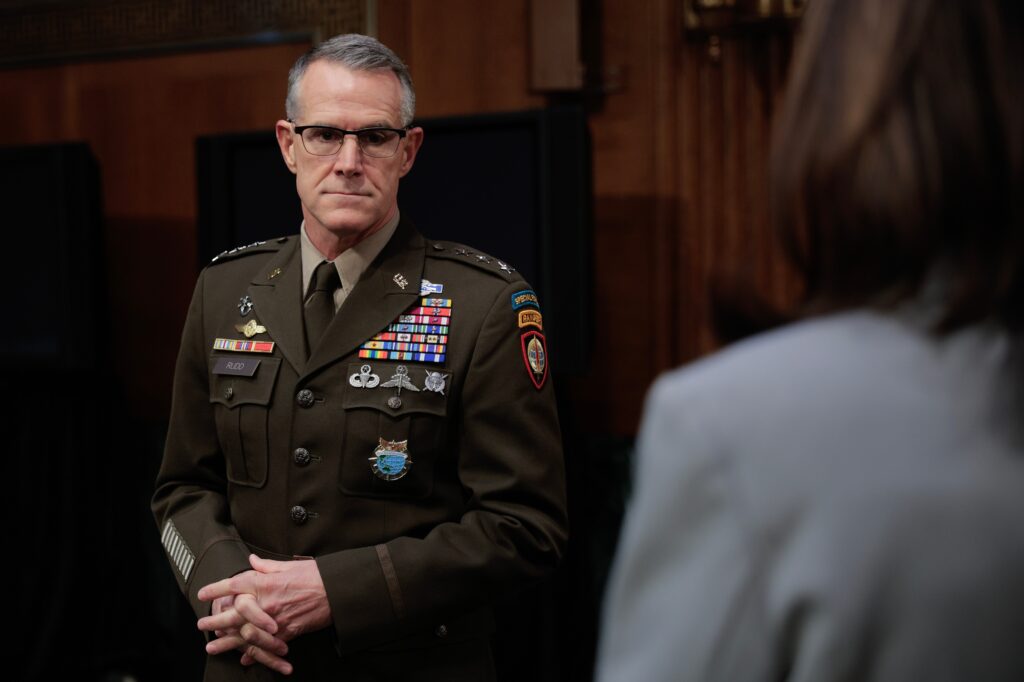
A senior Democrat on the Senate Intelligence Committee is attempting to halt the confirmation of Lt. Gen. Joshua Rudd, the Trump administration’s pick to lead the National Security Agency and U.S. Cyber Command, citing concerns about the general’s qualifications and knowledge of constitutional safeguards on civil liberties.
Sen. Ron Wyden (D-Oregon), a longtime advocate of privacy rights, submitted a statement to the Congressional Record this week detailing his reservations in an extraordinary rebuke of a senior military officer.
“He is not qualified for this job,” Wyden wrote of Rudd, whose Army service includes extensive experience leading elite Special Operations units. “And, when it comes to the cybersecurity of this country, there is simply no time for on-the-job learning.”
Spokespeople for Rudd and the NSA did not immediately respond to a request for comment Thursday. In a statement, the Pentagon praised his “outstanding qualifications” and urged the Senate to vote on the nomination at “the earliest opportunity.”
Wyden’s attempt to block Rudd’s nomination was reported earlier by the Record.
The senator’s move is unlikely to succeed, as the Republican-controlled Senate can break Wyden’s hold on the nomination with a majority vote, albeit with some delay to the general’s confirmation, a congressional aide said.
The powerful spy agency has not had a Senate-confirmed leader since April, when President Donald Trump abruptly fired the former director, Gen. Timothy Haugh, without publicly explaining his reason for the dismissal. The far-right activist Laura Loomer, who is an unofficial adviser to the president, has said she advocated for Haugh’s removal and accused him of being disloyal to Trump.
Rudd, currently the deputy head of U.S. Indo-Pacific Command in Hawaii, came under intense scrutiny during his confirmation hearing last month by Democrats concerned that the Trump administration may use the intelligence community to infringe on Americans’ civil liberties.
Some of the sharpest questioning came from Wyden, who asked the general to commit to not surveilling U.S. citizens without a judicial warrant. Rudd said in response that he respected Americans’ civil liberties and pledged to follow the law if confirmed, but declined to explicitly oppose the practice.
“That, respectfully though, doesn’t get close to what I’m talking about,” Wyden said at the time.
The NSA’s immense power to conduct electronic surveillance beyond American shores has worried some Democrats concerned about those tools being used domestically.
Last month, Sen. Mark R. Warner (Virginia), senior Democrat on the Senate Intelligence Committee, separately warned that the Trump administration was crossing a red line when Director of National Intelligence Tulsi Gabbard appeared at an FBI raid in Fulton County, Georgia, where federal agents seized voting records and data as part of an investigation into the 2020 election.
Gabbard, who has been tasked with leading the probe, serves in a role meant to focus on foreign, not domestic, threats.
Ellen Nakashima and Theodoric Meyer contributed to this report.
The post Senator seeks to block Trump’s NSA pick, citing civil liberties concerns appeared first on Washington Post.