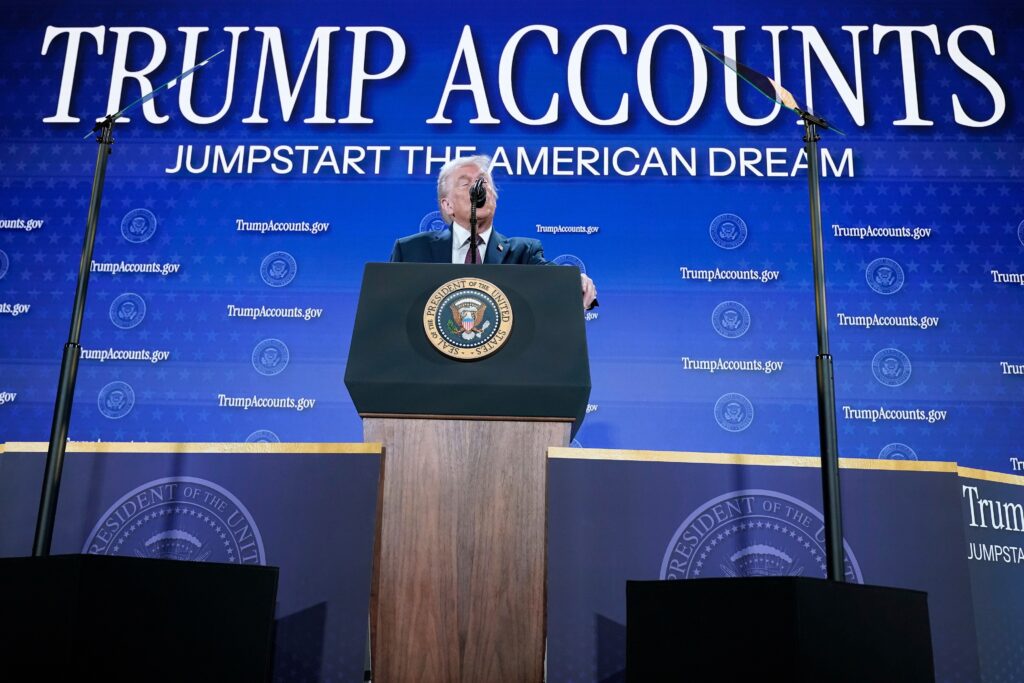
The White House has touted “Trump accounts” as a new way to grow a nest egg for children, with preferential tax treatment. But some states plan to tax those accounts as they would other investment income.
The accounts, created through last year’s major tax law, are available starting in July to any U.S. citizens under 18 whose parents fill out a form opting in. Parents, employers, friends and philanthropies can invest in the accounts. And, as part of a pilot program, the U.S. Treasury will offer $1,000 to every participating child born between Jan. 1, 2025, and Dec. 31, 2028.
Although the accounts were designed to get less favorable tax treatment than 529 college savings plans, they impose fewer restrictions on how the money is spent. Recipients aren’t supposed to owe any taxes until the money is withdrawn, which can happen at any point after a child turns 18, in accordance with rules for traditional IRAs.
But despite a flashy rollout that included a Super Bowl ad this month, many U.S. states don’t recognize Trump accounts, which means the money isn’t shielded from taxes.
That’s not in issue in D.C. and the 20 states that automatically match federal tax law or in the nine states that don’t impose a personal income tax. The Washington Post asked the remaining 21 states whether earnings in Trump accounts would be taxed.
Eight said the annual earnings, under existing laws, would be considered taxable: Arkansas, California, Hawaii, Kentucky, Massachusetts, Pennsylvania, South Carolina and Wisconsin. Georgia, Maine, Vermont and Indiana said state legislation is under consideration to exempt the accounts from annual state taxes. Minnesota, Mississippi and North Carolina said the issue would be decided later.
Virginia and Idaho said the accounts would not be taxed annually.
Four states did not respond to The Post’s query.
After the publication of this article, a Treasury Department spokeswoman said in an email: “The Treasury Department has been engaging with a number of states to address outdated tax codes that could impact Trump Account contributions. These states are seeking to update their tax laws to ensure that they do not unknowingly take from the financial futures of every child in America, and Treasury is committed to working with them and encourage all states to work on this effort on behalf of our nation’s children.”
Since the investment accounts will belong to minors, many participants will fall below the threshold that requires paying yearly taxes. But children who have substantial earnings aside from their Trump accounts may owe taxes, along with those who accumulate sizable balances in their Trump accounts before they turn 18.
State rules for minors’ tax liability tend to parallel the federal government’s, which require children to pay a “kiddie tax” if they have more than $2,700 in unearned income in a given year. Not many children have to pay a kiddie tax — out of more than 70 million kids in America, about 333,000 paid in 2021, the most recent year with IRS statistics available. But those who do often have substantial income. The average kid who filed in 2021 had $18,000 in income. Collectively, that group paid more than $1 billion in federal income taxes.
In California, the nation’s most populous state, children must file tax returns if they have more than $2,600 in unearned income. In Hawaii, another state that plans to tax the accounts, kids with more than $1,000 in unearned income, such as dividends in their accounts, might owe taxes.
Figuring out those taxes could be tricky. Since the accounts aren’t taxed on the federal level, the banks that hold them won’t be required to send 1099s to account holders showing the annual earnings. (That lack of paperwork might also make it highly impractical for any state to go looking for people who aren’t paying taxes on earnings in the account.)
The new accounts have other complications, including that even the smallest contributions could require a highly complex federal gift tax form. Those complications could make some families cautious about putting money in a Trump account.
California accountant Richard Pon, who noticed his state’s plan to tax the accounts in an obscure government document, expects that some states may treat contributions to the accounts differently depending on the source.
States might consider the U.S. government’s $1,000 contribution nontaxable, akin to a federal tax refund, and might view contributions from charities as nontaxable gifts, such as billionaire Michael Dell’s pledged contributions to millions of children’s accounts. But Pon thinks states will probably tax contributions from employers. Relatives can give up to $5,000 per year to kids’ accounts, and companies can give their employees and employees’ children $2,500. Charles Schwab, Chipotle, Comcast, IBM, Intel, Uber and other companies have said they will contribute for their employees’ children.
Brian Schultz, an accountant who specializes in ultrarich households, said some wealthy families might run into tax issues using the accounts. “If my child’s Trump account was funded by this $1,000 pilot contribution and nobody else ever puts any money into the account, odds are it’s not going to rise to enough income” that it poses a tax problem, Schultz said. “It could be more of an issue if you have family members or other people contributing to fund the Trump account.”
Schultz noted that the calculations could get complicated in the long run. When account holders eventually take their money out, they will need to pay taxes on it — but they shouldn’t have to pay state taxes twice on the same earnings, so they will need to track what they’ve already paid, perhaps many years ago. And what happens if a family moves from one state to another?
Others predicted that most states will simply pass legislation at some point to exempt the accounts from taxes.
Amira Boland, chief of staff at New America’s New Practice Lab, is working with states on potentially contributing to the accounts for residents. She expects states will stop taxing the accounts once they see how popular they become. “People are going to love this,” she said.
“It can quietly become the largest individual cash-transfer program we have in the United States,” Boland said, predicting a future in which charities and companies become much more likely to contribute to the new accounts than to such existing vehicles as 529s. “There’s something particularly American about the agency of choosing what you’re going to use your money on, and starting a business and stuff. … Honestly, it’s a beautiful story. You invest in children, and then they can invest in America, and then they can start a company and own a home.”
This story has been updated to include Arkansas, which will tax earnings in Trump accounts.
The post The ‘Trump accounts’ for kids come with a catch in some states appeared first on Washington Post.