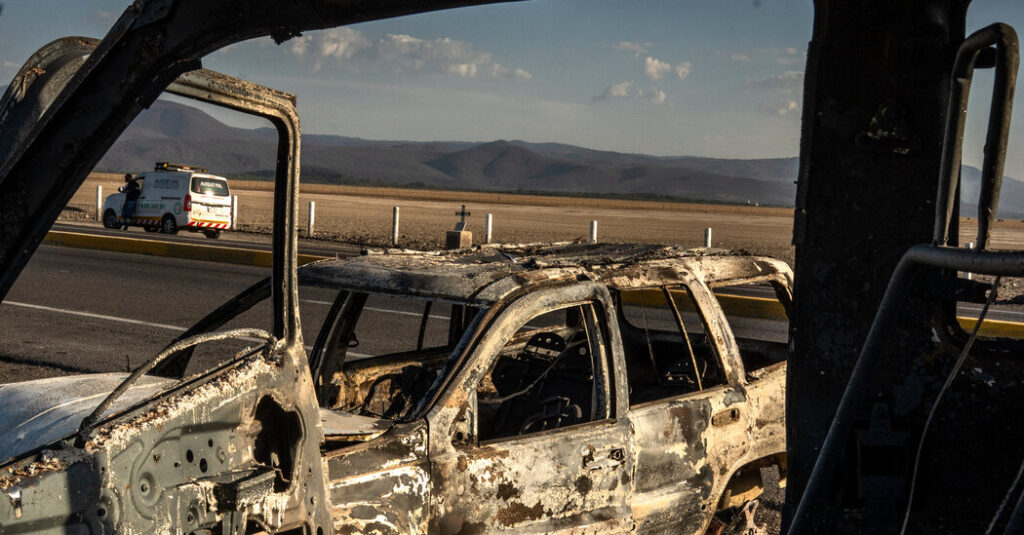
Early on Sunday, drug cartel operatives in Mexico’s western state of Jalisco began hijacking trucks, positioning them horizontally across highways and setting them ablaze. The attacks spread quickly across the country, with thugs also stealing cars and buses for their narcobloqueos — narco blockades — on roads from Mexico’s Texas border to its Caribbean beaches.
Gangsters set fire to pharmacies, grocery stores and banks. Gunmen ambushed security forces and left their bullet-ridden corpses on the streets. Residents cowered in their homes, embassies issued warnings, and airlines canceled flights. At an airport in Guadalajara, people rushed for cover amid a false alarm that it was being stormed by gunmen.
Behind this wave of terror was the Jalisco New Generation Cartel, whose abbreviation in Spanish is C.J.N.G., a sprawling crime mob that traffics cocaine, meth and fentanyl and runs other rackets including oil theft and extortion. After Mexican security forces killed the cartel’s leader, Nemesio Oseguera, on Sunday, cartel operatives unleashed the narco blockades in 20 of Mexico’s 32 states. Its gunmen effectively shut down large swaths of the country, killed at least 25 members of the National Guard and showed the world that Mexico’s cartels are not just a public safety problem but a debilitating national security threat.
In many ways, the killing of Mr. Oseguera was a clear victory for President Claudia Sheinbaum. The gangster, known as El Mencho, was no doubt the mastermind behind many of Mexico’s mass graves, disappearances and shakedowns. Mothers of murdered children and shop owners facing extortion have called on Ms. Sheinbaum to do more. The killing may have also bought her time with President Trump, who has been threatening to order unilateral military strikes against cartel targets on Mexican soil since returning to office. (U.S. intelligence was pivotal in locating Mr. Oseguera before Mexican troops swept in.)
But that achievement was overshadowed by the brutal attacks that followed, as images of violence and chaos were broadcast to the globe just months before Mexico is set to host World Cup matches this summer. The violence underscored a central conundrum facing the Mexican government: If you allow cartel kingpins like Mr. Oseguera to roam free, that breeds impunity, but taking them down can unleash more bloodshed as the entrenched cartels hit back against soldiers and civilians and their lieutenants battle among themselves for the spoils of their empires.
The term “narco blockade” entered the vocabulary of Mexicans in the mid-2000s, part of a grim lexicon that emerged to describe rising cartel violence, along with other words like “narcofosas” (narco graves) and “narcopolíticos” (narco politicians).
At the time, various cartels had begun staging blockades — blocking traffic and spreading fear — in places like Monterrey and the state of Michoacán, using them along with burning businesses and shooting at security forces to stop arrests. Over the years, the attacks got bigger and bloodier. On May 1, 2015, the Jalisco cartel put up 39 narco blockades in Jalisco state and shot down a military helicopter, thwarting an attempt by Mexican security forces to arrest Mr. Oseguera. In 2019, the Sinaloa Cartel set up blockades that paralyzed the city of Culiacán until Mexican troops released Ovidio Guzmán López, a fentanyl trafficker and a son of El Chapo.
Narco blockades have always served a practical purpose for the cartels: They disrupt security operations and give gangsters a chance to escape, ultimately helping to protect cartels’ business. They also help rally cartel forces, observers say. Narco blockades “function as a mechanism of internal cohesion,” writes Carlos A. Pérez Ricart, a researcher at Mexico’s Center for Economic Research and Teaching. “They move resources, test loyalties, reaffirm hierarchies.”
Increasingly, they serve another purpose, too. As cartels have become more deeply embedded in Mexican society, blockades have become a way for them to visibly assert their power. The political scientist Benjamin Lessing calls this strategy “violent lobbying”: Gangsters put pressure on the national government with bloodshed so that it gives in to their demands — or, in the case of the most recent attacks, to warn the authorities not to go after its leaders again.
All of this raises the question: Who really runs Mexico? Despite the Trump administration’s designation of the Jalisco cartel and other gangs in Latin America as foreign terrorist organizations, cartels certainly don’t control territory the way the Islamic State did in Syria and Iraq; Mexican security forces still go into cartel strongholds, and the government still sends teachers to schools, keeps the lights on and collects garbage.
But cartels do want a weak and corrupt state that they can bully — and for many years, tragically, they have had this in Mexico. In 2006, the country’s president, Felipe Calderón, launched a military crackdown on cartels, but it turned out that his own security secretary Genaro García Luna was working with the Sinaloa Cartel to take out that gang’s rivals. (Mr. García Luna was later convicted of cocaine trafficking in New York.) Later, President Enrique Peña Nieto tried to change the narrative and get narcos off the front page, but then, in 2014, cartel thugs working with corrupt police officers disappeared 43 students, drawing global attention and condemnation. Ms. Sheinbaum’s predecessor and mentor Andrés Manuel López Obrador was accused of being too soft on cartels; he said during his campaign that the government should have a policy of “hugs, not bullets.” He presided over the most murderous period in Mexico in decades.
Ms. Sheinbaum came into office saying she did not want a war with cartels, but pressure from Mr. Trump has apparently forced her administration to act. Her government has transferred people thought to be bosses to the United States outside the usual extradition process, arguing that they pose a national security threat. The extraordinary takedown of Mr. Oseguera was her boldest move yet, one that she undertook despite his cartel’s record of violent retaliation.
It could be the start of a wider shift among Mexican authorities to stand up to the bullies who have ravaged Mexico for too long and to clear the way for broader policies to reduce impunity and violence. True change would require the United States to act, too. Not by conducting illegal military strikes on Mexican soil, as Mr. Trump has threatened, but by working to reduce American demand for drugs by transforming its rehabilitation system and by stopping the flow of guns south of the border.
Standing up to cartels in the face of their violent lobbying is a first step. A nation cannot cede its future to the threats of crime kings like Mr. Oseguera forever.
Ioan Grillo is a contributing Opinion writer who has covered gang violence and organized crime in Mexico and elsewhere in Latin America for two decades.
The Times is committed to publishing a diversity of letters to the editor. We’d like to hear what you think about this or any of our articles. Here are some tips. And here’s our email: [email protected].
Follow the New York Times Opinion section on Facebook, Instagram, TikTok, Bluesky, WhatsApp and Threads.
The post Mexico’s Cartel Fight Is a Terrifying High-Wire Act appeared first on New York Times.