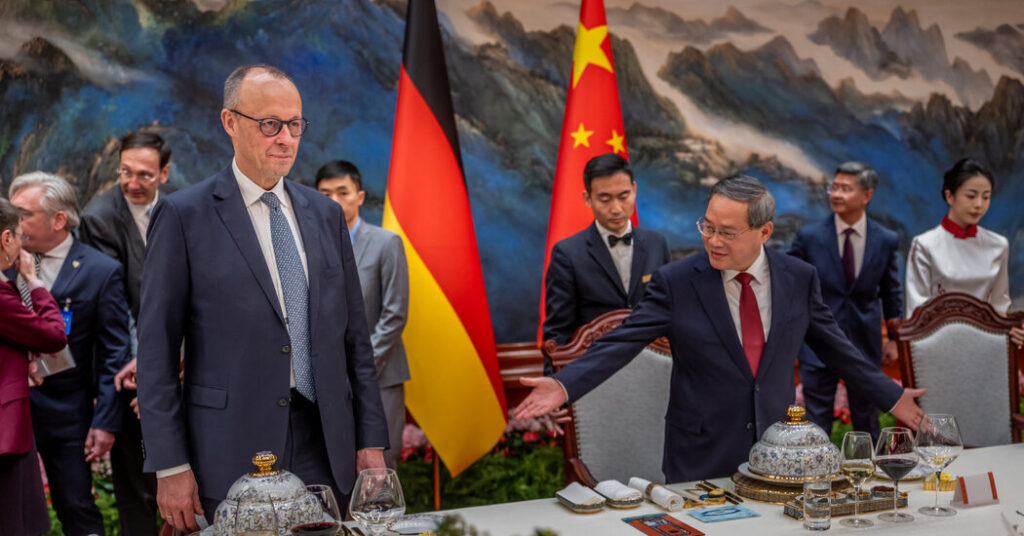
On Wednesday in Beijing, German Chancellor Friedrich Merz criticized Chinese trade policies that hurt German companies.
The next day, he visited the Beijing operations of an iconic German automaker, rode in its new luxury sedan and listened politely as its chief executive extolled innovation opportunities in China.
The juxtaposition showed a disconnect between Mr. Merz and the 30-some captains of German industry who accompanied him on his quick trip to China this week, a disconnect that is not limited to Beijing.
Mr. Merz, arguably his continent’s most powerful politician, wants Europe to become less dependent on China and the United States, economically and militarily. He has warned both countries — and his European friends — of the dangers of a world in which great powers bully their way to whatever they want on the global stage.
Europe’s business leaders are, at least publicly, far more constrained. They have avoided ruffling feathers in the world’s two largest economies, eager to tune out politics and focus on profits.
In a meeting this week with Xi Jinping, China’s leader, Mr. Merz raised concerns over Chinese factory subsidies and its weak currency, which he said impeded economic cooperation.
Yet in interviews broadcast from the sidelines, executives talked mostly about exciting new technological partnerships with Chinese companies and opportunities to increase sales and innovation in the country.
Europe’s political leaders are reacting differently than its business elites are to the efforts by Mr. Xi and President Trump to bend the world to their will through economic and military might, said Lauren Goodwin, the chief market strategist for New York Life Investment Management.
Politicians and business leaders caught between the great powers “have the same things they have to worry about,” Ms. Goodwin said. “Just in a really different way.”
National leaders like Mr. Merz, Prime Minister Keir Starmer of Britain and President Emmanuel Macron of France have called for ambitious steps to make Europe more capable in defense and more self-reliant economically. They want to keep ties with America and China, but rely on them less.
Some corporate leaders have rejected that strategy, which is sometimes called de-risking. They worry it could upend longstanding investments and economic relationships across borders that have grown highly entwined.
“The idea of de-risking seems like a good concept,” Bill Anderson, the chief executive of pharmaceutical titan Bayer, told Table.Media, a Berlin-based news outlet, in an interview as he accompanied Mr. Merz to China this week. “But I think we then have to get grounded right back in reality, which is that the global supply chains that have been established over the last four to five decades have been enormously beneficial.”
Some executives, while offering careful support for Mr. Merz’s efforts this week, took pains to praise China as a market opportunity.
“Anyone who is serious about driving transformation in key sectors — from mobility to renewable energy — cannot look past China,” Ralf Brandstätter, the chief executive of Volkswagen Group China, said in a social media post this week. “At the same time, Europe, and Germany in particular, has every reason to articulate and pursue its interests with confidence.”
Some executives, like Ola Källenius, the Swedish-German chief executive of Mercedes-Benz, have increased their bets on America and China.
“We are on an investment offensive in the United States,” Mr. Källenius told me last month at his headquarters, during an interview in which he repeatedly praised Mr. Trump’s economic policies and declined to criticize China.
Mercedes is a case study in the challenges facing German companies in reducing dependence on both those countries, which remain crucial markets for their products.
Mercedes and other large multinational companies — particularly European automakers — have been playing defense against a blitz of change to the global economic order, largely wrought by Mr. Xi and Mr. Trump.
China’s hefty state subsidies have helped it flood global markets with low-priced Chinese vehicles that are eating into German automakers’ market share. Mr. Trump’s tariffs on European exports have begun driving up the price of the cars Mercedes makes in Germany and ships to America, while his opposition to clean energy has clouded Mercedes’ plan to turn its fleet electric.
Mr. Källenius is not a fan of tariffs, and has said so repeatedly; the company reported its profits were halved last year from the year before, and Mr. Trump’s levies were a major cause.
But when I asked him if any recent events or policies in the United States, including actions by the Trump administration that have alarmed Europe’s leaders and citizens, had changed his views on investing there, his answer was short.
“No,” he said.
On the rainy afternoon I visited Mr. Källenius in Stuttgart late last month, diplomats in Berlin were consumed with the fallout from Mr. Trump’s attempts to gain ownership of Greenland, the Danish territory he covets. German officials were privately expressing horror over the behaviors of federal immigration and customs officers in Minneapolis; coverage of the violence there dominated the German press.
I asked Mr. Källenius how he reacted to calls for business leaders to denounce the administration’s actions in Minneapolis. “I think before you pass judgment on anything, you really need to understand what’s going on,” he said. “And I would say a European business leader is not the right person to judge a situation anywhere in the world where you don’t have the local information.”
When I asked about doing business in China, or other authoritarian countries, he said Mercedes sells into every country where Germany has diplomatic relations — 150 in all.
“If you would limit yourself to the places in the world that have exactly a mirror image of your society or your system down to the last bit and byte,” he said, “that would be a small group.”
Mr. Källenius was relaxed, in a brown turtleneck and sport coat, in a conference room at company headquarters. He was soon to unveil the new S-class sedan — the same model Mr. Merz would later inspect in Beijing.
When I asked about regulation from Brussels, Mr. Källenius offered an extended critique of European rules that he and Mr. Merz both say hinder competitiveness and growth.
In talking about the United States, Mr. Källenius was effusive in his praise for Mr. Trump’s administration, including its low energy costs and relaxed regulations. He described a phone call he took last year from Howard Lutnick, the American billionaire who was soon to be confirmed as the U.S. commerce secretary at the start of Mr. Trump’s second term.
In the call, Mr. Lutnick pushed Mr. Källenius to move the automaker’s headquarters from Stuttgart to the United States.
Mr. Källenius declined, but he went out of his way to explain to me that decision was a function of Mercedes’ 140-year history in Germany, and not a reflection on Mr. Lutnick’s investment pitch.
“He did a phenomenal job presenting the U.S. as an investment case for any multinational company,” Mr. Källenius recalled. “And I’m sold on that, except for the headquarters.”
“There,” Mr. Källenius said, “the roots are too deep.”
Jim Tankersley is the Berlin bureau chief for The Times, leading coverage of Germany, Austria and Switzerland.
The post Europe Needs Some Space From China and Trump. Its Firms Don’t. appeared first on New York Times.