Photos and videos of a young girl posted to YouTube and Instagram flashed across a screen in a Los Angeles courtroom on Thursday.
One showed the girl, then a preteen, in her childhood bedroom with her pet Chihuahua. In another, she played guitar and sang a song about being sad.
All were of K.G.M., the 20-year-old plaintiff in a landmark social-media-addiction trial who testified that her life would have been unequivocally better if she had not used YouTube or Instagram. Clad in a beige sweater and floral dress, the woman explained how her near-constant use of social media, starting around age 6, affected her self-worth and development.
“I just felt like I wanted to be on it all the time,” said the woman, who lives in Chico, Calif., and, to protect her privacy, was not named. “If I wasn’t on it, I was going to miss out on something.”
K.G.M. took the stand as one of the thousands of young people, schools and state attorneys general who have filed lawsuits against Meta, Snap, TikTok and YouTube. Taking a page from the legal playbook used against Big Tobacco last century, she and others have claimed that social media use can be as addictive and harmful as cigarettes or casino slot machines.
The companies have denied the allegations. A win by K.G.M. or any of the plaintiffs could result in huge monetary penalties and other consequences for the companies.
As the first plaintiff to testify in these bellwether cases, K.G.M. spoke for thousands of teenagers and parents who have accused social media companies of hooking young people. The apps have caused mental health issues that have led to anxiety, depression, eating disorders and self-harm, they claim.
Those concerns have caused dozens of parents, who have said that social media contributed to their children’s deaths, to form groups lobbying for child safety protections. The parents have swarmed Capitol Hill and state legislatures to urge lawmakers to pass new laws. They’ve pushed state attorneys general to prosecute the social media companies.
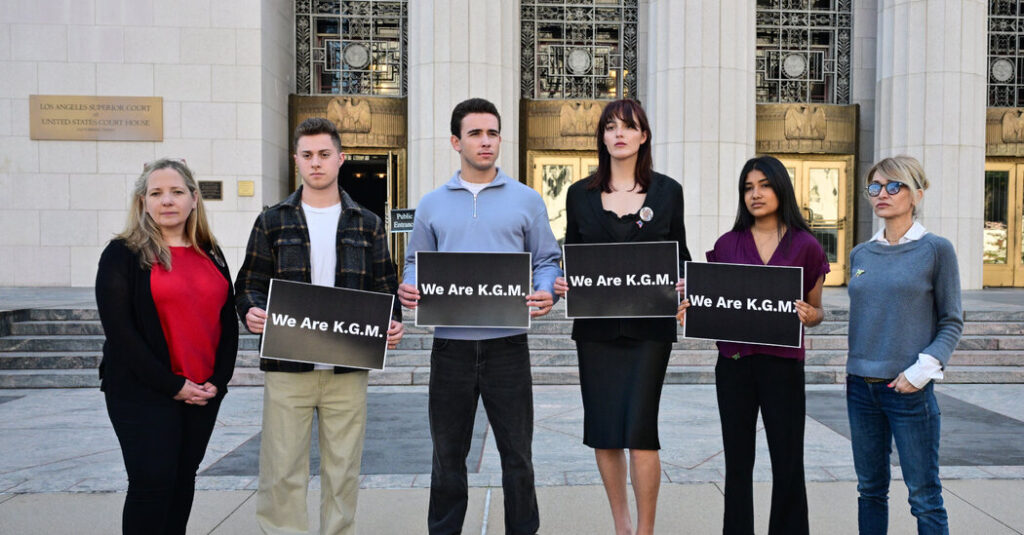
Some of the parents have sued the companies, and more than a dozen grieving parents have attended K.G.M.’s trial in support.
While the parents failed to push through a landmark federal child safety law last year, Congress has held several child safety hearings and cited their stories. In one in 2024, Mark Zuckerberg, the chief executive of Meta, which owns Facebook, Instagram and WhatsApp, was forced to stand and apologize to the parents.
Concern has mounted globally. Australia in December barred children under 16 from using social media, setting off a debate among parents globally over whether similarly tough action is needed in their own countries. Several countries are weighing whether to adopt similar laws.
K.G.M. sued YouTube, TikTok, Snap and Meta in 2023, claiming she became addicted to the social media sites as a child and experienced anxiety, depression and body-image issues as a result. She settled with Snap and TikTok for undisclosed terms before the trial.
K.G.M., who now works filling online orders at Walmart, said on Thursday that she started using Instagram when she was 9 and struggled with addiction. She blamed features like beauty filters for causing serious anxiety and body dysmorphia, and detailed how she engaged in self-harm to deal with her depression at age 10.
Social media “made me give up a lot — my hobbies and old interests,” K.G.M. said. “It prevented me from making friends because I was on my phone at school. It caused me to compare myself to other people and that made me feel very depressed.”
Her lawyers asked K.G.M. about her childhood and more recent life. She graduated from high school in 2023 before majoring in communications at Butte College, she said. She has two dogs and lives with her mother.
Meta, which owns Instagram and Facebook, and YouTube, which is owned by Google, have argued in court that social media is no more addictive than television or a book. Harming users would be bad for their businesses in the long run, they added.
Meta’s lawyers have said that some of K.G.M.’s mental health issues were caused by turmoil and abuse at home, and that Instagram couldn’t be blamed as the sole factor for harm. YouTube argued it was not a social media app and that K.G.M. spent less than half an hour a day on its app, indicating its features were not addictive.
Mr. Zuckerberg and Adam Mosseri, the head of Instagram, both took the witness stand earlier this month. They defended Meta, saying the company did everything it could to keep children safe while still respecting the “freedom of expression” of its users.
On Wednesday, K.G.M.’s lawyer, Mark Lanier, questioned one of K.G.M.’s former therapists. He presented medical records that showed K.G.M. was diagnosed with anxiety and body dysmorphia in 2019.
The therapist, Victoria Burke, said K.G.M. would use her Instagram account as an escape from social interactions at school that made her anxious, and that social media addiction could have contributed to her diagnoses. A vice principal at K.G.M.’s school recommended she should delete her social media accounts because she was being bullied, Ms. Burke said.
Eli Tan covers the technology industry for The Times from San Francisco.
The post In Landmark Trial, Plaintiff Says Social Media Harm Started at Age 6 appeared first on New York Times.