Welcome to Eye on AI, with AI reporter Sharon Goldman. In this edition: Perplexity CEO Aravind Srinivas talks to Fortune about the company’s new OpenClaw-like Computer…AI politics gets messy as Florida Governor Ron DeSantis leans into AI skepticism, seeking a contrast with Vance…Mistral AI lands Accenture as its latest big partner…AI complicates old internet privacy risks.
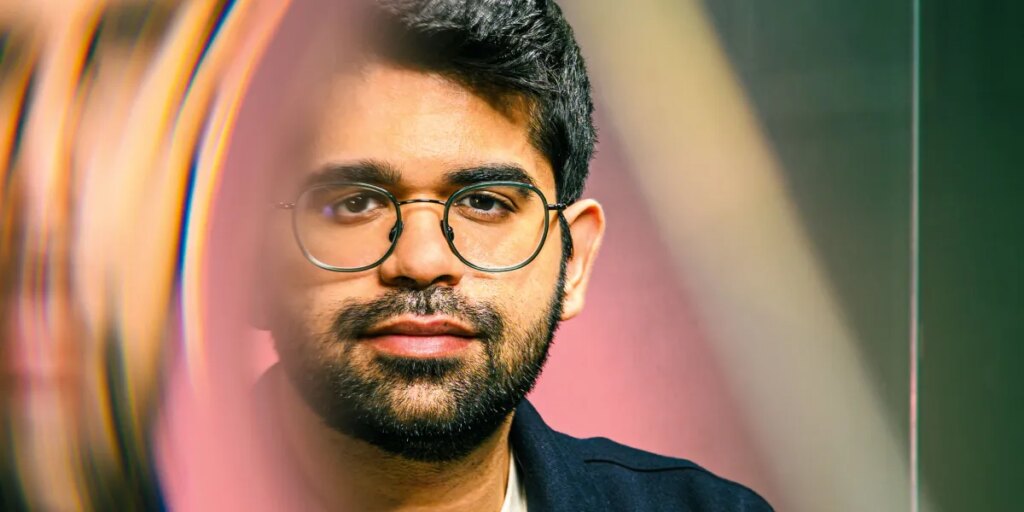
A few weeks ago, AI watchers began to notice something odd: Perplexity CEO Aravind Srinivas, once among the most social-media-savvy executives in the AI world, had gone unusually quiet. The silence stood out at a moment when agent-style tools like Claude Code, Codex, and the viral open-source OpenClaw were dominating the conversation. Perplexity—long positioned as an AI-powered “answer engine” and a Google Search challenger—seemed conspicuously on the sidelines. Some even began to wonder whether the company had lost its way.
But Perplexity wasn’t lost, according to Srinivas—it was just busy building. I spoke with him yesterday, shortly after the company launched Computer, its attempt to turn today’s powerful but intimidating agent tools into something closer to a shared digital workspace that non-experts can actually use. The product is currently available only to Perplexity Max subscribers, with a broader rollout to Pro and Enterprise users planned in the coming weeks.
To my ear, Computer sounds like an OpenClaw for everyone else. Tools like OpenClaw often run on a separate machine, such as a Mac mini, with deep access to files and settings. Perplexity’s approach keeps that work in the cloud instead—letting users hand off tasks like research, writing, or coding to a tool that works for hours or even months, without giving an AI full control over any personal device.
The defining feature of Computer is also that it isn’t tied to one AI model. Different parts of a task can be routed to whichever model does them best—it currently orchestrates 19 models on the backend, including Claude Opus 4.6 for orchestration and coding tasks, Google Gemini for deep research, Google Nano Banana for images, Google Veo 3.1 for video, xAI’s Grok for speed in lightweight tasks, and ChatGPT 5.2 for long-context recall and wide search.
“When you build a team, you don’t build a homogenous group where everyone has the same skills,” Srinivas told me. “You build a team with diverse strengths. We’re applying that same logic to AI workflows. The orchestration is the product. The model is a tool.”
That model-agnostic stance is not new for Perplexity. Srinivas said more than half of the company’s enterprise users already select multiple models within a single workday. But with Computer, that philosophy becomes the core strategy—and a source of leverage. Srinivas said he isn’t worried about OpenAI, Anthropic, or any other model provider limiting access. “In fact, I got congratulations messages from Anthropic and Google,” he said, adding that model makers benefit when their systems are part of broader workflows. If access changes, he said, Perplexity will adapt. “The model layer is the most competitive it’s ever been.”
Srinivas also drew a sharp contrast with tools like OpenClaw, which typically run on a local machine with broad access to files, passwords, and settings—an approach he compared to malware because of how easily it can damage data or expose sensitive information. Instead, Perplexity’s system runs remotely in the cloud, inside a locked-down environment, and carries out tasks in the background, more like assigning work to a coworker on Slack than watching an AI take over your screen. That creates a system that is safer and more dependable, he emphasized.
While he said more ambitious goals are coming for Computer, for now the goal is accessibility. Srinivas insisted that with Computer, “Even your mom can text on the app and delegate tasks,” whereas with OpenClaw it “took our own engineers a long time to set up,” he said, ticking through terminals, API keys, and permissions.
Perplexity, by contrast, wants to make agent-style work feel more like using a Macintosh or an iPhone than configuring a server. Internally, he said, the company is already using Computer to debug code, analyze metrics, and generate marketing assets—often directly from Slack or a phone. “It finally feels like I have a swarm of agents working for me,” he said. “I know that’s a buzzword that everyone uses, but this is the first moment I’ve actually felt it.”
With that, here’s more AI news.
Sharon Goldman [email protected] @sharongoldman
The post After months of quiet, Perplexity’s CEO steps into the OpenClaw moment appeared first on Fortune.