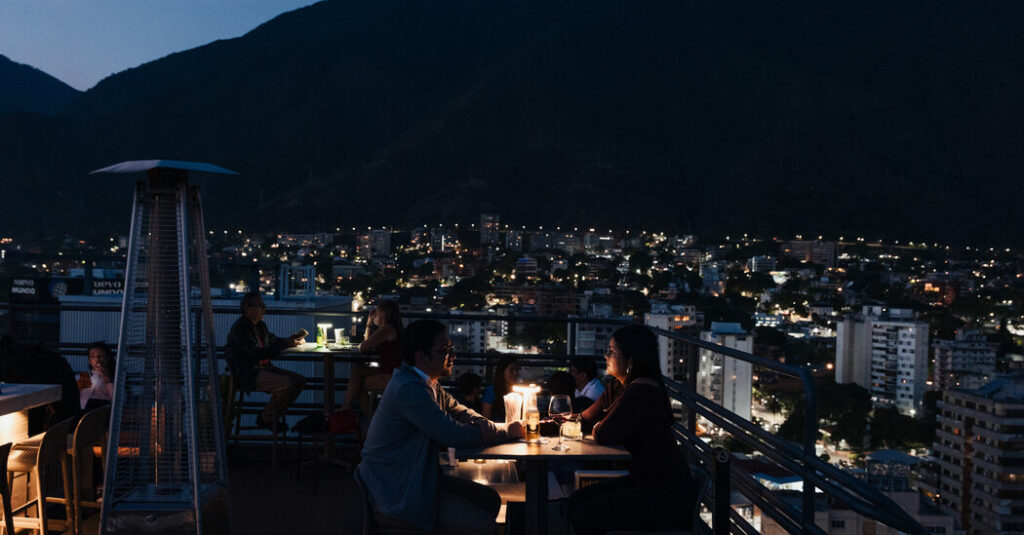
At the 360 rooftop bar, in the heart of Caracas, all the tables were taken, even though drinks can cost more than several months of base wages for many.
Sitting with friends on a recent February evening, Verónica Sanguino, 19, who works at a fish market, said she had saved for weeks to afford the night out at the open-air lounge.
Her group clinked wine glasses and nibbled on ceviche as they sat with a stunning view of the city, which was bombed last month by U.S. forces during the capture of Venezuela’s leader, Nicolás Maduro.
“We go out just to slip away for a moment from this country’s reality,” Ms. Sanguino said.
In a city that refuses to be humbled by decades of misrule, such scenes are starting to spread.
I first started living in and covering Venezuela in 2006, and this month I made my first trip here in years. I was stunned at what I saw: A proud capital city laid low by economic decline, authoritarian rule and an immense brain drain, but showing signs of stirring back to life.
New restaurants are multiplying, and nightclubs are packed. Start-ups are flourishing in what some dare call the start of an economic revival.
Much of the budding optimism is grounded in hopes that Venezuela’s moribund oil industry could show growth this year. Authoritarian restrictions are also, tentatively, starting to ease as political prisoners are released and Venezuelans test censorship limits and take to the streets in small protests.
Still, the moment is fragile, and serious limitations abound. Caracas remains something of a bubble, where wealth is concentrated in the hands of a small elite and only a fraction of Caraqueños, as the city’s residents are known, can afford its pricey nightspots.
The unusual warming of ties between Venezuela and the United States is also in its infancy. The U.S. government is aggressively pressing for economic and political changes, potentially fueling pushback in a country where the ruling Socialist Party has long viewed U.S. meddling as anathema.
And even as ties with Washington start to change, on the streets of Caracas, murals still praise governments in Iran, Cuba and Russia, and billboard slogans seethe with defiance and threats against dissent:
“To doubt is treason!”
“We are nobody’s colony!”
“Venezuela is not a threat!”
Such displays mask the forces that were already slowly reshaping Caracas, with a population estimated at around three million, before the ouster of Mr. Maduro.
The economy’s crash over the last decade prompted many inhabitants to flee. Once-legendary traffic jams have given way to breezy commutes on highways conceived by the American urban planner Robert Moses.
Caracas, which used to be so plagued by homicides and kidnappings that residents compared it to Baghdad during the Iraq war, is also much safer these days.
Crime specialists attribute this shift to the migration of members of gangs like Tren de Aragua, now operating up and down the Americas, and a campaign of extrajudicial killings by elite police units. These specialists say a bigger threat now comes from security forces like the Bolivarian National Police, the primary law enforcement agency at the federal level, which is notorious for extortion and demanding bribes.
Other changes are more subtle but no less profound. Images of Hugo Chávez, who died in 2013 and was the founder of the regime that has controlled Venezuela for nearly three decades, used to be ubiquitous across Caracas, reflecting the personality cult his followers created.
Now paintings of El Comandante, as Mr. Chávez was known, are largely limited to the old center and the bastions of his remaining followers. That is a reflection, some say, of the market-oriented policies that Delcy Rodríguez pushed to adopt in a bid to stabilize Venezuela’s economy before becoming interim president in January.
“The color red has been gradually disappearing from the cityscape,” said Asdrúbal Oliveros, an economist, referring to the color that is not merely an aesthetic choice, but a source of revolutionary identity for the Chavismo movement Mr. Chávez forged.
Still, in an interview at Loccal, a trendy co-working space, Mr. Oliveros emphasized that Venezuela’s economy, while showing promising signs of growth, remains volatile.
Many of the new investments in Caracas got underway before Mr. Maduro’s capture, while Ms. Rodríguez, long a top ally of the deposed leader, began exposing the economy to market forces, he added. But to return the economy to its size before Mr. Maduro drove it into the ground by spending excessively and printing large amounts of money, which unleashed hyperinflation, Venezuela would need to grow about 10 percent a year for the next 10 years, Mr. Oliveros said.
Inflation is galloping at an annualized rate of roughly 560 percent, Mr. Oliveros estimated, eroding the base salaries of many public-sector employees to the equivalent of about $2 a month. At the same time, a de facto use of dollars instead of the domestic currency, combined with a reliance on imports, has produced jaw-dropping prices for many items and services in Caracas.
Deodorant or shampoo, for example, can be 30 percent more expensive in Caracas than in a Walgreens store in Miami. Cocktails at some new bars go for $17 or more.
“This city has the wages of Zimbabwe, the public services of Bangladesh and the prices of New York,” said Phil Gunson, a British political analyst who has lived in Caracas for decades, over lunch at La Estancia, a steakhouse where a Porterhouse goes for $160. The place was nearly full on a recent Thursday afternoon.
Gerson Gómez, an entrepreneur who works out of a new tech hub in a building where Procter & Gamble once developed brands for the Latin American market, attributed the ability of people to pay for such luxuries partly to the growth of start-ups like his own.
“The amount of unexplored potential in this city, and the rest of the country, is simply immense,” said Mr. Gómez, 38, whose ride-share company, Ridery, has gone from two full-time employees to more than 400 in the last five years.
Underscoring a demand for high living, which Venezuela’s socialist-inspired revolution never managed to stamp out, ritzy new eateries are opening around the city. One is Filomena, an Italian seafood restaurant that opened less than three months ago in the verdant hillside district of San Román.
“The country is turning a corner,” said Andrés Elizalde, the general manager of Filomena, where customers can easily spend $200 apiece on Maine lobster, grouper in truffle foam, caviar and imported wines.
A vast majority of Caraqueños will never experience Filomena’s delicacies. Most eke out an existence that relies heavily on government subsidies.
Elsewhere in Caracas, there are signs that the socialist thinking that has informed government policies for decades still has a role in providing a safety net, albeit frayed, for many in the city.
I came across evidence of this one afternoon at a street fair in Parroquia San Pedro, a poor area with decaying Art Deco apartment buildings.
Under tents, public employees offered various free services like blood pressure exams, blood tests, eye exams, basic medicines, haircuts and even therapeutic massages to people, in addition to vaccinations and nail trimming for dogs and cats.
“Things like this make life here bearable, even pleasant,” said Katy Valderrama, 53, a high school teacher who showed up to get her blood pressure checked; she had her dog, Duque, in tow. Nearly 200 others waited patiently in line for the state-provided benefits.
With such contrasts on display, my head was spinning. After racing from one interview to the next, I escaped on my last full day to hike up El Ávila, the mountain range rising majestically above Caracas, separating its urban sprawl from the Caribbean Sea.
On my way down, on an empty street near my hotel, half a dozen officers on motorcycles with the Bolivarian National Police suddenly swarmed around me.
While grasping rifles, they asked for my ID, conducted a pat-down search, made me empty my pockets, threatened to detain me and looked incredulous when I told them I was in the country on a journalist visa.
I took a deep breath as I remembered this police force’s fearsome reputation. I also recalled how the Maduro regime had in recent years arrested foreign visitors and accused them of hatching destabilization plots, without offering any evidence, before freeing them in prisoner exchanges.
Calmly, I showed them an electronic copy of my visa on my phone. I told them they should call the Ministry of Communication and Information if they had further questions, since senior officials there had granted me permission to be in the country.
With a predatory grin, the leader of the pack grudgingly handed my passport card to me and told me to get on my way.
I walked briskly down the hill. It was a jarring reminder of how the city’s charms have long been served with a sense of menace, and how the changes washing over Caracas remain a work in progress.
Isayen Herrera and María Victoria Fermín contributed reporting.
Simon Romero is a Times correspondent covering Mexico, Central America and the Caribbean. He is based in Mexico City.
The post Venezuela’s Capital, Laid Low by Misrule, Is Stirring Back to Life appeared first on New York Times.