Step 1: Jot down your ideas and share with a partner.
What movements does your hand make when picking up an object? Observe: Pick up one or more objects with your hand, and take detailed notes on what your hand, fingers and thumb do while completing the task.
Step 2: Read a Times article about a recent study.
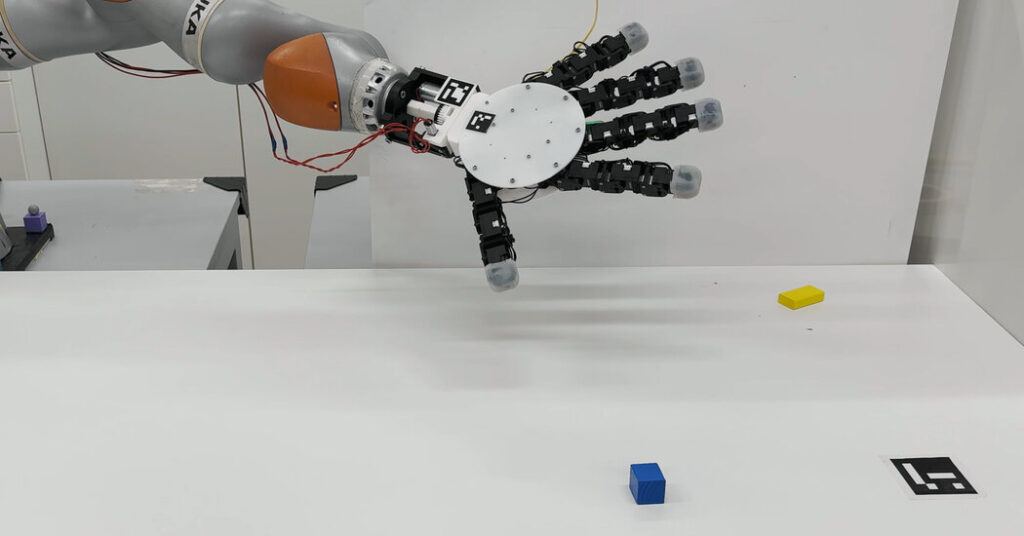
Read the New York Times article “Life Resembles ‘The Addams Family’ With Thing-Like Robotic Hand,” published on Jan. 20. It begins:
As a mother of three, Aude Billard, a roboticist at the Swiss Federal Institute of Technology, frequently finds herself needing to hold many objects at once.
“I constantly have tons of things under my arms and in my fingers,” she said, adding: “I use my entire body to grasp things.”
In these situations, Dr. Billard has noticed that “the fantastic human hand is not that fantastic.”
“When you want to grab something that is behind you, you have to rotate your hand and do very complex motion,” she said.
And so, for years, Dr. Billard has been dreaming about creating a more capable robotic picker-upper. On Tuesday in the journal Nature Communications, she and her colleagues presented a design for a hand-like robot that’s, in some ways, more dexterous and versatile than our claspers. It can even detach from the rest of the robot to “crawl and grasp several objects and then come back to become a hand again,” said Xiao Gao, a roboticist now at Wuhan University.
The result is something akin to Thing from “The Addams Family” — with all the scamper and skill, but none of the skin or snark. (Despite the resemblance, neither researcher had heard of Thing until they began showing their new robot to others. “So no, it was definitely not inspired by that,” Dr. Billard said.)
Step 3: Analyze the study.
1. What was the scientific question that researchers wanted to answer?
2. How did researchers plan and carry out their investigation?
3. What do you notice in the two videos above? What do they reveal about the study?
4. What new data did the investigation yield? (Data is the factual information collected during observations, experiments or studies.)
5. What significance does this research have for science, the world or our lives?
6. What is one thing you learned about this study or about how scientists approach their work?
Step 4: Work with others to come up with your own scientific investigation.
In this study, researchers tried to better understand robotic hands. Collaborate with others to propose another scientific investigation in robot design. For example, a researcher might want to investigate robotic arms.
-
What scientific question might you want to answer?
-
Briefly describe how you might design a study using similar techniques mentioned in the article to try to answer that question.
More?
• Science Practice, a new resource aligned with the Science and Engineering Practices for the Next Generation Science Standards, aims to help students better understand how scientists actively gather evidence-based knowledge and solve problems. Learn more about this feature in this introductory post.
• See all the lesson plans in this series.
The post Science Practice | A Study on a Robotic Hand Design appeared first on New York Times.