In 1934 Isamu Noguchi submitted a proposal to the New York City Parks Commission and the New Deal-era Public Works of Art Project for a playground in Central Park. Called “Play Mountain,” it would be part modernist ziggurat, part land art: a stepped earth mound perfect for climbing, with slopes for sledding in winter and, in summer, water slides emptying into a pool.
Noguchi had recently returned to New York from Paris, where he had been studying under the artist Constantin Brancusi and, years earlier, was apprenticed to John Gutzon de la Mothe Borglum, who designed Mount Rushmore. “Play Mountain” synthesized those sculptors’ sense of architectural possibility — it was the space of a city block with an apex nearing the height of a two-story building, a monument to communal, open-ended play. And it was roundly dismissed; officials reportedly “turned their thumbs down … so hard they almost broke their thumbnails.” The Parks Commissioner Robert Moses was looking for murals, not utopian lunar landscapes, and Noguchi recalled being laughed out of the room.
Noguchi was born in Los Angeles but lived in New York, off and on, for nearly 70 years, creating many of the sculptures, stage sets, and industrial designs that made him one of the most successful artists of the 20th century. But “Noguchi’s New York,” at the Noguchi Museum in Long Island City, dwells in failure. Curated with ample affection by Kate Wiener, it surveys the artist’s relationship with the city. But it also resurrects, via models, archival photographs, and correspondence, more than two dozen unrealized or destroyed public projects, and details the myriad ways Noguchi’s adopted city relegated his expansive, democratic vision to filing cabinets.
Today, it’s possible to encounter Noguchi’s public interventions around the world, from gardens in Paris to fountains in Chicago, from Fort Worth plazas to Bologna piazzas. Yet only five remain in New York. He proposed four times as many that went nowhere, stymied at various stages by bureaucratic intransigence or neighborhood resistance, or fickle turns of real estate. Like every New Yorker, Noguchi loved and was frustrated by the city, which he saw alternatingly as sustaining, callous and dispassionate. “Noguchi’s New York” is as revelatory about his art as it is about the city, what is valued and what gets built, and what it takes to sculpt a better version of it.
Noguchi came of age as an artist in the 1930s, subscribing to the idealism of the era, and the notion of the artist as a public servant. He largely rejected galleries and museums. “Sculpture is no good if it’s just put in a gallery,” he said. “It must be a part of daily living.”
In many ways, New York was the only place that could mirror his restless, recirculating energy. By the time he arrived in 1922, at 17, he had been shuttled to Pasadena, Tokyo, and Yokohama, and shipped to boarding school in Rolling Prairie, Ind. That restlessness never dissipated. He traveled constantly, researching and fulfilling commissions, referring to himself as a “citizen of Spaceship Earth.” But in his 70s he revised that view. “I’m really a New Yorker,” he decided. “Not Japanese, not a citizen of the world, just a New Yorker, who goes wandering around like many New Yorkers.”
The chronology of deflated proposals in “Noguchi’s New York” charts this pilgrim’s progress. There was the 1936 proposal for subway murals inspired by “History Mexico,” the frieze Noguchi completed earlier in a public market in Mexico City. Influenced by Mexican muralism and sympathetic to the plight of the worker, “History Mexico” was Noguchi at his most leftist (one panel depicts the New York Stock Exchange, money bags, and a skeleton stabbing J.P. Morgan). Unsurprisingly, the WPA did not thrill to anticapitalist murals in the New York City subway system. He had better success with “News” (1940), his first public work in the U.S., a stainless steel relief bolted to the old Associated Press Building at 50 Rockefeller Plaza (still in place) that depicts journalists as propulsive figures, heroically jotting notes.
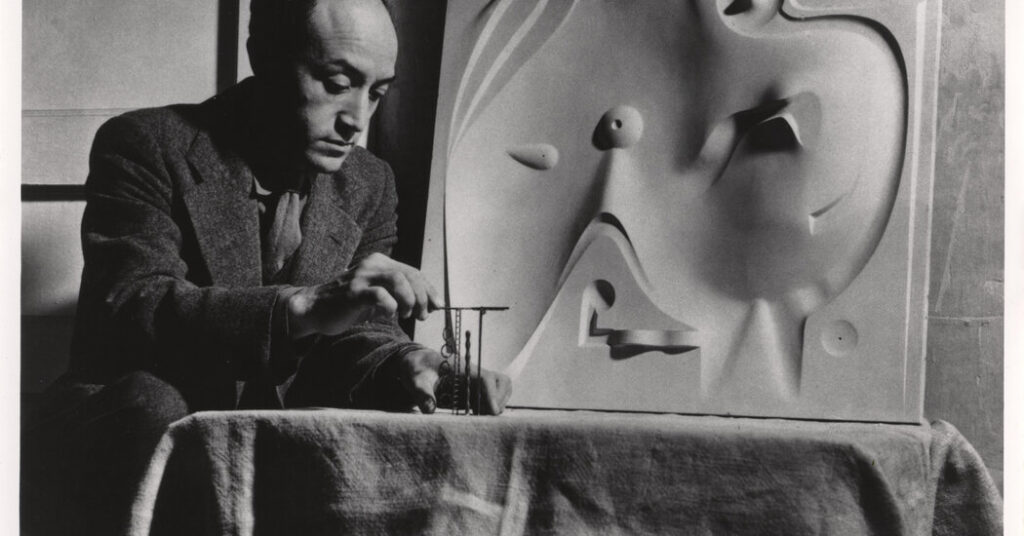
Noguchi fits uneasily in the history of art. He was a sculptor with an architect’s sensitivity to space, but uninterested in art’s hermetic purity. In the 40s, working out of a studio on Macdougal Alley, he scavenged the city for materials, fashioning thin sheets of marble and slate used to face buildings into skeletal, interlocking pieces held together by gravity. Those forms repeat in commercial pieces, like the chess table shown at an exhibition organized by Max Ernst and Marcel Duchamp.
Scratched were his proposals for MoMA’s nascent sculpture garden. Playscapes for the Bronx Zoo’s Great Apes House got as far as a discussion of the emotional disposition of orangutans. A totemic, moon-reaching sculpture that would have greeted travelers arriving at what is now Kennedy International Airport didn’t get past the selection committee (they went with Alexander Calder instead). A sculpture garden at Lever House sputtered, and one for a plaza at Vincent Astor’s speculative skyscraper across Park Avenue was consigned to the dustbin when the lot was sold.
But “Black and Blue” (1958—59), folded forms of anodized aluminum, illustrate how the city’s new steel and glass architecture seeped into Noguchi’s sculptural practice. Pieces like “Night Bird” (1966—67), a basalt form supported by polished stainless steel, mediated carving and modern industrial design, resulting in poetic meditations on the changing shape of the city.
Again and again, Noguchi returned to playgrounds, the highest expression of his vision that art could be “beyond personal possession.” In 1940, the Parks Department balked at a suite of protozoan, vaguely dangerous playground equipment. He returned the next year with the thwarted “Contoured Playground,” a 100-square-foot playscape exclusively of molded earth that he declared fall proof, because there was nothing to fall from. A decade later, Noguchi envisioned a sculpted mountain range of tunnels, caves, and spiral slides at the United Nations. Moses compared it to a rabbit habitat, threatening that he would decline to install railings to prevent children from falling into the East River.
A sprawling 1961 proposal for Riverside Park got the farthest. It would have remade a four-block stretch of the Upper West Side, from 101st to 105th Streets. Multiple iterations of plaster models show how the project evolved, sprouting sand mazes, a skating rink, and, naturally, a slide mountain, its contours futilely compromised to appease pushback. Noguchi said, “my best things have never been built.”
As attitudes about public art changed and new zoning laws incentivized public space for building height, Noguchi found a suddenly more receptive city. He placed “Red Cube” (1968) on a patch of concrete where Broadway meets Liberty Street — a rhomboid whose elongated steel plates echo what he called “the strange geometry” of the streets that crunch around Wall Street. Teetering on a corner point, it’s a fine metaphor for the improbable city.
A few blocks away, “Sunken Garden,” at 28 Liberty Street, is similarly improbable, a Japanese Zen garden plonked in one of the world’s least Zen places. Noguchi had stones from Kyoto’s Uji River shipped in, a bit of quasi nature inserted into the unnatural environment of Lower Manhattan.
Less monumental but perhaps most profound, “Unidentified Object,” an eleven-foot basalt monolith, commissioned by the Public Art Fund in 1979, was installed outside Central Park and later transplanted outside the Metropolitan Museum of Art. A picture taken at its debut shows Noguchi grinning. He was 75, and it was his first public sculpture on New York City land.
Peripatetic throughout the 1950s, Noguchi had moved back to New York in 1961 and found he was priced out of Greenwich Village. Queens was cheaper, and the factory building he found was convenient to his stone suppliers and fabricators. On an industrial stretch on the far west edge of the borough, it surely appealed to Noguchi on a psychic level, and to his outsider nature. He consolidated a former photo engraver’s warehouse across the street, a disused service garage and the scrapyard behind it, and displayed the sculptures that were turned down elsewhere in an indoor-outdoor sculpture court topped by floating galleries. It was Noguchi’s most uncompromised vision, and it endures, like everything that endures in New York, because he bought the real estate.
“New Yorkers after all felt a special relationship to the world,” Noguchi mused. “They were on this island looking out on the whole damn world, which they had to do something about.” Instead of going to the moon, he added, “you bring the moon to you.” A picture taken in the gallery in 1985, the year Noguchi’s conversion of his studio into a museum opened, shows the Chrysler and Empire State buildings from a window, twinkling in the distance.
Noguchi’s New York
Through Sept. 13, Noguchi Museum, 9-01 33rd Road (at Vernon Boulevard), Long Island City, New York; 718.204.7088; [email protected].
The post Noguchi Envisioned a More Open New York. New York Wasn’t Interested. appeared first on New York Times.