Planners and politicians may be scrambling to prepare for the 250th anniversary of American independence in July. But already, some people have their eyes a full 250 years further into the future.
On Thursday, the federal group overseeing the anniversary unveiled details of America’s Time Capsule, a vessel filled with relics of the current moment to be buried in Philadelphia until the almost unimaginable date of 2276.
In technical drawings, the three-foot-tall stainless steel cylinder looks unprepossessing. But inside, it will hold dozens of tiny archival boxes filled with relics and documents representing 56 states and territories, all three branches of government and the commission itself.
At a videoconference on Wednesday, Rosie Rios, the chairwoman of America 250, said the purpose of the capsule was to capture the broad variety of the country, and the group’s nonpartisan, “sea to shining sea approach.”
”Our goal is to make sure everyone feels like it’s their commemoration and celebration,” she said.
The creation of the time capsule — and the 2276 unearthing date — was mandated by Congress in 2016, in the legislation authorizing the nonpartisan United States Semiquincentennial Commission. The law was vague on the contents, saying only that they should include “a representative portion of all books, manuscripts, miscellaneous printed matter, relics and other materials” relating to the anniversary.
States and other parties will have until March 15 to choose their items. They will then be loaded into the capsule and buried near Independence Hall in Philadelphia on July 4, under the site of a planned sculpture inspired by the segmented snake from Benjamin Franklin’s famous “Join or Die” woodcut.
Rios said the idea was to let the states tell their own stories, their way, rather than imposing any top-down vision.
“Think of 1776,” she said. “We were a nation of nations.”
The tradition of creating commemorative time capsules dates at least to the Centennial of 1876, when a magazine publisher created a “Century Safe,” filled with relics like a gold pen, an album of autographs of prominent citizens and a book on temperance.
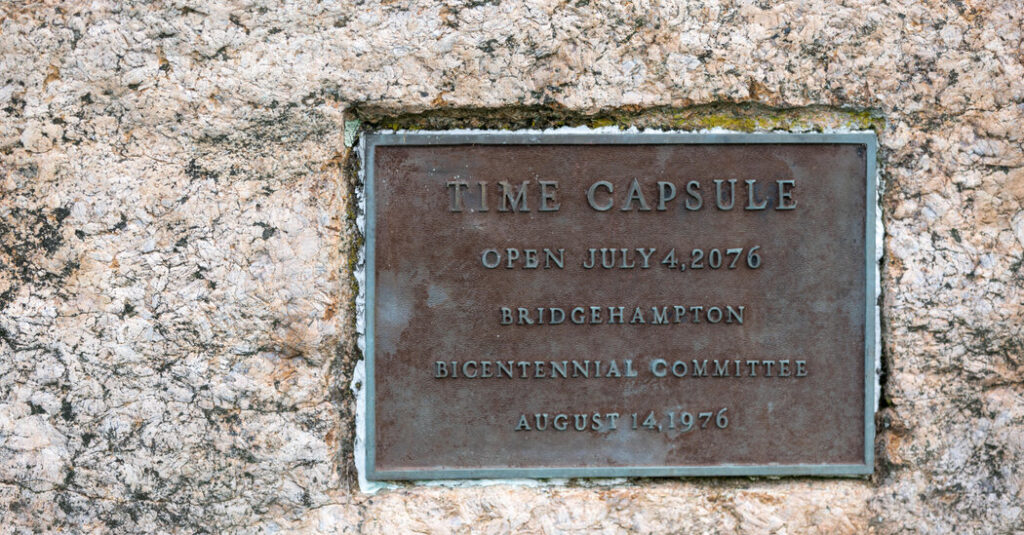
It languished nearly forgotten for decades in the bowels of the U.S. Capitol, but was rediscovered in time to be opened by President Gerald Ford at the 1976 Bicentennial. That anniversary set off its own time capsule craze, with vessels of all kinds — including, in one case, a Chevrolet coupe packed with relics and buried in Nebraska — created across the country. (The official Bicentennial time capsule, currently in climate-controlled storage at the National Archives, will not be opened until 2076.)
But there’s the theory of time capsules, and then there’s the practice. Jacob Ricker, an engineer with the National Institute of Standards and Technology, which is developing the vessel, noted that 250 years underground “is a really long time.”
Trump Administration: Live Updates
Updated
- Here’s what to know about the talks between the U.S. and Iran.
- Vance says Trump administration will withhold over $250 million in Medicaid funds from Minnesota.
- Patel ousts F.B.I. personnel tied to the inquiry into Trump’s retention of classified records.
“When we unbury things, a lot of times the contents are completely degraded,” Ricker said, noting a lead vessel discovered in 2023 at West Point that was filled mostly with dirt. “So this is a very complicated task.”
The outer layer will be made of 316L, a special type of low-carbon, corrosion-resistant stainless steel. It will create a protective air bubble around the inner capsule. Choosing a round structure, rather than a box, also helps.
“Anytime you have a corner, that’s where it’s going to fail,” Ricker said.
The inner capsule, with a 24-inch diameter, will be fitted with shelves holding small boxes dedicated to each state and territory. There will also be a separate specially designed archival box for paper, with room for one sheet per state.
States and territories will have wide latitude in filling their dedicated boxes, though materials must be stable and nonreactive. A full reveal of the time capsule’s contents will not come until closer to July.
But Tom Medema, a retired National Park Service employee who is managing the project, offered a teaser from Hawaii. That state, he said, wanted to include a letter to the future both in English and Hawaiian, which would require permission for an extra sheet of paper. “We said yes,” Medema said.
In April, a replica of the vessel will go on display at the White House visitor center, where people will be invited to drop notes to the future inside — some of which will be included in the final capsule.
Then, in late June, the real thing will be on display at the Liberty Bell Center, next to Independence Hall, before being buried on July 4.
Asked about the possible impact of climate change, Ricker noted that Independence Hall is 30 feet above sea level. And Medema said that if the site somehow became endangered, and Independence Hall and the Liberty Bell needed to be relocated, the time capsule would move as well.
But his thoughts for America’s 500th anniversary in 2276 were optimistic.
“As somebody who still collects Bicentennial coins, the idea of a message in a bottle to people 250 years into the future is almost incomprehensible,” Medema said.
“Hopefully, they won’t know everything that’s in there,” he added. “So there will be some beautiful surprises.”
Jennifer Schuessler is a reporter for the Culture section of The Times who covers intellectual life and the world of ideas.
The post For America’s 250th Year, a Time Capsule to Stay Buried for 250 More appeared first on New York Times.