Galleta de campaña, a Uruguayan quick bread known as pan criollo in neighboring Argentina, has a height and crumb that biscuit lovers in the American South would recognize. Bakers roll out the galetta dough, slick the surface with beef tallow or pork lard and then fold the mass in half, repeating the steps four or five times before cutting pieces into squares and poking the top with fork tines.
Layered, bronzed towers emerge from the oven. They flake apart easily to spread with butter and jam, a sustaining start to the day alongside coffee or yerba mate.
At Alto in Studio City, chefs Juana Castellanos Lagemann and Esteban Klenzi reshape this breakfast staple into a dinner appetizer, fitting the dimensions of their imaginations: the form is higher and tighter, like a contracted accordion bellow, and the crisp-soft textures more delicate. It’s one of the purest joys on an ambitious menu that expresses and reinterprets their respective Uruguayan and Argentinian cultures.
Los Angeles has relatively few stellar dining options representing the Southern Cone. At their debut restaurant, Castellanos and Klenzi acknowledge prevailing culinary tropes: A few strapping cuts of meat sizzle theatrically over surging flames on a gleaming hearth, but this is pointedly not a South American steakhouse. Many dishes reconceive homier, regionally specific aspects of their cuisines — framed by the Río de la Plata, a wide-mouthed estuary outlining the borders of Uruguay and Argentina — sometimes in ways that might be obvious only to them. The juxtaposition is thrilling, and idiosyncratic, and nervy. Alto is like nothing else in the city.
An informed, high-energy server will go over the menu, describing a small section at the top labeled “appetizers,” though you soon realize they’re all breads.
The galleta de campana is simply called “criollo,” which the chefs transformed with viennoiserie as inspiration: They employ the kind of dough sheeter a bakery would use to crank out croissants. The square shape remains, but the strata are so thin and distinct you can count nearly 20 of them. You don’t break the thing in half. You peel it from the top, layer by layer. The edges crackle, but the interior has the plush bounce of a Parker House roll. A gorgeous ceramic crock alongside contains intense, chartreuse-green compound butter blended with roasted garlic paste, chives, thyme and other herbs.
Intersperse this pleasure with chipa, a ubiquitous stretchy cheese ball, popular as street food, that Klenzi and Castellanos retooled with pâte à choux explicitly in mind. They combine tapioca starch (the bread’s original binder) with milk, butter, orange juice, sharp white cheddar, Gouda and parmesan. This one you absolutely ply open with your hands, the crusty exterior giving way to steam and velvet. Its cheesy tang rings in three-part harmony.
Tomato flavors the chipa butter, crusted with toasted buckwheat. Mention the combination to Castellanos — who oversees the dining room while Klenzi takes the role of executive chef — and she’ll tell you the inspiration for tomato came from tuco, the Argentinian-Uruguayan pasta sauce introduced to the cultures with the influx of Italian immigrants in the 1800s. A swipe of bread through tuco always kicked off a Sunday spaghetti meal.
With the Europeans came their drinking customs. Alto’s cocktails lean modernist and sweet. A fun concoction of gin macerated in yerba mate and scented with basil and cardamom arrives with a silvery bubble of lemon vapor that playfully pops on your face while you take your first sip. I gravitate to a selection of classic Argentinian drinks based on recipes that date to the early 1900s, especially the Ferroviario, an ease-into-the-evening glass of Fernet Branca, two vermouths and a spritz of lemon verbena soda. Serious Malbecs might come later.
One could start the night in Alto’s front bar room, arranged with low-slung lounge chairs. Most people head straightway to the dramatic main dining room, longer than it is wide, where the hearth, manned by several chefs at a time, looms in the far back, a stage on its own lower tier. Exposed ceiling beams, polished wood tables, dangling light fixtures that look fashioned from volcanic rock, tastefully draped sheep hides and arty smirched patterns trailing up the walls exude brooding sophistication. The design feels at once intimate and spacious.
Klenzi and Castellanos met while working last decade at Mugaritz, the 28-year-old avant-garde restaurant in northern Spain’s Basque Country. The pair, thankfully, didn’t absorb too, too many of its molecular-gastronomy penchants for gelatins and trompe l’oeil. Still, in creating their shared cuisine, whimsy often takes the wheel.
A salad arrives with a halved avocado nestled among greens. Has the woody black skin been left unpeeled? No, that’s the work of a blowtorch to trick the eye. Harmless, and the fruit finds its balance among the crunch of fried onions and bits of candied Meyer lemon that offset bitter, lightly dressed arugula.
A seasonal special involves a small kabocha roasted, hollowed and filled with cheddar and provolone fondue. “It’s inspired by kabutia, a squash widely consumed in the Río de la Plata region during winter,” Castellanos explained. “It is one of the few vegetables traditionally eaten in puchero, a classic winter stew.”
The intent was to evoke the feeling of gathering around the pot. And the fondue? “To honor a ritual,” Castellanos said. “Culturally, we tend to eat almost everything with cheese.”
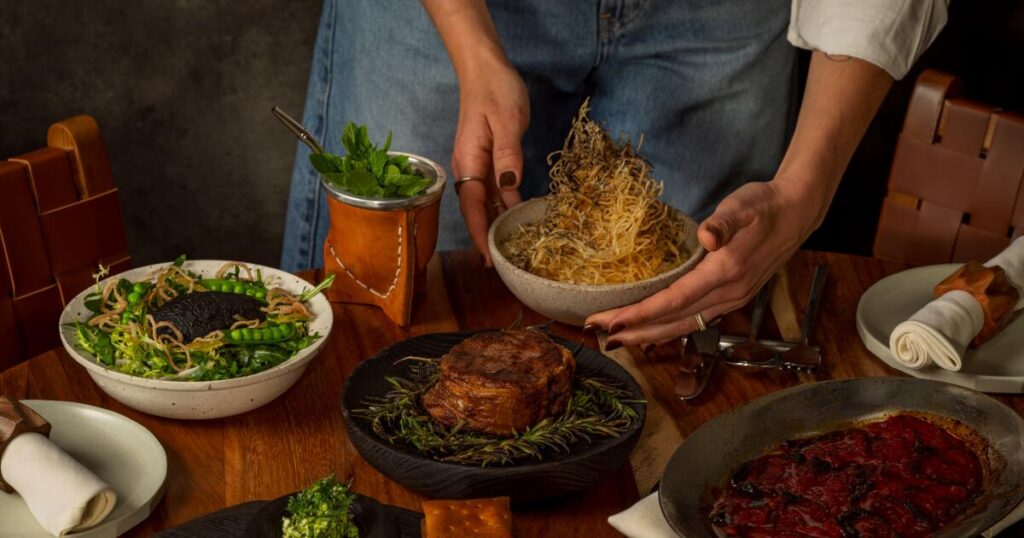
It makes for a satisfying group side dish for the straight-ahead meats at the meal’s center. Asadero banderita is the classic Argentinian cut, marbled and sliced thinnish across the visible rib bones. I’m most partial to the lamb saddle, aged in bee’s wax and cooked over branches of rosemary, adding a forest-herb quality among the smoky, mild gaminess. A pork chop, laid out on a plate in boneless dominoes, has been dry-aged, smoked over applewood chips and then roasted in kombu. It’s a fiddly conceit that pays off: The meat is lush and deeply seasoned and campfire-fragrant.
This is also the portion of dinner that reads most like a steakhouse. Meats are a la carte and the vegetable sides, at $20 to $23 each, lean expensive and underwhelming. I have loved a platter of piquillo peppers slowly confited in beef tallow, but they’re finished with a char in the hearth that can leave them desiccated and metallic-tasting. Little gem lettuces, presented fresh and slighted roasted, need a bigger shock of acid in a lemon vinaigrette. (I felt the same yearning for acidity in a starter of warmed oysters.) Potatoes cooked directly in the heat, mashed and beset with foam and fried garnishes are, sure, decent mashed spuds.
I’ll mention here that the restaurant’s website lists two large-format specials that require at least several day’s advance notice to order. I’ve heard the whole turbot dressed in Basque-style salsa verde is wonderful, but I learned the day before my reservation that the requested fish had been hard to procure that week. It happens. The restaurant proposed instead the other option: asado ancho, an enormous, blandish center short rib cut that costs $300, including potatoes and lettuces. It was advertised for two or three people but could really feed six as part of a full dinner (and a requested side of chimichurri to rev the meat).
Another under-the-radar special, a spectacular dessert, appears only on Saturdays. Torta rogel is a painstaking pastry, often served as a birthday cake in Argentina, comprised of crisp, layered wafers glossed with dulce de leche and crowned with wisps of shiny Italian meringue. It shatters, it soothes, it transcends.
Even as Klenzi and Castellanos define and refine their shared heritage through innovation, they also know when a tradition is perfect as is.
The post Not your typical South American steakhouse. Alto is modernist, bread-centric and groundbreaking appeared first on Los Angeles Times.