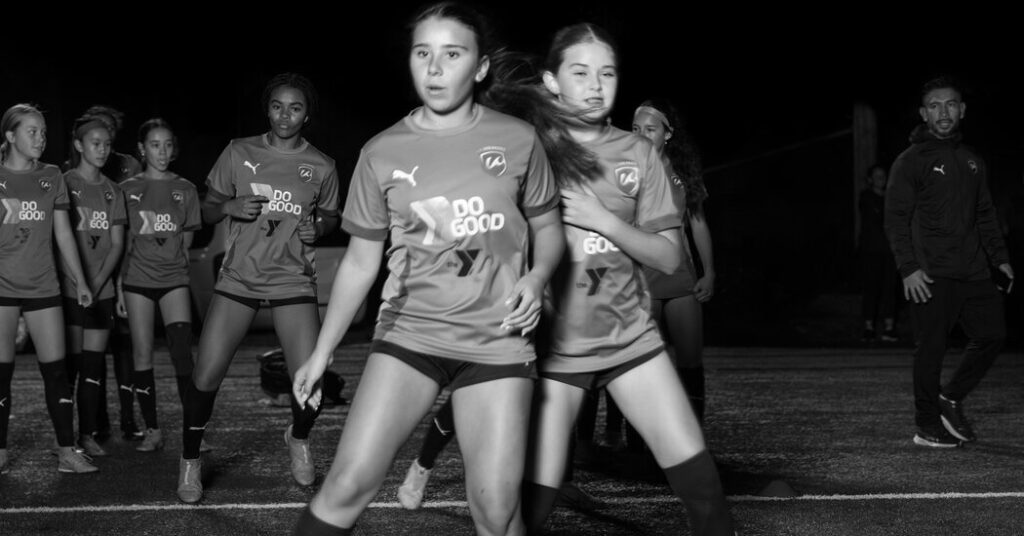
On a damp February night in 2021, I was parked in a gravel lot waiting for my daughter’s soccer practice to wrap up. Through the windshield, I could see another player, Ella Goldsmith, head bowed, back against a fence, as worried coaches hovered around her.
Ella lived near us in our Seattle neighborhood. She and my daughter had become fast friends years earlier when they met at tryouts for their soccer club. On the field, Ella was fierce and determined, so I knew something had to be seriously wrong. She would have practiced with both arms in slings.
It turned out that while chasing a ball, Ella had changed direction and “just stepped funny,” she would tell me later. She heard a pop, her knee buckled and she crumpled in a heap. Her joint felt “creepy” and “gross,” she says, as if the lower leg had detached from her body. Like the professional athletes Megan Rapinoe, Ronald Acuña Jr. and Lindsey Vonn, Ella had torn her anterior cruciate ligament. Ella, though, was only 12.
A.C.L. injuries are among the most devastating in sports. Unlike broken arms or pulled hamstrings, they almost always require surgery and grueling rehab; players are frequently sidelined for a year, sometimes longer. Significant side effects can appear years later and follow athletes for life. A.C.L. tears are associated with long-term pain, early-onset osteoarthritis, even heart attacks (perhaps because damaged knees increase chronic inflammation and make it harder to stay active). Ella approached recovery with the grim discipline of a major leaguer, and 13 months later her doctors cleared her to play again.
A few games after stepping back onto the field, however, she tore the A.C.L. in her other knee when a larger girl smashed into her from the side. After that, she quit soccer, unwilling to risk yet another tear and a third year of rehab, all before she could drive.
The most remarkable part of Ella’s story is how routine this type of injury has become. In July 2022, a few months after her second injury, I watched trainers hoist another of my daughter’s friends onto a cart — another torn A.C.L. The next summer, that girl, too, ripped the ligament in her other knee. In the fall of 2023, three girls on my daughter’s high school team also ruptured their A.C.L.s. Soon the tally of torn A.C.L.s among my daughter’s current and former teammates would reach an astonishing number: 19.
By then, worried, I had started querying experts. None were surprised. “I don’t know that the public knows how bad this problem is,” Joseph Janosky, who had worked at New York’s Hospital for Special Surgery, the country’s premier orthopedic institution, and is now a professor of athletic training at Lasell University in Newton, Mass., told me. “Every country in the world where kids play sports is seeing the same thing.” In Norway, A.C.L. surgeries for teens rose more than 40 percent over a 16-year period ending in 2021. Between 1997 and 2017, A.C.L. reconstructions among teenagers in Britain increased almost 30-fold. “The numbers are staggering,” Janosky said.
Some of this increase reflects improved diagnosis of A.C.L. injuries and exploding participation in youth sports, especially among girls. But that can’t entirely account for the rising number of injuries per hour of sports played, or the fact that these incidents hit girls more than they do boys. Young female athletes are three to six times more likely than boys to tear an A.C.L., and in a recent 15-year period, across a dozen sports in U.S. high schools, the rate of A.C.L. injuries among girls jumped 32 percent, more than double the increase among boys.
Perhaps the most at risk: teenage girls, like my daughter and her friends, who play soccer 12 months a year. They face a greater than one-in-six chance of a tear before finishing four years of high school. Those returning to soccer after rehab face a one-in-three chance of a second tear. “It’s probably the biggest youth sports issue in the world right now, apart from concussions,” Nev Davies, a knee surgeon in Reading, England, who is also a trustee at a charity for knee-injury prevention, told me. “The A.C.L. is the next big crisis.”
It didn’t have to be this way. A quarter-century ago, Holly Silvers-Granelli, a young, driven physical therapist, helped create a sequence of warm-up exercises designed to protect young athletes’ knees. In 2000, she and some colleagues had nearly 3,000 female teenage soccer players in Southern California take part in an experiment to test their regimen. The results were extraordinary. Performing their 20-minute workout three times a week cut the risk of A.C.L. tears by more than two-thirds. When the experiment was repeated a year later, the pattern held.
Silvers-Granelli has since advised medical task forces with Major League Soccer, the N.F.L. and FIFA. She is a co-author of dozens of chapters in books and academic papers, including many with scientists from the Centers for Disease Control and Prevention, the N.C.A.A. and the International Olympic Committee, highlighting the effectiveness of A.C.L.-protection measures. Over and over, her research and that of others has shown that doing the right drills before games and practices significantly reduces the likelihood of A.C.L. tears, especially among teenagers. She calls it perhaps “the most-studied sports-medicine intervention in the history of sports medicine.” When we first spoke in 2023, she told me, “We know these programs work because, at this point, they’ve been validated and recreated and revalidated around the globe.”
Yet even as youth sports have ballooned to a $40 billion business, with millions of kids competing like semipro athletes, playing for paid coaches and traveling out of state for matches, that information has rarely reached those who need it. Studies and surveys have shown repeatedly that a vast majority of sports parents and youth coaches do not know that risk-reduction strategies exist. Some coaches believe that A.C.L. injuries are unavoidable if unfortunate, or insist that their athletes do enough already. Even those familiar with prevention routines often lack the time, resources, knowledge or inclination to insist that their charges do drills properly and consistently. So injuries among kids just keep mounting.
Six weeks after my first chat with Silvers-Granelli, my own daughter, Edie Welch, then 15, limped through our front door after practice. The swelling was visible from across the living room. “I think I’ve done something bad to my knee,” Edie said.
At least 100,000 people in the United States have reconstructive A.C.L. surgery every year; some estimates put the number of ruptures at more than double that, but no single organization tracks every injury. Most people who tear an A.C.L. do so without coming into contact with another player. The culprit is usually a millisecond’s lapse in agility or coordination: a volleyball player lands awkwardly after a spike; a point guard plants a foot and pivots hard.
Dozens of factors amplify the risks. Some studies have suggested that artificial turf may boost the threat of ligament ruptures, prompting N.F.L. players to lobby for natural grass, a debate that resurfaced during this past season when the New York Giants receiver Malik Nabers tore his A.C.L. in September. Wearing the wrong kinds of cleats for a given playing surface may increase risks, too. But teenagers today face an additional challenge: Young athletes no longer learn how to move correctly. When researchers videotaped 16,028 adolescents doing squats and jumps, most of them did not bend or land with adequate neuromuscular control, according to an unpublished study by Janosky.
Silvers-Granelli, who is 52, sees several things at work. Because outdoor activities compete with the couch, TikTok, Minecraft and the like, fewer children today scramble on jungle gyms, build obstacle courses, chase one another in games of tag — the kind of unstructured free play that strengthens the legs and core and engenders intuitive movements. At the same time, more young athletes specialize early in one sport, with no seasonal breaks, rather than switch from soccer to basketball to softball in a given year. Silvers-Granelli recalled an episode of the podcast “Mind the Game” in which LeBron James relayed how he used to regularly make his children take a break from basketball.
“There’s a lack of movement diversity, lack of sport diversity,” Silvers-Granelli told me one morning as we strolled with one of her young clients toward Clover Park in Santa Monica, Calif. The park sits amid a strip of restaurants and boutique shops, beside the brick building where she rehabs injured athletes, from N.B.A. professionals to high school flag-football players. She regularly sees kids on elite teams who “can’t do a forward roll,” she said, “can’t climb a tree, can’t climb a fence.”
Proper movement is important because the human knee, while an engineering triumph, is a bit of an evolutionary kludge. When our primate forebears scurried about on their palms and soles, stress was distributed among four limbs. Going upright doubled the load carried by each leg and drove more force to our bones. Our knees hinge the tibia and femur — the longest bones in the body — primarily through four ropy ligaments. Spongy cartilage, called menisci, provide stability and shock absorption, and the capsule that surrounds them fires signals to the brain. The joint is a marvel — until it isn’t. If we jump, pivot or cut side to side incorrectly or without proper muscular development or preparation, force can be funneled through the chain’s most vulnerable link, the A.C.L. When it ruptures, victims often tear one or both of their menisci in the same knee, too.
Athletic women, particularly in adolescence, also battle their anatomy. The notch in the femur through which the A.C.L. passes is smaller in women than in men. The combination of wider hips and shorter thighs can put more strain on their knees. Hormones released during menstruation can make ligaments looser and possibly increase the risk of injury.
Gender contributes in less obvious ways, too. Despite skyrocketing participation in girls’ sports, girls’ cleats are often just boys’ shoes with different stylings. (“Shrink it and pink it,” in the argot of the apparel world.) But the female foot tends to be shaped differently than its male counterpart, and it absorbs forces differently. Female knees are also more likely to turn inward during quick movements, while ankles roll outward. This can put strain on the shin and therefore the A.C.L. Appropriate shoes may help mitigate these risks; an improper fit can exacerbate them.
Research also shows that coaches introduce boys to weight rooms at earlier ages than girls. Lifting can help address biomechanical or muscular deficits, but researchers note that the oppressive masculinity of gyms pushes some young girls away from strength training. Yet on the field, coaches often train female athletes as if their bodies were the same as boys’.
Still, focusing too much on the risks that can’t be altered without doing more to address the ones that can irks Silvers-Granelli. “Yes, there are anatomical risks; yes, we have to deal with hormone fluctuations,” she told me. But we shouldn’t be so “precious,” she added. “What if we just try to bulletproof the kids a little bit?”
Over several days in Santa Monica, I watched her work with a half-dozen young clients who had torn A.C.L.s. I found Silvers-Granelli empathetic and cheerful, in the way of a popular high school teacher. She read their school essays, watched videos of their goals, helped put words to their grief.
One teen who had torn both of her A.C.L.s told us she worried about needing knee replacements one day. To Silvers-Granelli, that was “emotionally tragic.” High school sophomores should not have to contemplate getting arthritis in their 30s, she said. Silvers-Granelli grumbled about teaching another athlete the kinds of safe movements that she should have picked up years ago. A.C.L. injuries ought not to feel inevitable. “She shouldn’t be on my table right now.”
At the park, Silvers-Granelli, dressed in a black tracksuit and white sneakers, spread colored cones on the grass. Her young athlete, 17 months into recovery from an A.C.L. tear, moved diagonally, backward or side to side toward whatever colored cone Silvers-Granelli shouted out: “Orange! Pink! White! Pink!” She explained to me that girls, more than boys, tend to remain upright and stiff when slowing or cutting left or right — a common driver of A.C.L. injuries. So she was training her client to drop low and engage the backs of her legs when decelerating. By having the girl concentrate on the colors of the cones, Silvers-Granelli was teaching her to move this way unconsciously so she would later do so even when distracted. Performing drills before practices and games then prep the body and brain for movement.
A survey of players at the 2019 Women’s World Cup found that two-thirds of the respondents followed some A.C.L.-protection measures. Yet an overwhelming majority of youth players still don’t do any knee-specific injury-prevention work at all. “That, to me, is the most frustrating thing,” Silvers-Granelli said. “Because that’s low-hanging fruit, and that’s completely modifiable.”
Little about my daughter’s A.C.L. tear was extraordinary, yet it felt catastrophic. A few days after her surgery, she howled in agony when we rolled on compression socks to prevent blood clots. Her pain meds led to stomach cramps so severe that she ended up back in the E.R. The physical therapist she saw twice weekly tried occlusion training — lifting weights with blood flow in her knee restricted — which was nauseating. “That was terrible,” Edie says. Weeks of missed classes put her behind in school.
While some parents push kids into competitive leagues, we signed Edie up at her request. We saw little downside; she liked learning advanced skills. Later, playing four days a week provided a lifeline through the pandemic. But pro sports organizations dedicate time, expertise and resources to helping athletes overcome injuries. Youth athletes, with their hyperactive limbic systems and still-maturing frontal lobes, mostly struggle alone while navigating math quizzes, acne and nervous energy.
Halting physical activity for a year distressed my daughter. Edie had always been in motion. As a toddler, she zipped across monkey bars before many of her peers could even grip the rungs. In a fun run at age 6, for much of the race she outran nearly a hundred boys. She rock-climbed and skied. Joining her school soccer team as a freshman (she played for her travel club the rest of the year) eased the awkward transition to high school.
Suddenly, after her injury, that awkwardness took new form. In the spring, when Edie normally ran track, she now struggled to fold herself into chairs. She attended her first formal in a knee brace, strictly forbidden from dancing. For months she could not bike, swim or jog. When she was finally cleared to run, she was limited to just minutes a day, and only on a track — no gravel or pavement.
Her body sent wrong signals. Five months after her surgery, she felt healed and could not accept that she wasn’t even halfway through her recovery. She wanted to join her friends on a hike, but her doctor said no. Instead, she still spent hours doing physical therapy.
It took six months before the doctor let her kick a ball, and several more months before she could train in earnest. Edie had always been a teammate; now it felt as if part of her were missing. Longing and loneliness and anger crept in. “It’s not like you’re sad all the time,” she says. “It just kind of hits you in random moments.”
When she finally played soccer again, in January 2025, a year and a day after her surgery, she looked fit and joyful. She talked about playing in college. I, though, felt uneasy. Between the two teams, I counted seven girls recovering from A.C.L. tears.
That Silvers-Granelli spends so many days rehabilitating shredded knees troubles her. She has spent her career trying to make such work less necessary. That it has not caught on is “bewildering,” she says. Silvers-Granelli grew up around athletes. Her hometown, Kearny, N.J., a few miles from the Meadowlands, became known as Soccertown, U.S.A., after three local boys found stardom with U.S. World Cup teams in the 1990s. One of them, the goalie Tony Meola, married her sister — and helped set Silvers-Granelli on her path.
In 1999, Silvers-Granelli, fresh out of graduate school with a degree in physical therapy, was living in California and looking for a life in sports medicine. On St. Patrick’s Day, Meola tore his A.C.L. while practicing with his team, the Kansas City Wizards. On a trip to Los Angeles to meet with his knee surgeon, Bert Mandelbaum, the physician for the U.S. Men’s National Team, he brought Silvers-Granelli along. When the three of them later met for dinner, Silvers-Granelli told Mandelbaum that her brother-in-law’s injury had inspired her: What if they tried preventing A.C.L. tears?
Mandelbaum was intrigued. Men once dominated his operating table. With more women playing sports after the enactment of Title IX, the civil rights provision that bans sex discrimination at schools and colleges, he was now, in his private medical practice, operating mostly on the A.C.L.s of young women. What if they focused on girls? The two began working on exercises to protect knees.
A routine created by a medical group in Ohio and tested on female athletes in three sports at Cincinnati-area high schools showed promise. But that protocol, designed as a preseason regimen to be completed several times, took about two hours. Silvers-Granelli and Mandelbaum and a few others wanted a user-friendly alternative, something short that required no equipment. They developed drills that incorporated jogging, stretches, agility movements such as hopping on one leg and strength training for the core, glutes, calves and hamstrings. At 20 minutes or so, the series took a bit longer than traditional warm-ups but could be performed throughout a season.
Their successful tests with girls in California drew attention from FIFA, which sent Silvers-Granelli and others to Oslo to design a soccer-specific version. The global soccer organization called that routine FIFA 11+ and by 2009 had begun promoting it in dozens of countries with instructional manuals, web pages and a brief teaser video highlighting famous pros, including Lionel Messi. FIFA’s medical team planned to spread prevention across the globe.
But in 2015, FIFA’s president resigned following a bribery scandal. A year later, under new leadership, the organization’s medical chief left abruptly. The web pages vanished.
Still, evidence supporting such programs kept piling up. In studies — of male soccer players in Nigeria, female field-hockey players in Australia, female handballers in Norway, women’s basketball teams in Japan — prevention exercises consistently reduced the risk of A.C.L. injuries, often by 50 to 80 percent. Precautions couldn’t eliminate all harm any more than wearing a seatbelt could. But even the International Olympic Committee urged youth coaches in 2017 to adopt the FIFA 11+ drills so young people would learn “movement strategies” or protective habits, much like buckling up.
Yet young players still don’t do them. Studies of teams from Canada to Germany, and polls of parents and coaches of youths across the United States, show that very few players — less than a third — follow any A.C.L.-injury-reduction protocol.
The reasons are varied. Volunteer coaches most likely know little about injury prevention. But most paid, trained leaders remain in the dark, too. As one research team put it: “A prerequisite for using the 11+ is being aware that it exists.” Then there are the coaches who express skepticism. “People are like, ‘Where’s the research?’” Silvers-Granelli told me. “And I’m like, Oh, my God!”
Many of the coaches who devote practice time to prevention do so reluctantly. Clubs reward them for winning. Even if they understand the risks, players and parents may hesitate to question coaches who are responsible for playing time and recruiting. Families harboring dreams of college acceptances or scholarships may see little value in drills that don’t teach kids to score. Silvers-Granelli finds these attitudes maddening. Her research shows that college teams adhering to A.C.L.-injury prevention actually win more games, and she concludes that’s because they keep more players healthy.
Performing drills consistently and well is also hard. It often requires supervision. My daughter’s club coach, Slavo Rafailovic, starts most practices with a modified version of FIFA 11+. But Rafailovic coaches multiple teams — as many of his peers do — and he uses quiet moments to chat with other coaches or parents. Players then lead drills themselves. “Even though you’ve shown them multiple times,” Rafailovic told me, “are they going to do it every time? No.”
Perhaps the biggest problem of all: Children’s sports are Balkanized bureaucracies. Soccer is typical. U.S. Youth Soccer is the country’s largest children’s soccer institution. It represents 2.7 million boys and girls from some 10,000 clubs. The group is part of the U.S. Soccer Federation, which oversees men’s and women’s World Cup teams under the auspices of FIFA. Additional soccer groups represent more than a million other youngsters. And none of these are affiliated with high school sports, which have their own leadership structures. U.S. Youth Soccer doesn’t require coaches to train teams with specific drills, anyway. It runs tournaments and offers educational materials to state associations, which largely govern themselves.
This doesn’t mean that action is impossible. Several years after doctors documented an uptick of Tommy John elbow surgeries among kids in the 1990s and early 2000s, Little League executives set a maximum number of pitches that can be thrown by individual players. In the wake of Larry Nassar’s sexual assault convictions, Congress required abuse-prevention training across youth sports. In 2015, to settle a class-action lawsuit over concussions, U.S. Soccer set age limits on when kids should be allowed to head the ball.
The context surrounding A.C.L.-injury prevention differs in important ways. Lawmakers led the response to Nassar, while athletic organizations tackled concussions and elbow injuries by reforming what national sports bodies regulate: the rules of the game. Reducing knee injuries requires altering practice and pregame behavior — which “we can’t mandate,” Tom Condone, Youth Soccer’s top executive, says. Normally his organization would just pass along suggestions. Hey, here’s a resource, is how Condone told me he might put it. We strongly recommend that your association really looks at this.
But he conceded that the sentiment might not sound as if it meets the moment. With the U.S. Women’s National Team’s Olympic gold medals and World Cup championships, the rise of superstars like Caitlin Clark and Angel Reese in the W.N.B.A. and the recent emergence of Major League Volleyball, Unrivaled and the Professional Women’s Hockey League, women’s sports are surging. Post-pandemic revenue and viewership growth for women’s sports have outpaced that of men’s. Women’s soccer is on track to become the world’s fifth-most-followed sport, with 800 million fans by 2030.
That popularity filters down. There are 12 times more female athletes in U.S. high schools than there were pre-Title IX, in 1971. Thousands of teenage girls now play at exceptionally high levels. That should be celebrated, but early specialization and computers in their pockets and declines in school physical-education programs distract from developing healthy movement patterns. So when it comes to A.C.L. injuries, “I think there needs to be more done,” Condone says.
Youth Soccer recently joined with Silvers-Granelli, Mandelbaum, the Aspen Institute and others to form a coalition to refocus attention on the A.C.L.-injury crisis and kicked off a campaign to promote knee-injury-prevention exercises.
Coaches I spoke with want more, however. Emma Sanders, who coached my daughter’s high school team, does not understand why coaches must figure out A.C.L.-injury prevention themselves. The state made her get a background check and take online courses on bullying, blood-borne pathogens and asthma attacks. Why is knee protection optional? She says that someone should hand coaches a plan and tell them: “Our players are going to follow this.”
Rafailovic, my daughter’s club coach, agrees. So does Chris Lofgren, who is the director of a Southern California youth soccer club, the L.A. Breakers. His club hired extra trainers to lead prevention drills after one player, another client of Silvers-Granelli, suffered two tears. Whether through coach certification or licensing, “it needs to come top-down,” Lofgren says.
Condone himself would support a well-considered mandate. “I like to be told, ‘This is what we’re going to do,’” he says. The question, of course: Who would give that order?
A few weeks after my daughter’s return to soccer, she played in a pair of games attended by college recruiters. Five minutes into the second match, an offensive player swept past Edie, a defender. Edie turned and ran down the girl at top speed. She felt eyes on her. After a year away, she wanted to show what she could do. She caught the player near the goal, planted her left leg and swung — and heard a sound like ripping Velcro. She collapsed and pounded her fist in the turf. The field went silent, except for her sobs. Later, an M.R.I. revealed what we all knew: She had torn her A.C.L. again, along with both menisci. Her high school soccer career was finished.
Silvers-Granelli was sympathetic. She asked if I’d made Edie do A.C.L.-injury-prevention warm-ups. I admitted I had not. I’d assumed her rehab would be enough. But after a year of injury and grief, I was also tired of hounding my teenager. Edie was tired of being hounded.
Silvers-Granelli winced at my confession. Many things can gum up signals between the knee and brain when kids kick a ball. High on that list: a previous knee injury in an otherwise healthy girl. She asked if Edie was done with sports. I could only shrug.
Late that spring, after more surgery and more time on crutches, Edie attended a lacrosse match at a rival school. She found herself wondering if she would ever perform as an athlete in a stadium again. She had missed the college-recruiting window. Athletics now felt scary. She left early, drove to a park and sat in her car and cried.
Not long after, one of her friends suggested we visit the batting cages. Edie, in a knee brace, hit almost every pitch, even though she had swung a bat only once before. It was the happiest I had seen her since her second injury. She had forgotten the simple joy of being an athlete. She smiled and joked all evening. That night, her leg propped on the couch, she turned to me and asked: “Do you think I’d like softball?”
The post Why Are So Many Teen Girls Still Tearing Their A.C.L.s? appeared first on New York Times.