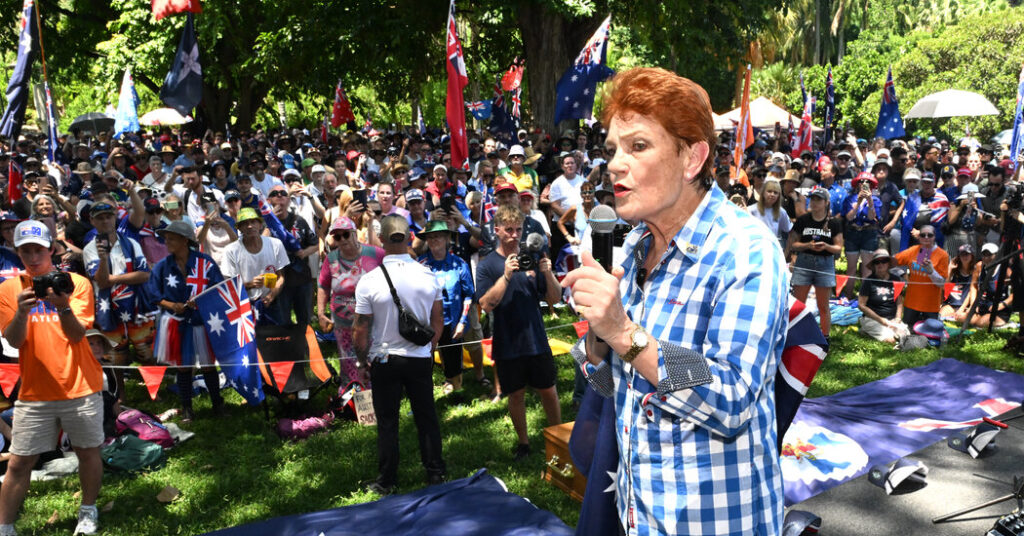
In three decades in the public eye in Australia, the firebrand politician Pauline Hanson has steadfastly been against immigration.
Going in and out of Parliament, basking in reality TV stardom and staging headline-grabbing political stunts, she has warned of the country being “swamped” by newcomers. Each time, she was met with widespread outrage and criticism. After all, modern-day Australia is a diverse society with an economy that has long been heavily dependent on immigration. Still, Ms. Hanson and her far-right party, One Nation, persisted on the fringes of Australian politics.
In recent weeks, though, they have soared in opinion polls to record levels, with nearly a quarter of Australian voters saying they back the party.
One Nation’s base had already been growing in the second half of 2025, with many voters dissatisfied with mainstream parties, given the high cost of housing and living. Then in December, two gunmen — who the police say were an immigrant from India and his Australian-born son, and who were inspired by the Islamic State — attacked a Jewish celebration and killed 15 people.
“For politicians like Hanson, who have built up their repertoire capitalizing on politics of resentment, this is the perfect storm,” said Anna Broinowski, a documentary filmmaker and author who has followed Ms. Hanson’s career.
The groundswell for One Nation in many polls has put it ahead of the main opposition, a coalition of the conservative Liberal and National parties that has been racked by internal turmoil, causing a stir in the political establishment. And it has raised fears that the wariness over immigration that has reshaped politics in the United States and in Europe is now taking hold in Australia, where nearly a third of the population was born overseas and where immigrants largely enter legally.
Some new One Nation supporters said they had once been uneasy about Ms. Hanson’s diatribes against immigration but now feel ready to embrace her arguments.
John Adams, 44, an independent economist who was previously a member of the Liberal Party and later an independent voter, joined One Nation in January.
He said that he was spurred to make the switch, which he had been mulling for sometime, in the aftermath of the Bondi Beach attack. Mr. Adams said that, instead of talking about immigration as a factor behind the attacks, he felt that state and federal leaders focused on curbing protests and curtailing gun rights.
“Pretty much what she was warning about came to pass,” said Mr. Adams, who described himself as the child of Catholic immigrants from Jordan.
“She’s become more palatable,” he added, referring to Ms. Hanson.
Kester Wilson, 69, who said he had voted for the center-left Australian Labor Party for five decades, used to think Ms. Hanson was “a bit of a nutter.” But when a nationwide housing crisis seemed to engulf even his small Western Australia town of Manjimup, where he said prices went “through the roof,” he found himself thinking she had been “on the right track” about immigration.
“We’ve got nowhere to house them,” he said. “Australia’s changed, and I’ve changed.”
Ms. Hanson, 71, is a former fish and chips shop owner and mother of four from Queensland, Australia’s most conservative state. She has highlighted her outsider status to claim to speak for regular Australians, railing against what she sees as elites and political correctness. She has argued against benefits for Indigenous Australians, saying that she is as indigenous to the country as they are.
Over the past week, she has pointed to her party’s newly growing support as a sign that a broader swath of Australians were warming to her consistent message — that Australia needs to curb what she calls “mass migration.”
“Even when the people have been screaming, ‘Pull it back, stop it, we don’t need this many,’ the government disregarded them and just kept bringing in more and more people,” Ms. Hanson said in an interview.
The Bondi Beach shooting, she said, had pushed people to voice concerns about immigration they had been previously reluctant to express.
“People have been worried about this for a long time, but they didn’t know where to go or what to do or how to say it or speak up,” she said. “Bondi has given them the opportunity to say how they feel about it, what’s happened to our country.”
Public attitudes toward immigration in Australia have soured in recent years, as the country saw an influx of foreigners after the end of pandemic-era restrictions, coinciding with a spike in the cost of living and an acute housing crisis. In the 12 months ending in June 2023, Australia saw a record number of more than a half million more people arriving into the country than those who left. In a survey in November, two-thirds of respondents said they wanted fewer immigrants.
The rising anti-immigration sentiment is a sign of conflicting ideas of national identity in a country that actively courted immigrants to build its robust economy in the 20th century, and attempted to embrace multiculturalism after the end of an official, race-based “White Australia” policy in 1973.
Ms. Hanson began her political career attacking Asian immigrants. Over the past decade, she has focused her attention on people from Muslim nations, twice wearing a burqa in Parliament in a stunt to promote laws against the garment.
For One Nation, sustaining the new popular support and turning it into votes and lasting political power will be a long path. The next federal election is two years away, and the party currently holds just four seats in Australia’s 76-member Senate, with a smattering of representatives at the state level.
Jordan McSwiney, a researcher at the Center for Deliberative Democracy at the University of Canberra who has written about Australia’s far right, said the level of support for Ms. Hanson’s party was “completely uncharted territory,” but that channeling it into electoral success was a “big if.”
Among One Nation’s new supporters is Rob Pearce, a 58-year-old owner of a manufacturing business who lives in Mornington Peninsula, east of Melbourne.
Mr. Pearce, who said he had voted for the Liberal Party for decades because he believed its policies were favorable to businesses, said the attack at Bondi Beach prompted him to start showing up for One Nation meetings in his area. Many other attendees, he said, were first-time supporters who had not previously engaged in politics.
“It’s not an embarrassing party like it used to be,” he said. “It’s now standing for something we believe in.”
Himself an immigrant from South Africa, Mr. Pearce said he was not unconditionally opposed to immigration but felt that there was not enough vetting of newcomers. “Choosing the right people who will fit in, not cause trouble,” he said.
Jill Sheppard, a political scientist at the Australian National University, said One Nation’s popularity is forcing immigration into the political debate in a way that would make the major parties uncomfortable.
“They’re in a bind. They’re facing an electorate that is not entirely convinced of the merits of immigration,” she said. “Business wants more migration, voters don’t, and the parties find themselves caught in between.”
Victoria Kim is the Australia correspondent for The New York Times, based in Sydney, covering Australia, New Zealand and the broader Pacific region.
The post She’s Been Anti-Immigrant for Decades. Now Her Popularity Is Soaring. appeared first on New York Times.