What is a fur house to do in a world where fur has fallen out of favor?
That is the existential question that has been facing Fendi, a brand built on the allure of pelts of all kinds, for decades. The brand’s double-F logo, perhaps its most recognizable symbol, does, after all, stand for “fun fur,” not “Fendi Fendi.” A series of designers, including Karl Lagerfeld (who came up with the FF in 1965) and Kim Jones, have tried to offer an alternative, to no avail — the rise of the Baguette bag as a pop culture phenomenon never quite trickled down to the clothes.
Could Maria Grazia Chiuri, who helped build Dior into an approximately $9 billion powerhouse only to depart that brand last May and then be named the first sole creative director of Fendi in October, change all that?
On Wednesday in Milan, as anti-fur protesters shouted outside the cavernous Fendi show space, she revealed her answer. And it was … “Less I, More Us.”
Huh?
The slogan, written in big letters on the runway, seemed to suggest a potential political statement was coming; perhaps a call to unity in fashion and in the face of a fractured world. Ms. Chiuri does, after all, love a slogan: As the first woman to lead Dior, she opened her decade at the house with the T-shirt call-to-arms “We Should All Be Feminists.” And backstage before her Fendi show began, she talked about the fact that designers are only as good as their team, and about the five Fendi sisters who worked together to transform their family company into a global name.
Yet when the first look appeared — a loose, airy, black shirtdress under a black jacket — it became clear this was going to be a collection heavy on the basics and light on the big ideas.
Black was the dominant color, with shots of white and nude; something for everyone was the overriding message. There were cool white collar suits for the office and baggy cargo shorts for Coachella; sheer lace skirts with crisp white shirts and silk slip dresses; leather motorcycle jackets and mirrored hippie vests.
There were slinky bias cut gowns, the occasional animal print and some very cool studded slides. There were even aviator jumpsuits. There were, in other words, a lot of Ms. Chiuri’s favored silhouettes from her Dior days (minus the classic bar jacket so associated with that brand).
And that wasn’t all she brought with her from one brand to the other. She brought her collaborations with female artists, too. Soccer scarves with slogans such as “Rooted but not stuck” and “Present but not dependent” by the Italian artist SAGG Napoli accompanied many looks, as did jewelry from the archive of the Italian artist Mirella Bentivoglio.
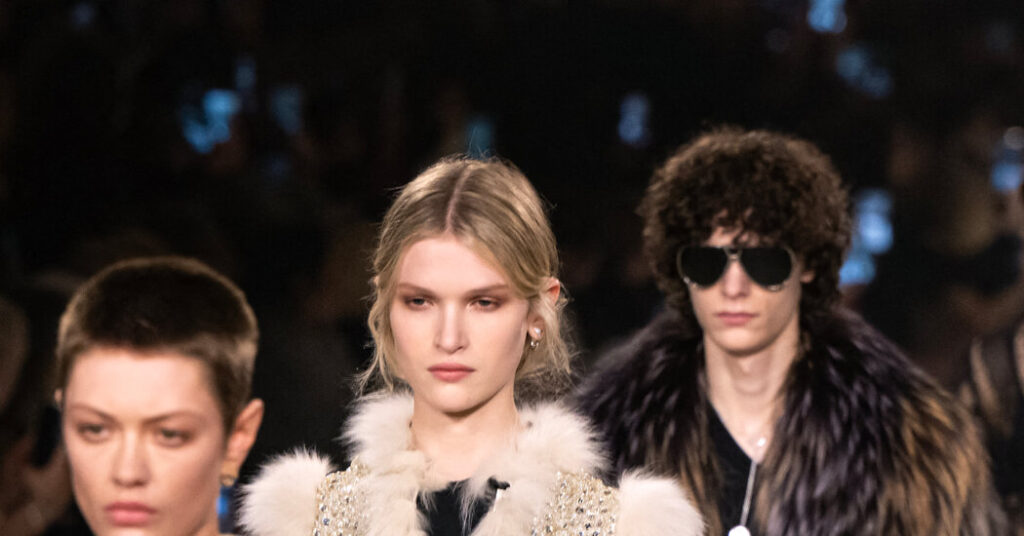
If unity was to be found on the runway, it was in the interchangeable nature of the pieces on both men and women: here a neat single-breasted trouser suit for her with an integral strap keeping the two sides of the jacket in place; there a neat single-breasted trouser suit for him with an integral strap keeping the two sides of the jacket in place. Here a faded Canadian tuxedo for him; there a faded Canadian tuxedo for her.
Ms. Chiuri said her guiding principle was “practicality,” which she saw as a very female approach to design. That came through in the clothes. There was plenty here for people to wear. What there wasn’t was anything to make it identifiably Fendi.
Except for one thing, ironically enough: the fur.
Sprinkled throughout the collection was a lot of fur: in the scarves, curling over coat collars, trimming the vests, patchworked together into big chubby jackets. It was real fur, and not all shearling made to look like other fur (like it is on most runways). But all of it had been upcycled from the Fendi storerooms and archives.
It was, Ms. Chiuri said, the first iteration of a new service the brand aimed to provide by helping clients upcycle their own family furs — the kind inherited from grandparents and great-aunts — rather than abandoning the garments to landfill. The protesters outside might not like the approach, but it served to reframe such clothes’ continued existence, the foundations of Fendi itself and the whole concept of “heritage,” in a way that is both functionally and emotionally sustainable.
That has the makings of a genuinely great idea.
Vanessa Friedman has been the fashion director and chief fashion critic for The Times since 2014.
The post Letting the Fur Fly at Fendi appeared first on New York Times.