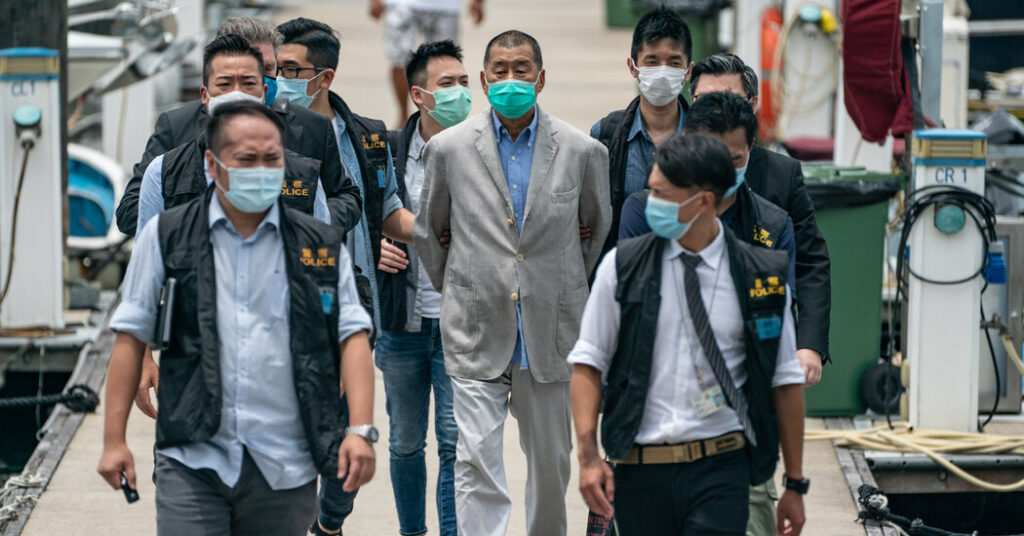
One of the few tycoons who dared to insult the Chinese Communist Party, Jimmy Lai has long been a thorn in Beijing’s side. He backed pro-democracy protests that swept Hong Kong in 2019 with his popular Chinese-language newspaper, Apple Daily.
Mr. Lai, 78, was one of the first and most prominent targets of a national security law that Beijing imposed on Hong Kong the following year, under which more than 340 people have since been arrested. After a landmark trial that lasted more than a year, he was sentenced on Feb. 9, 2026 to 20 years in prison.
On Feb. 26, he won a rare legal victory when an appeals court quashed a separate 2022 fraud conviction related to his newspaper’s lease. The latest ruling clears his record of the charge, but does not materially change his stay in prison. He has been behind bars since December 2020, and his health has faltered.
The 20-year sentence is the longest handed down under the national security law to date.
Here’s what to know.
Who is Jimmy Lai?
Mr. Lai is a businessman who made his fortune in textiles. Born in China in 1947, he stowed away on a boat to Hong Kong, then a British colony, at age 12 and worked in a factory. He eventually founded Giordano, a clothing chain with stores across Asia, and acquired British citizenship.
He was a rare tycoon who did not keep quiet about his political stance.
When student activists in China protested to demand a more democratic government in 1989, he supported them by printing T-shirts with the faces of activists. After Chinese troops killed hundreds, possibly thousands, of demonstrators around Tiananmen Square in Beijing, Mr. Lai decided to become a publisher, launching Next Magazine in 1990 and Apple Daily in 1995.
In 1994, he wrote a column telling the then-Chinese premier, Li Peng — who was seen as a force behind the 1989 Beijing crackdown — to “drop dead.” After Beijing closed Mr. Lai’s clothing stores in mainland China, he decided to sell his stake in the business to focus on his media business.
His news outlets gave blanket coverage to mass, pro-democracy protests in Hong Kong, including in 2014 and 2019. “I believe in the media by delivering information, you’re actually delivering freedom,” Mr. Lai said in an interview with The New York Times in 2020.
Why was he on trial?
Prosecutors argued that Mr. Lai was a “radical political figure” who led a global campaign urging foreign governments to impose sanctions on China and Hong Kong for their crackdown on free speech.
Calling for sanctions is considered a “hostile activity” against the government and is an offense under the national security law. Prosecutors cited as evidence Mr. Lai’s meetings with American politicians, messages he had exchanged with officials and views that he expressed in interviews with news outlets or on social media.
In December, Mr. Lai was found guilty of two counts of conspiracy to collude with foreign forces, punishable by up to life in prison. In 2021, he was sentenced to one year in prison, along with other pro-democracy figures, over his role in an unauthorized peaceful protest.
The newsroom of Apple Daily was raided twice by the police before the newspaper was forced to close down. Five executives and editors who worked with Mr. Lai were also arrested in 2021 and pleaded guilty to collusion charges in the same case. Mr. Lai was also convicted of a separate count of conspiracy to publish seditious material in Apple Daily. He has denied all the charges.
Mr. Lai’s lawyers argued that his calls for sanctions ceased after the national security law took effect, and that he never intended to break the law. Robert Pang, one of his lawyers, argued that it was not wrong to exert pressure on the government in the hope that it would change its policies.
Mr. Lai’s trial was not heard by a jury, but by three judges appointed by the city’s leader to hear national security cases. Some of his former colleagues testified against him in exchange for a reduction in their sentences.
What did Mr. Lai say in his testimony?
Mr. Lai took the stand for more than 50 days. When questioned, he made light of his meetings with American politicians and denied that he had asked them for political favors beyond voicing support for Hong Kong.
He described his conversations with the former national security adviser, John Bolton, as general “chitchat” and said he did not listen “very intently” during a meeting with Nancy Pelosi, then the House speaker. Donations of between $20,000 and $50,000 he made to American think tanks were “too small to even be mentioned,” he said.
He defended his intentions in running Apple Daily, saying it reflected the values of the Hong Kong people, including the pursuit of democracy and freedom of speech, religion and assembly. China has accused the tabloid of spreading “fake news” and “hate speech,” and of instigating calls for “Hong Kong independence.”
“All I was doing was carrying a torch to the reality,” Mr. Lai said.
Tiffany May is a reporter based in Hong Kong, covering the politics, business and culture of the city and the broader region.
The post What to Know About Jimmy Lai’s 20-Year Prison Sentence in Hong Kong appeared first on New York Times.