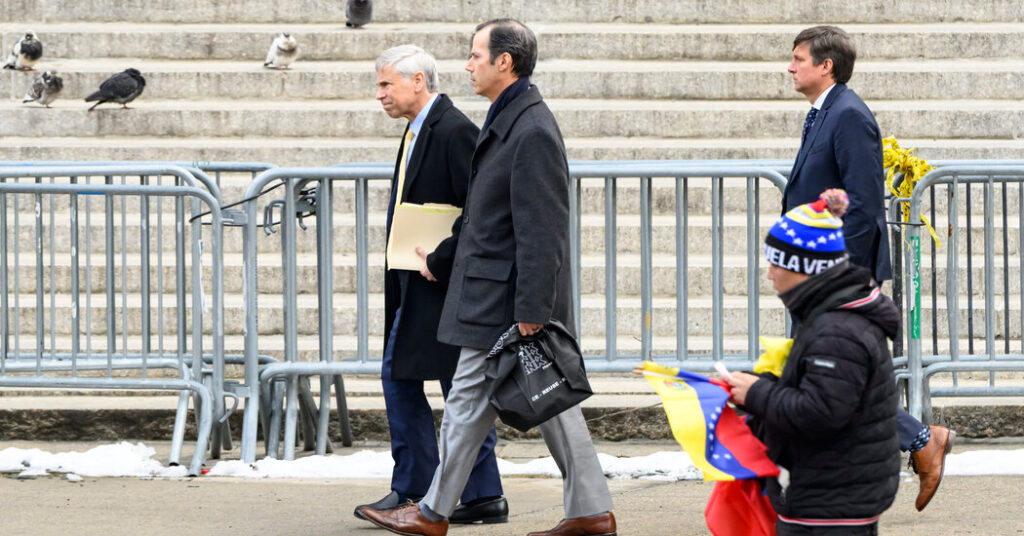
A lawyer for Nicolás Maduro, the Venezuelan leader who was seized from his country by U.S. forces last month and charged with federal crimes, says that the Trump administration is blocking the Venezuelan government from paying Mr. Maduro’s legal fees.
The lawyer, Barry J. Pollack, said in a letter made public on Wednesday that because his client, Mr. Maduro, and the government of Venezuela are subject to sanction by the Department of the Treasury, it was necessary to obtain a license so that he could represent Mr. Maduro and be paid by Venezuela.
A license was granted on Jan. 9, Mr. Pollack said, but three hours later the Treasury Department’s Office of Foreign Assets Control amended it so that it would not authorize the payment of defense costs by the Venezuelan government.
As a result, Mr. Pollack said in his letter, dated Feb. 20, Mr. Maduro cannot afford his services. He argued that the Treasury Department was “interfering with Mr. Maduro’s ability to retain counsel” and his Sixth Amendment right to the counsel of his choice.
“The government of Venezuela has an obligation to pay Mr. Maduro’s fees,” Mr. Pollack wrote. “Mr. Maduro has a legitimate expectation that the government of Venezuela would do so.”
Mr. Pollack said he had asked the Treasury Department on Feb. 11 to reinstate the original license. If it does not act on the request, he said, he would ask Alvin K. Hellerstein, the federal judge overseeing Mr. Maduro’s case, to intercede. The Treasury and Justice Departments did not immediately reply to a request for comment.
The Office of Foreign Assets Control, known as OFAC, grants licenses to allow companies and individuals to enter into arrangements that would normally be barred with countries subject to U.S. sanctions. In this case, if Mr. Pollack was to represent Mr. Maduro or to be paid by the Venezuelan government without such a license, he could be penalized.
Mr. Pollack said in his letter that, after the U.S. blocked payment of defense costs by Venezuela, OFAC had granted several licenses allowing Americans to engage in transactions with the Venezuelan government — even though, he argued, the denial of those licenses would not have raised any constitutional issues.
It is unclear whether the unusual circumstances of Mr. Maduro’s capture have anything to do with the situation. It is possible that the U.S. government believes that Mr. Maduro has other means by which to pay his lawyer. In that case, the Justice Department may ask Mr. Maduro to provide evidence that he has no other assets.
The question of Mr. Maduro’s defense fees — and who exactly will represent him — has been an issue since the outset of the case. Before his arraignment, he was assigned a court-appointed lawyer, who was replaced by Mr. Pollack at the plea hearing.
Then, another lawyer, Bruce Fein, joined the case, saying he had received information “from individuals credibly situated within President Maduro’s inner circle or family” who had informed him that they “trusted no one in Maduro’s hastily arranged initial representation.”
After Mr. Pollack protested, Judge Hellerstein removed Mr. Fein from the case.
Mr. Maduro and his wife, Cilia Flores, were seized from a Caracas, Venezuela, compound in early January and transported to the United States, where Mr. Maduro was charged in U.S. District Court in Manhattan with narcoterrorism conspiracy and cocaine importation conspiracy. He and Ms. Flores have both pleaded not guilty and are being held in a Brooklyn detention center.
Mr. Pollack said in his letter that the license granted to Ms. Flores’s lawyer allowed her to receive funds for her defense from the Venezuelan government.
Benjamin Weiser contributed reporting.
Jonah E. Bromwich covers criminal justice in the New York region for The Times. He is focused on political influence and its effect on the rule of law in the area’s federal and state courts.
The post U.S. Blocking Venezuela From Paying Maduro’s Legal Fees, His Lawyer Says appeared first on New York Times.