As federal judges last spring began to consider the legality of President Trump’s punishing global tariffs, the administration offered an assurance: It told the court that a set of suing companies would “assuredly receive payment” if Mr. Trump ever lost the fight.
Now that the president has suffered such a stinging defeat, major businesses including Dyson, FedEx and L’Oreal have filed an early barrage of lawsuits in search of hefty tariff payouts. But the Trump administration has responded in recent days with a mix of dismissal and derision, setting up what may be a landmark legal battle over refunds.
At stake is more than $100 billion in revenue collected over the past year under a roster of tariffs that the Supreme Court invalidated last week. While a defiant Mr. Trump has since taken steps to try to revive the duties, he still faces the prospect that the money collected from his past tariffs might have to be paid back.
So far, roughly 900 claims seeking those refunds have been filed in federal court, according to the Liberty Justice Center, a legal group that represented some of the small businesses in the lawsuit that reached the nation’s justices. On Tuesday, the group took the first steps in two different courts to pave the way for affected firms recover their past duties. The government must respond in one of those proceedings by Friday.
Despite its earlier assurances that it would repay the money, the Trump administration has now signaled it may be ready for a fight. In the wake of the Supreme Court’s ruling, Mr. Trump brushed off any refunds as unsettled legal ground, as he wagered aloud that a resolution could take “years.” Scott Bessent, the Treasury secretary, said on Tuesday that refund requests could not even start for about a month.
“We will see what the lower court says, and we will follow what the lower court says to do,” Mr. Bessent said in an interview on NBC.
The secretary also faulted FedEx, after the company sued the government this week and demanded a tariff refund. He attacked it for participating in an organization that helps U.S. firms operate in China. And Mr. Bessent argued that the chief executive of FedEx and others should “explain how he’s going to get the money back to the consumers if he, in fact, passed those costs along.”
The public sniping evinced not only the fiscal stakes for Mr. Trump but the philosophical issue that has loomed over his trade war for nearly a year. Even though the president insists that foreigners, not Americans, pay the sky-high duties, his tariffs are taxes on imports, which means they actually fall on U.S. consumers and firms.
Now, some of them quite literally have the receipts to show for it — and they want that money repaid.
Jeffrey Schwab, the senior counsel of the Liberty Justice Center, said that he believed that businesses are in “pretty good shape” legally “because the government has already essentially promised” to issue refunds.
“We won the case, and our clients were harmed by paying the money,” he added. “Our clients are the ones that are, right now, harmed by the fact they haven’t gotten their money back.”
The White House did not respond to a request for comment.
From Washington to Wall Street, the simmering battle over tariff refunds could prove highly consequential, given the sum that the Trump administration has amassed over the past year and the state of the U.S. economy.
Mr. Trump, for one, long has boasted about the revenues collected from his tariffs around the world. Without that money, however, the government’s own finances could worsen, a decline coming months after Republicans added considerably to the federal debt by enacting a set of expensive tax cuts.
On Tuesday, a report from Oxford Economics outlined some of the hypothetical stakes: If the administration is forced to send out tariff refunds in full, it would amount to about 0.4 percent of the country’s total economic output. That would worsen the ratio of U.S. debt to growth, a closely watched figure for fiscal hawks, while possibly adding seven basis points to the yield on 10-year bonds, making borrowing more expensive, the firm found.
For businesses, the tariffs they have paid over the past year also represented a major financial burden. Some raised prices; others renegotiated deals with suppliers or absorbed the duties into their bottom lines. There were even firms that sold the rights to any potential refunds ordered by the court in exchange for an upfront cash payment.
As a result, Richard A. Mojica, a lawyer at Miller & Chevalier Chartered, said he was already receiving a “ton of questions” from clients about the process.
With little information about how refunds would work, or even if a court would order them, he said many companies had tried to pursue multiple avenues at the same time. Some had filed various motions with U.S. Customs to recover duties they had already paid, while others had retained lawyers and started filing lawsuits to claim the money through litigation.
Still, Mr. Mojica said, he had been telling companies “to assume that customs is not going to make it easy.”
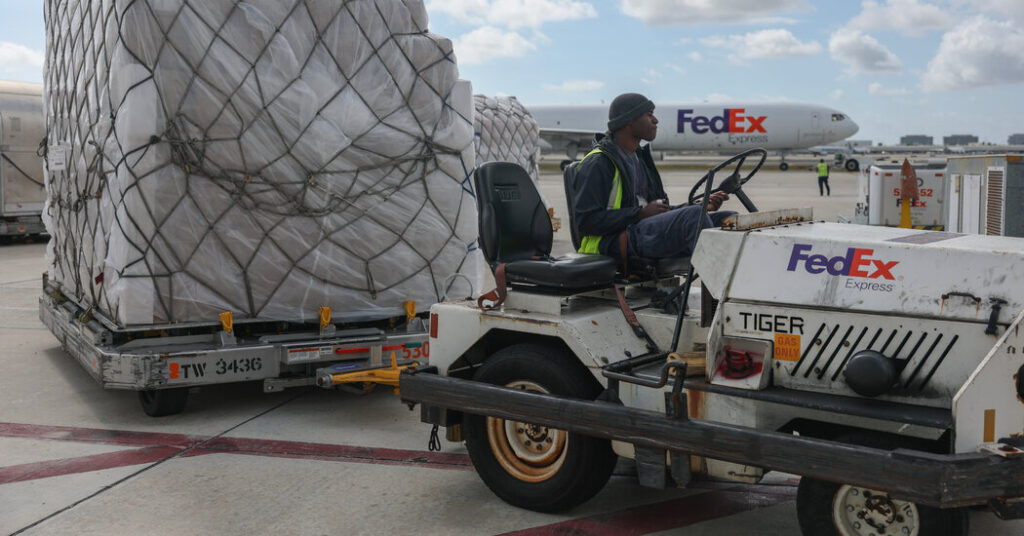
Some of the largest businesses, including FedEx, have opted for lawsuits, seeking to recover the money paid in tariffs under the International Emergency Economic Powers Act, known as IEEPA. In a filing this week, the shipping giant asked judges on the Court of International Trade to “order refunds” related to those duties, “with interest as provided by law,” though the company’s request did not include any specific dollar figure.
The trade court, which had been the first to rule against Mr. Trump and his use of IEEPA, has received similar requests recently from businesses including L’Oreal, which makes cosmetics; Dyson, which manufactures vacuums; AllSaints, a clothing brand; and Bausch + Lomb, which makes eye health products, according to court filings.
Other major companies, including the buy-in-bulk retailer Costco, filed their lawsuits before the Supreme Court could issue its decision last week. While more filings are likely, some large businesses may choose to tread carefully because they see reputational risk in going up against the Trump administration, according to one industry executive, who declined to be named for fear of retribution.
Mr. Schwab, the lawyer at the Liberty Justice Center, said judges may “want to figure out a way that is very efficient” to handle the requests “so that they aren’t hearing 900 cases.” Alternatively, he said businesses are “happy to work with the court and with the government in attempting to come up with a process” so that money could be returned in an orderly matter.
But Mr. Schwab emphasized that he expected the Trump administration to pay, citing its own past comments and a belief that the Court of International Trade “would basically hold the government to that promise.”
The Justice Department offered its view on refunds back in May, when it asked the trade court to hold off on enforcing its original ruling invalidating the president’s tariffs. The move was aimed to buy time for the administration to file its appeal.
Explaining its thinking, lawyers for the government said that the pause, known as a stay, was warranted and would not harm businesses because the administration “will issue refunds as directed by the Court, including any post-judgment interest that accrues during the pendency of the appeal.” It made the same claim in other filings, and across multiple cases, many of which ultimately did not resolve in the Trump administration’s favor.
The Justice Department has not yet filed a formal legal reply on its latest views since the Supreme Court’s decision. But Mr. Trump and his top advisers have suggested at times they may try to fight back.
“I guess it has to get litigated for the next two years,” Mr. Trump said on Friday, as he lamented what he described as a lack of clarity from the justices on the issue of refunds. Later, he wagered: “We’ll end up being in court for the next five years.”
Ana Swanson contributed reporting.
Tony Romm is a reporter covering economic policy and the Trump administration for The Times, based in Washington.
The post Businesses Push for Tariff Refunds as Trump Aides Hint at Fight to Come appeared first on New York Times.