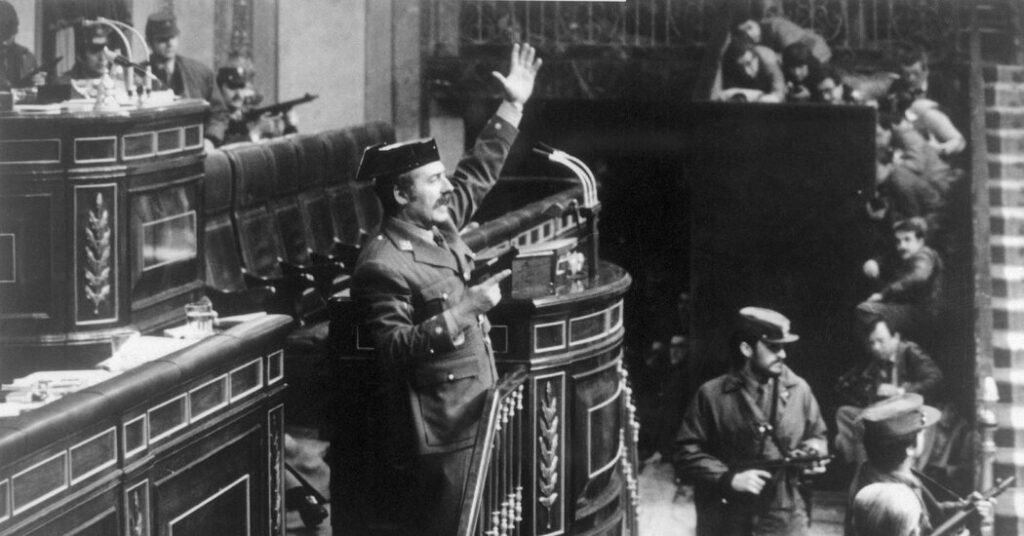
Shortly after 6 p.m. on Feb. 23, 1981, a mustachioed Spanish military leader nostalgic for the dictatorship of Francisco Franco led more than 150 civil guardsmen into the Spanish Parliament, shooting at the ceiling and sending lawmakers cowering behind their desks, as part of an attempted coup to end Spain’s fledgling transition to democracy.
Seventeen hours later, the coup leader, Lt. Col. Antonio Tejero Molina, surrendered. The standoff has filled 45 years of conspiracy theories, books, movies, television shows and endless public debate — often along partisan lines — about what exactly happened in those hours when practically all of Spain stood still and many worried that its fragile democracy had shattered.
On Wednesday morning, the government declassified 153 documents from a state investigation into the coup, known simply as 23-F, for the 23rd of February, releasing all of the files the government said it had found on the topic.
The documents offered no shocking revelations but provided new details that deepened the public’s understanding of the failed putsch — included the plotters’ hand-drawn flow charts on possible military operations; transcripts of phone calls in which the king told the conspirators to pull the plug; the involvement of intelligence agents; and the wiretapped conversations of a soldier who said he was ordered to “shoot to kill.”
The unsealing, after decades of secrecy, comes months after Spain celebrated the 50th anniversary of its transition to democracy. “Democracies must know their past to build a freer future,” Prime Minister Pedro Sánchez said when he announced on Monday that he would declassify the documents.
The publication set off a scramble by scholars and reporters — as well as political partisans and a seemingly insatiable Spanish public — to scan the material for new information. Much of the searching focused on the role of King Juan Carlos I, Franco’s handpicked successor, who renounced the absolute powers he inherited from the dictator in 1975 and then emerged from the 1981 coup as the keeper of Spanish democracy.
The coup failed after Spanish television broadcast a message by Juan Carlos, wearing full military uniform, urging the rest of Spain’s armed forces to reject the attempted takeover and honor Spain’s young Constitution.
Coup plotters had long claimed the king knew what was coming and encouraged the putsch, but Juan Carlos — now 87 and in self-imposed exile in Abu Dhabi after financial, sex and elephant-hunting scandals led to his abdication a decade ago — has so far escaped the declassification unscathed. In fact, the new material left his reputation for defending democracy, which his supporters consider the true centerpiece of his legacy, intact and even strengthened.
“Any coup d’état cannot hide behind the King; it is against the King,” Juan Carlos told one of the coup leaders, Lt. Gen. Jaime Milans del Bosch, in a tense phone call, the documents show. He then ordered the general to “withdraw all the units you have deployed.” He added, “Whoever revolts is prepared to provoke, and will be responsible for, a new civil war.”
The declassification represents yet another effort by Spain to turn the page on its painful transition from dictatorship, even as the past again seems to bleed into the future. Franco is enjoying renewed popularity with young men. The former king is fighting over his legacy. A new best-selling novel about the Spanish Civil War is reviving old debates.
Elma Saiz, a government spokeswoman, said the declassification aimed to prevent “the far right from continuing to use hoaxes, conspiracies and disinformation to promote theories that our democracy does not deserve, and also from misleading young people who think life was better under Franco.”
Spain’s right wing leaders said the government was using the material to score political points.
“I refuse to play along,” said Santiago Abascal, a far-right leader, when asked on Spanish television about the declassification.
Scholars were more interested in the substance of the coup than how it was spun.
“After decades of work by historians, and now with this release, no one can say that we will never know what happened on 23-F,” said Julián Casanova, a noted historian of contemporary Spanish history at the University of Zaragoza.
The documents are from a 1982 state investigation into the preparations and execution of the coup, which took place as lawmakers voted on the appointment of a new prime minister. The investigation resulted in the conviction of 22 defendants, including its leaders, Colonel Tejero Molina, who led the attack on parliament, and General Milans del Bosch.
Colonel Tejero Molina told investigators that with his own family’s money and an advance on his salary, he had bought six 50-seater buses and raincoats so that 288 Civil Guards could move surreptitiously through Madrid.
Intercepted phone conversations revealed that one soldier involved in a siege on the Spanish television broadcaster said his captain ordered subordinates to fire a warning shot and then “shoot to kill.”
Another wiretap showed that Colonel Tejero Molina’s wife complained to a friend that her husband had been hung out to dry. “Left,” she said, “like a cigarette butt.”
Other documents suggested that plotters sought to implicate King Juan Carlos in an attempt to deflect blame and revealed that six members of Spain’s secret service either knew or helped plan the coup. One report from 1982 by a Spanish intelligence agent suggested that a meeting between royal officials and General Milans del Bosch was “above all” intended “to ensure that the Crown does not emerge damaged from the proceedings.”
General Milans del Bosch received a 30-year prison sentence but was released in 1990 and died in 1997. Colonel Tejero Molina was also sentenced to 30 years but was released in 1996 and, at 93, remains a die-hard supporter of Franco.
Among the documents is a handwritten note from a putschist complaining about the coup’s failure, which it attributed to the plotters failing to capture the king “and treating him as if he were a gentleman.”
Carlos Barragán contributed reporting from Madrid
Jason Horowitz is the Madrid bureau chief for The Times, covering Spain, Portugal and the way people live throughout Europe.
The post 45 Years After Botched Coup, Spain Declassifies Files About Why It Failed appeared first on New York Times.