In the long, uphill climb that Democrats face in this year’s fight for control of the Senate, the seat being vacated by Senator Thom Tillis, a Republican, is a must-win. But it is in North Carolina, a state that has broken the national Democratic Party’s hearts for nearly two decades.
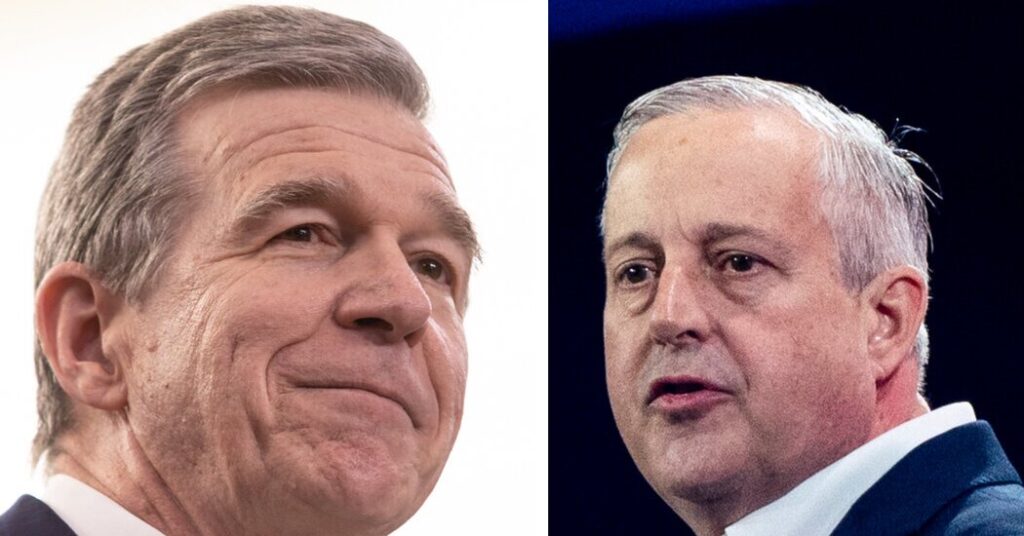
After the primaries on Tuesday, voters are likely to be choosing between two sharply different candidates who are expected to win their races: former Gov. Roy Cooper, a moderate Democrat with widespread name recognition; and Michael Whatley, a former chairman of the Republican National Committee who entered the race with President Trump’s support.
In other states, Democrats are trying to decide between youthful candidates on the left and older, more established politicians, while Republican primary voters drive their party farther to the right to satisfy Mr. Trump’s base. In North Carolina, the template is simpler: a Democrat who has been in public office for more than 30 years versus Mr. Trump’s man behind the scenes.
“More so than any race North Carolina has had in the past, this is going to be a purely nationalized race,” said Andrew Dunn, a Republican strategist and the publisher of Longleaf Politics, a conservative newsletter. “The result will rise and fall based on President Trump’s popularity in North Carolina.”
The North Carolina is one of just two Senate contests this year in states where Democrats have recently been competitive (the other is in Maine). To win control of the Senate, Democrats need to net four seats, and the path is much steeper in states like Ohio, Alaska and Iowa.
But many Democrats appear most confident about their chances in North Carolina, partly because Mr. Cooper, who served as the state attorney general for 16 years before being elected governor, has never been beaten. Republicans argue that’s because he has rarely been in a tough election.
On the Republican side, Mr. Trump’s early endorsement of Mr. Whatley, who has helped the president’s political movement thrive behind the scenes, will test whether there is still substantial devotion to Trumpism in the politically purple state. North Carolina voted for Mr. Trump in 2016, 2020 and 2024, but Democrats managed to win the governor’s contest those years, too. And the state has continued to grow rapidly since the last election, especially in its liberal-leaning cities.
Several issues are expected to loom large over the Senate race, including health care and the continued recovery from Hurricane Helene in western North Carolina. Mr. Trump appointed Mr. Whatley as the “recovery czar” for the region last year, a title that could hurt Mr. Whatley’s standing among voters because of local frustrations over the Federal Emergency Management Agency. At the same time, others in the heavily conservative area have blamed Mr. Cooper for what they described as a chaotic immediate response to the 2024 storm.
Mr. Cooper’s campaign has already begun to prioritize affordability, an issue that has struck a nerve across the country, and he has portrayed Mr. Whatley as a Washington lobbyist who is out of touch with residents’ struggles. He has also sought to tie some of the president’s policies to Mr. Whatley, saying that chaotic “Whatley-backed tariffs” are raising costs.
Mr. Whatley has been attacking Mr. Cooper’s record and his image as a moderate. He has tried to pin the fatal stabbing of Iryna Zarutska last summer on a light rail in Charlotte on Mr. Cooper, a killing that ignited a firestorm on the political right. Mr. Whatley and other Republican officials have claimed that a settlement about prison conditions led to the early release of Decarlos Brown Jr., the man charged in Ms. Zarutska’s death. But state prison officials say there is no evidence that occurred, nor that Mr. Cooper had ordered his early release.
Mr. Whatley has also described his opponent as weak on curbing immigration and ineffective when working with Republicans in Raleigh, the state capital. Mr. Cooper, though, has highlighted his ability to pass Medicaid expansion and create jobs while working with a Republican-controlled legislature.
Trying to rebrand a longtime elected official like Mr. Cooper could be hard, said Chris Cooper, a political science professor at Western Carolina University. To redefine the former governor, he added, “is in some ways to tell voters, ‘you were wrong,’ and that’s tough.”
Despite longstanding criticisms from the right that Mr. Cooper is much more liberal than he lets on, with nicknames like “Radical Roy,” he had an approval rating just above 50 percent several months after leaving office.
Mr. Whatley’s allies note that it is still early, and that there is plenty of runway to make up ground before the general election in November. Mr. Whatley, who is from western North Carolina, is also a prolific fund-raiser. Total spending in the race from both parties could reach more than $600 million and possibly nearly $1 billion if the contest remains close through October, according to political strategists for both campaigns.
The messaging from both camps has been gelling since last summer, after Mr. Tillis announced that he would be retiring at the end of his term.
A marquee matchup had been expected between Mr. Tillis, a tough campaigner who defeated the last Democrat to hold a North Carolina Senate seat, and Mr. Cooper — so long as the Mr. Tillis survived a primary.
But Mr. Tillis, who has become unpopular with the MAGA base, abruptly announced his decision to retire last summer after Mr. Trump threatened to back a primary challenger. Mr. Tillis said at the time that he could not vote for the president’s expansive spending bill, which extends the Trump administration’s 2017 tax cuts but also includes items that the senator opposed, like cuts to Medicaid spending.
Soon after, Mr. Trump endorsed Mr. Whatley, who has worked for Republicans since 1984, when he volunteered for President Ronald Reagan and Senator Jesse Helms.
But it was Mr. Whatley’s early embrace of the Trump movement that endeared him to the president. Even so, political experts say, past midterms have shown that Mr. Trump’s success does not always pass on to other candidates when his name is not on the ballot.
“The question is: Is Trump a coattail that could bring Whatley in, or will he be an anchor that drags Whatley down?” said Michael Bitzer, a scholar of North Carolina politics at Catawba College in Salisbury, N.C.
Part of Mr. Cooper’s success has come from his ability to consistently gnaw off Republican advantages in rural counties and the suburban areas around Charlotte and the Research Triangle — Raleigh, Durham and Chapel Hill — or at the very least keep them competitive.
But Republicans have dominated North Carolina’s Senate races, stretching back to 1984, when Mr. Helms defeated Jim Hunt, a popular Democratic governor.
In more recent Senate races, though, Democrats argue that Republicans have had lucky breaks, because of bad election cycles, or, in the case of 2020, because a sex scandal dashed the hopes of Cal Cunningham, the Democratic candidate.
Either way, both Mr. Cooper and Mr. Whatley have begun to offer glimpses of what’s to come in their campaigns.
“Michael Whatley is going to do whatever this president tells him to do,” Mr. Cooper said at a recent campaign stop with small business owners in Charlotte.
This month in Fort Bragg, the military base near Fayetteville, Mr. Whatley stood beside Mr. Trump and reminded service members and attendees about the moment the Trump era began, with a ride down a golden escalator.
“North Carolina stood up,” Mr. Whatley told the crowd, “and said, ‘That’s our guy.’”
Eduardo Medina is a Times reporter covering the South. An Alabama native, he is now based in Durham, N.C.
The post In N.C. Senate Race, Democrats Bet a Big Name Can Beat Trump’s Endorsement appeared first on New York Times.