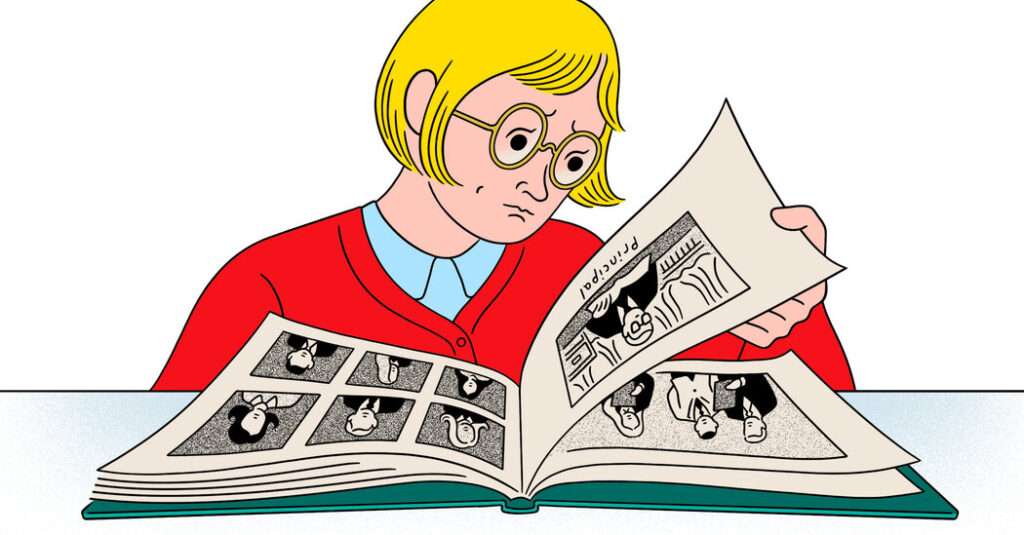
At my 55th high school reunion a few years ago, I talked with a classmate I barely knew — she had been a shy, reserved girl who came to our school as a transfer student. She told me that our principal would visit her home while her mother was at work and assault her. I don’t remember the specifics of the abuse, but he was clearly a sexual predator. He died more than a decade ago, his obituary celebrating him as a beloved principal and volunteer. He was a community pillar with a dark underside and possibly other victims. In this #MeToo era, such revelations have become depressingly familiar.
I haven’t been in contact with her since. I don’t know if she told me in confidence or how many others might know, but I’m unsure what to do with this information. I hate what happened to her and don’t want him to get away with it. Yet he’s not here to defend himself, and this may not be my story to tell. What to do? — Name Withheld
From the Ethicist:
I once asked my father why, in his autobiography, he had so little to say about the failings of Kwame Nkrumah, who was Ghana’s first president and someone he had known well. Dad’s reply was an old Latin tag: De mortuis nil nisi bonum (“One should not speak ill of the dead”). This struck me as exceptionally generous. One of President Nkrumah’s failings had been a habit of locking up his political opponents without a trial — my father among them.
The maxim isn’t entirely meritless. For one thing, post-mortem accusations can’t be rebutted by the accused. Still, if you have evidence of misconduct by a person who is now dead, bringing it to public notice can be useful. While losing a community’s good opinion is not exactly a punishment for someone who is no longer alive — and while such cases leave no scope for repentance or apology or reform — there’s a kind of justice in setting things straight. Sometimes, too, a public account reaches other victims who thought they were alone, providing a form of belated support. And people care about their posthumous reputations. A commitment to the nil nisi bonum rule would leave us without one form of leverage on the conduct of the living.
In this case, there are complications. To start with, the survivor of these assaults is a living person who could have made her story public had she wanted to. The sort of disclosure you heard generally comes with the presumption that it won’t be passed on without consent. Even if you spread her story without naming her, you would reasonably be asked for supporting details. Exposing him might end up identifying her, and airing these facts would, in any event, have an impact on her, pulling her experiences into public view.
Second, because the offender is no longer around to prey on young people, public disclosure wouldn’t protect others from him. The only certain consequence would be reputational: It would correct a falsely positive image of one man. The broader lessons are already well known; such revelations, as you note, are common. And this man has been dead for years. Despite the laudatory obituary, how many people remember him today?
It would be very different if the survivor herself, having weighed the consequences, chose to make her story public on her own terms. If she did want to come forward — perhaps through posting on social media or contacting journalists — she might appreciate your support in that. You’d be standing with her, not speaking for her.
Readers Respond
The previous question was from a reader who had recently become the legal guardian of a teenager and was struggling with the difficulty of the relationship. He wrote:
My wife and I recently became the legal guardians of a teenager. … They come from an extremely difficult situation involving neglect and emotional abuse. … From the beginning, we agreed with our ward that we would treat them as we treat our own children — same expectations, same privileges and full support. For a few months, this arrangement seemed to be working. … Then, little by little, they withdrew from us, no longer spending time with the family, and started getting worse grades again. … My wife and I are about to engage in therapy with our ward. I am not looking forward to it; I worry that even in that safe space, I will not take well the possible complaints and criticisms we may hear from them. What obligations do we have — beyond the legal ones that we’ll meet — to our ward, and to ourselves, as we navigate a painful emotional landscape? And what moral, economic and emotional obligations should we anticipate when they turn 18 and become independent with no real support network? — Name Withheld
In his response, the Ethicist noted:
However much you have done for this young person, they had a life before coming to live with your family, and their feelings for you are probably not going to be those that your children have. … I understand why the family therapy you’re about to engage in feels daunting. The complaints you will hear are going to sound like ingratitude. If the therapist is any good, though, the sessions will allow you to explore and explain your feelings, too. … What you’ll owe this person when they reach legal majority will depend, in good measure, on what commitments you make in the next year or two and what expectations you encourage them to develop. A lot of this will be up to you. The relationship you have with them may or may not gain genuine warmth. Once you reach into a person’s life in the way you have, however, you shouldn’t just abandon them — though you should be prepared for the possibility that they will decide to abandon you.
(Reread the full question and answer here.)
⬥
Long ago I was this teen. I cannot explain the trauma of having your parents give up on you and bouncing around in the households of parents who are not your own. The child sees that they are not loved in the way the other children are, a daily reminder of their unluckiness that re-traumatizes them. Feeling safe and comfortable and trusting may not be possible, at least in the short run. The teenager may feel better if there is simply a clear conversation about both parties’ responsibilities in this arrangement — that the guardians will provide shelter, and the teenager will be expected to assimilate to the household. This young person has a long life ahead of them, and these guardians are in a unique situation to make a difference in it. — Marlayna
⬥
My guess is that individual therapy for your ward will be far more helpful than family therapy, although doing both is a great idea. They need the chance to express and explore their feelings in a safe place, without you or your wife present. Additionally, they could benefit from learning coping skills and healthy ways to process the world around them. — Micah
⬥
Hoo, boy. First, kudos for helping this kid. Second, surround this kid with love and help them gain self-confidence. I am a mother to two kids whom I adopted when they were 5 and 10 years old, and yes, it was a challenge. The good news is that there can be an excellent outcome for all. Like our therapist said: “Be a Teflon boulder; nothing moves you and nothing sticks.” — Cindy
⬥
Any child whose parents have mistreated and abandoned them has profound doubt about their own worth. They’re asking you to prove your steadfastness precisely by testing it, and daring you to reject them. In their eyes, you hold pretty much all the power. Most important for every child is feeling secure that, no matter how hard they try to put distance between them, their parents (or guardians) won’t abandon them. — J.
⬥
I was touched by the Ethicist’s compassionate and thoughtful response. There is one issue that was not mentioned: the effect on the biological children of the couple. There is no doubt that their lives are being disrupted, as well, and the compassionate and tolerant gesture of their parents is now requiring a similar move from them. That is not trivial, and you might consider expanding the therapy session to the whole family. — Alexandra
The post Should I Tell People What My Principal Did? appeared first on New York Times.