In a nod to voter frustration over rising electricity prices, President Trump on Tuesday said he was negotiating pledges from major tech companies to pay a greater share of the energy costs associated with new data centers.
Silicon Valley is spending hundreds of billions of dollars to build power-hungry data centers for artificial intelligence as demand for electricity is increasing across the United States. That has led to widespread fears that the A.I. boom could cause utility bills to spike for ordinary households.
Mr. Trump’s announcement during his State of the Union speech was light on details, and experts said that any promises by tech companies to pay more for their electricity could be difficult to verify or enforce in practice. Yet the move underscored the extent to which White House officials and Republicans have worried that rising electricity prices could hurt them in the midterm elections this year.
“We’re telling the major tech companies they have the obligation to provide for their own power needs and can build their own power plants so no one’s prices will go up,” Mr. Trump said. He called it a “ratepayer protection pledge.”
Data centers being built today can use as much power as a small city, and they often require large new transmission lines, power plants and other costly upgrades before they can be connected to the local electric grid. Historically, utilities have spread those upgrade costs — which can reach billions of dollars — among all customers in their regions.
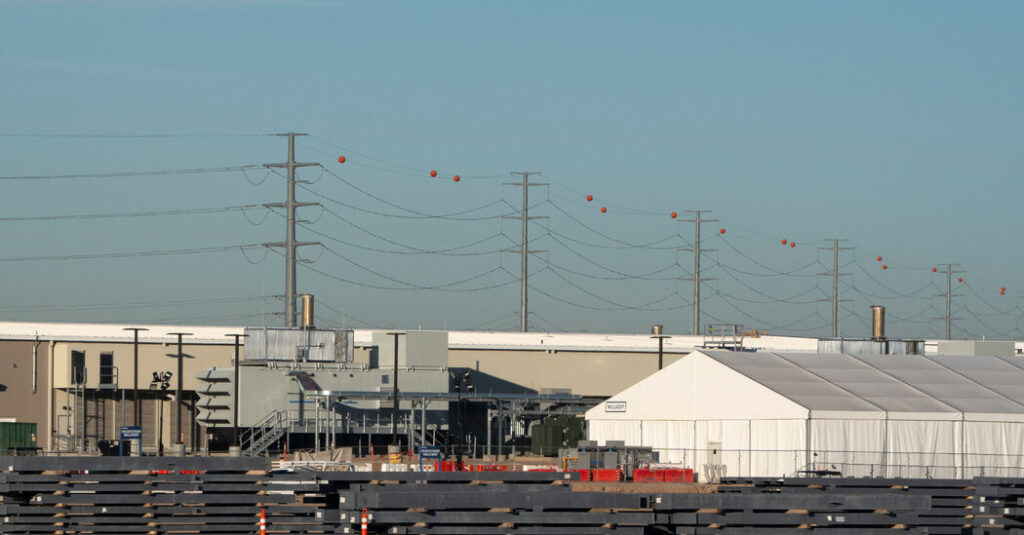
But politicians are increasingly calling on tech giants to foot most or all of the bill for these upgrades. In recent weeks, both Microsoft and Anthropic have publicly pledged to pay higher electricity rates to cover their costs. Many tech companies are also building their own power plants, largely fueled by natural gas, as Meta is doing with a data center in El Paso, Tex.
“We absolutely want to pay our fair share of all costs associated with serving us,” Briana Kobor, head of energy market innovation at Google, told a recent gathering of utility regulators in Washington.
Experts say that such pledges could potentially help curb electricity costs for everyone else but the effects would depend on the specifics of the plan. “If you could wave a magic wand and have tech companies pay for every nickel that’s being spent on infrastructure, that would have a significant effect,” said Ari Peskoe, who directs the Electricity Law Initiative at Harvard University.
“But it gets complicated in practice,” he said. “There are a lot of big question marks here.”
It can be difficult to figure out which expenses should be assigned to new data centers, such as the cost of upgrading transmission lines. The contracts that data centers sign with local utilities are typically confidential, which can make it hard for the public to verify whether tech companies are paying all of their associated costs. In some parts of the country, regional grid operators and regulators may also need to rewrite complex rules on how to allocate their costs.
Trump Administration: Live Updates
Updated
- U.S. and Ukrainian officials to meet in Geneva this week.
- Democrats counter Trump after his combative State of the Union speech.
- Casey Means, critic of mainstream medicine, is poised to become nation’s top doctor.
It is also unclear whether any pledges from the major tech giants would apply to the smaller third-party developers that are often the ones building data centers and negotiating power contracts.
The White House did not respond to questions about the pledge or which tech companies had signed it. On a call with reporters Wednesday, Energy Secretary Chris Wright said, “Every name you know that’s developing a data center has been in dialogue with us.”
Josh Levi, the president of the Data Center Coalition, a trade association, said in a statement that tech companies plan to “work closely” with the administration on the issue. “We appreciate President Trump’s focus on winning the global A.I. race, and we share his commitment to the continued responsible development of the data center industry, alongside a more affordable, reliable electric grid that serves all customers,” he said.
The Energy Department also announced Wednesday morning that it would loan $26.5 billion to two electric utilities, Georgia Power and Alabama Power, to help build new gas plants and batteries and upgrade nuclear plants and transmission lines. The loan would allow the utilities to reduce their borrowing costs by about $300 million per year, officials said, and allow Georgia Power to enact a three-year rate freeze at a time when data centers are expanding rapidly in the region.
Last month, the Trump administration also floated a plan to try to ease the rapid price increases occurring in PJM Interconnection, a regional grid that serves 65 million people in the Mid-Atlantic. That proposal, which would require significant regulatory changes and is still under review by the grid operator, would have tech companies pay to build new power plants in the region through specialized 15-year contracts.
But that plan could take years to have an effect, experts said. That’s because, in the short term, data centers can come online and drive up electricity demand faster than new power plants can be built.
Rising electricity rates have become a volatile political issue in many parts of the country. Over the past six years, the average retail price of electricity has risen faster than inflation in roughly two dozen states.
Some tech firms, electric utilities and Trump administration officials have disputed the idea that data centers are to blame. In Virginia, home to the nation’s largest concentrations of data centers, electricity prices have mostly stayed flat over the past six years after adjusting for inflation. Some analyses have suggested that new data centers can even lower prices by allowing utilities to spread the fixed costs of maintaining the grid among a larger set of customers.
Yet the new pledges suggest that the big data center companies, known as “hyperscalers,” are scrambling to avoid a backlash. At least 25 proposed data centers were canceled last year after protests by nearby communities, according to research by Heatmap, a climate news site.
“The rhetoric from hyperscalers has changed over the past year,” Mr. Peskoe said. “A year ago, they were saying that they were already paying their fair share. Now they seem to be acknowledging that they need to do better.”
Mr. Trump had originally promised that he would cut electricity bills in half within 18 months of taking office. While he almost certainly won’t come close to meeting that pledge, he again promised in his Tuesday address that energy costs would fall.
“Soon you will see numbers that few people would think were possible to achieve just a short time ago,” he said. “Nobody can believe when they see energy going down to numbers like that.”
Brad Plumer is a Times reporter who covers technology and policy efforts to address global warming.
The post As Electric Bills Rise, Trump Says Tech Companies Should Pay More appeared first on New York Times.